


Footwear is entering an era defined less by aesthetics and more by understanding - understanding the foot, the user, the fabrication system, and the data that connects them. What once sat in separate worlds - medical insight, fashion craft, performance engineering, digital tooling, additive manufacturing - is now converging into a unified design logic.
At Footwearise 2025, the conversations revealed a future in which fit is scientific, feel is predictable, fabrication is adaptive, and personalisation is not a luxury but a foundational assumption.
What emerged across two days was not a story of new tools, but of a new system; one where footwear becomes responsive, localised, behavioural, and deeply integrated from scan to recycling stream.
Key Takeaways
1. Fit Is Science, Not a Size
The industry is moving beyond reductive sizing models toward a multidimensional understanding of the foot, one that blends biomechanics, neurology, gait, pressure, anatomy and lived experience. Most fit issues are not about size at all; they are about how a foot moves, reacts and loads. Fit is becoming computational not just in scanning, but in how brands interpret the reasons behind discomfort, laying the groundwork for lower returns, better performance and more inclusive design.
Comfort is not subjective, nor is it simply a “preference.” With over 500,000 patients studied over two decades, Diana Palin (Foot and Ankle Institute) showed that the way people choose and wear shoes is driven by consistent neurological, anatomical and biomechanical signatures. Some feet avoid pressure. Some seek it. Some stabilise through containment. Others require space to prevent pain.
And crucially, what the industry has long described as a personal quirk is not a personality trait at all.
There’s a common comment that fit is a personal preference, and I would argue that it’s actually a foot preference.
Diana Palin, Foot and Ankle Institute
This reframes the role of the designer. When brands stop treating fit as a static input (“What size is this person?”) and instead treat it as a behavioural output (“What does this foot need to feel safe and stable?”), the entire system transforms.
Fit stops being a guessing game and becomes a form of biological interpretation. And once you see it through this lens, the legacy architecture of the industry, from uniform grade rules to static size charts to standardised lasts and the belief that comfort is subjective, feels dramatically outdated.

2. Feel Is Measurable & Predictive
If fit describes how the foot behaves, feel describes how the body interprets that behaviour. Sensory research shows that comfort is governed by predictable neurological patterns, not vague personal preferences. Each foot has its own sensory thresholds: some are highly pressure-sensitive, others seek compression; some rely on firm containment for stability, others need space to avoid irritation.
These sensory profiles influence how a person responds to material stiffness, lacing tension, collar height, heel structure or upper elasticity. What seems like an emotional or aesthetic preference is often the nervous system signalling what it can and cannot tolerate.
Fit choices look subjective, but they’re actually behavioural responses.
Diana Palin, Foot and Ankle Institute
This reframes feel as something that can be anticipated rather than discovered through trial and error. When designers understand the sensory drivers behind stability, security and ease of movement, they can build footwear that feels right immediately, without break-in periods or compensatory habits.
Instead of designing for a generic idea of comfort, brands can design for specific sensory behaviours. Suddenly, feel becomes a measurable and predictable dimension of product creation, rooted in how the body communicates safety, balance and ease.
3. Fabrication Is Flexible, Local and Intelligent
Footwear production is moving away from static, linear assembly lines toward systems that can expand, contract or reconfigure depending on the product, the user and the level of precision required. Instead of one fixed method of making shoes, fabrication is becoming an adaptable ecosystem built from additive manufacturing, hybrid knit-print processes, robotic DLP farms and CNC-driven tooling. These technologies collectively reshape what a factory is, shifting it from a place of mass throughput to one of modular capability.
This marks a fundamental change in manufacturing logic. Rather than scaling a single product for a global audience, brands are beginning to scale capacity itself, allowing production to be localised, customised or automated as needed.
We’re not scaling products anymore. We’re scaling capacity.
James Carnes, HILOS
In this new model, flexibility becomes the measure of efficiency. A factory is no longer defined by its size or volume, but by how intelligently it can adapt, whether that means producing a single bespoke component, a short-run performance model or a fully recyclable structure printed on demand. The result is a manufacturing landscape that is natively responsive, capable of meeting user needs with far greater precision and far less waste.
4. Personalisation Is the New Default
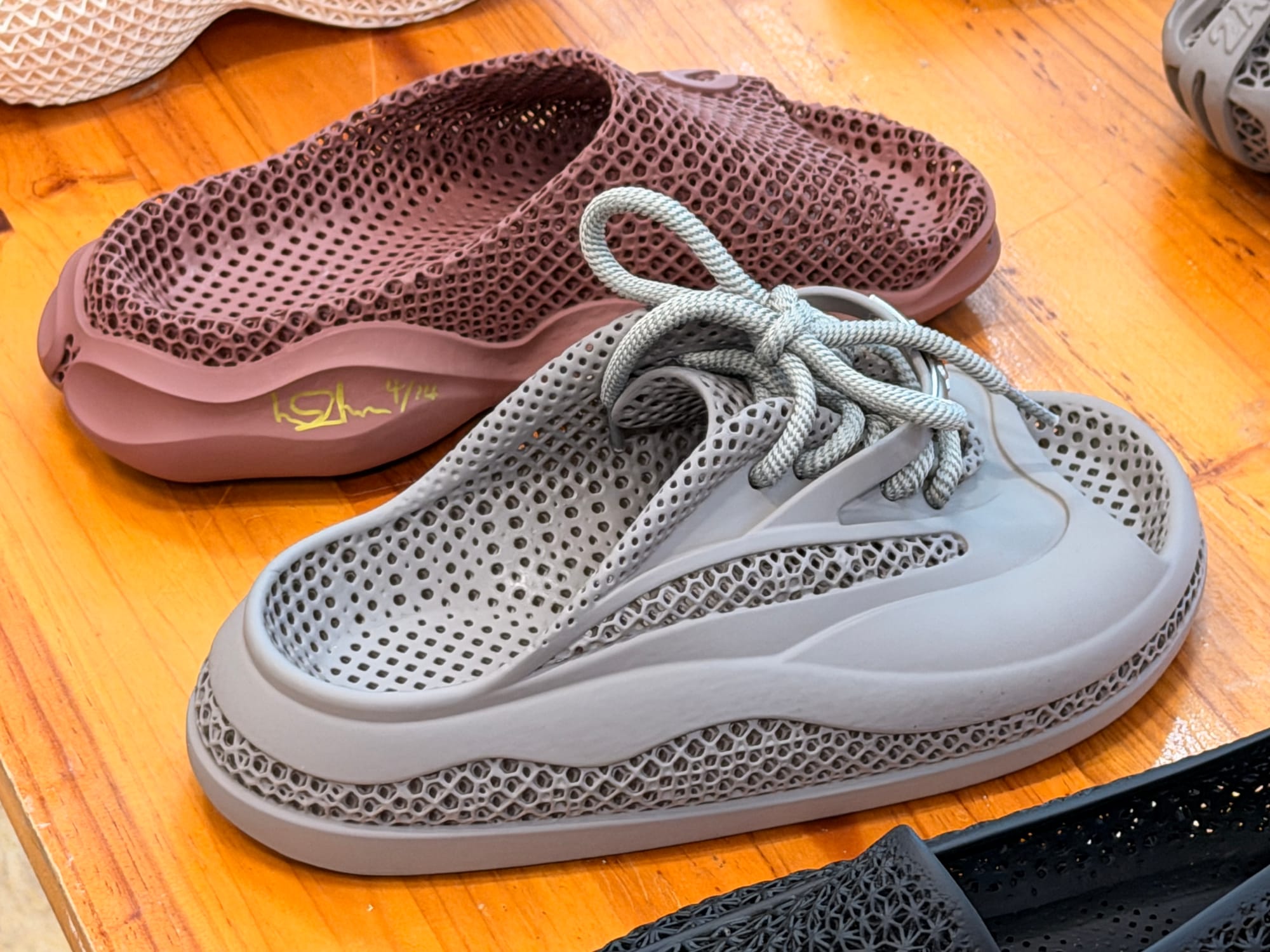
Across footwear categories, expectations are shifting toward footwear that adapts to the user rather than asking the user to adapt to the shoe. Growth, movement patterns, injury history, sensory thresholds and day-to-day variability all reveal that a single static size or structure cannot meaningfully serve most people over time.
Emerging approaches such as continuous-fit systems, transitional sizing, variable structural zones, personalised lasts and behaviour-driven design point to a future where generic size logic feels increasingly outdated. The underlying assumption is changing: footwear should evolve with the body, not resist it.
Kids grow. Shoes don’t. Let’s fix the right problem.
Satyajit Mittal, Aretto
But this insight applies far beyond children’s footwear. Once you recognise that bodies change, loads shift and needs fluctuate, the idea of a single “correct” size becomes difficult to defend. Personalisation moves from being a premium add-on to a baseline expectation, an infrastructural principle that anticipates variation rather than treating it as an exception.
In this emerging landscape, personalisation is not about luxury or one-off custom builds. It is about creating adaptive systems that meet people where they are today and continue to meet them as they change.

5. Boundaries Are Disappearing
Traditional distinctions between orthopaedic, performance and fashion footwear are dissolving as knowledge, techniques and priorities flow more freely between them. Concepts once confined to clinical settings, such as load distribution, pressure mitigation and pathology prevention, are now informing everyday design. At the same time, performance and lifestyle designers are reintroducing aesthetics, emotion and cultural relevance into areas long dominated by function alone.
These exchanges reveal that the industry is no longer organised around categories but around people. What begins as a medical insight may unlock a performance advantage, and what starts as a performance solution may translate into everyday comfort or inclusive fit. The separation between these worlds persists mostly on paper; in practice, they are converging into a shared design language grounded in human need.
Function and aesthetics aren’t opposites. When you design for the foot, beauty follows.
Daniel Petcu, Pedorthic Art
The future of footwear is increasingly category-agnostic, focused less on market segmentation and more on understanding the person, their behaviours and their lived realities. In this landscape, a medical insight can inspire a fashion silhouette, and a performance construction can solve a daily discomfort. Boundaries fade, and the product becomes a more holistic reflection of the body it serves.
6. AI is Rewiring the Workflow
The influence of AI in footwear is becoming most visible not in concept generation but in the operational core of product creation. Tasks that once absorbed days or weeks are now compressing into minutes, as AI systems generate 3D-printable structures, translate concept art into manufacturable patterns, flag feasibility issues before they become costly and automate the repetitive modelling steps that slow teams down. What emerges is a workflow where sampling, iteration and communication move with far greater speed and clarity.
This shift is not about replacing designers; it is about removing the friction that sits between an idea and its execution. By accelerating the technical layers of the process, AI allows designers to spend more time on intent, storytelling and refinement rather than on laborious translation work.
AI is most powerful when it reduces the distance between imagination and production.
Ivan Volchenskov, NewArc.ai
In this context, designers lose drag, not control. The workflow becomes more fluid, more iterative and more aligned with the pace at which ideas evolve. AI becomes less a tool and more an operational partner, expanding what teams can explore and how quickly they can bring it to life.
7. Hybrid Is the Real Path to Change
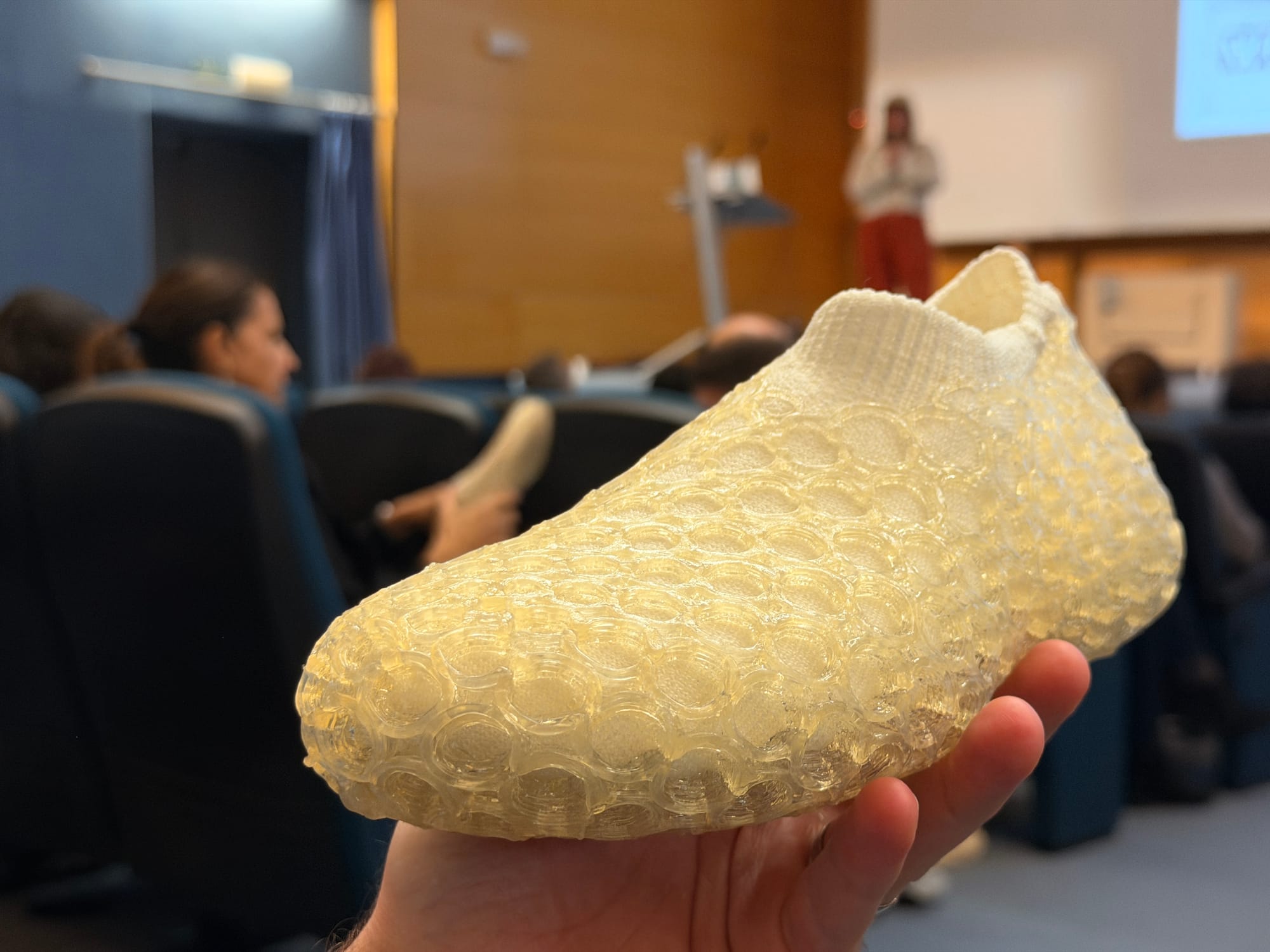
The leap from craft to full automation is neither realistic nor necessary. What the industry actually needs is a transitional model - one that blends the precision of digital systems with the judgment, tacit knowledge and adaptability of human makers. The most convincing examples of progress come from hybrid workflows: partial automation layered onto legacy systems, semi-digital pattern rooms, jigs that support manual assembly, incremental tooling upgrades and additive components stitched into traditional builds.
This is not about replacing expertise, but about preserving it long enough to translate it into the next era.
I think it’s a false problem, tradition versus digital…this tradition should be transferred into digital.
Daniel Petcu, Pedorthic Art
Hybridisation is the bridge that makes this possible, allowing brands to scale innovation without discarding the knowledge that makes good footwear good. It is also what makes change accessible beyond elite factories: you do not need a fully automated line to modernise, but you do need a system that respects both the craft and the code.
In a hybrid model, innovation doesn’t arrive all at once. It accrues. It layers. It compounds. And this is why it works.
8. Footwear as a Connected Digital-Physical Ecosystem
Footwear is no longer defined by a linear pipeline but by a connected loop in which every stage informs the next. What begins as a scan becomes a design, which becomes a simulation, which becomes a printed or assembled product, which then returns data through wear and ultimately re-enters a recycling or renewal stream. The process is continuous, each layer shaping and refining the others.
This shift is reshaping the industry’s understanding of what a product even is. Digital twins, material traceability, dynamic lasts, automated patterning and additive components are not isolated innovations. They operate as parts of a single system that links creation, performance, regeneration and insight.
It is not one thing anymore. It is all of it together.
James Carnes, HILOS
The future of footwear is therefore systemic rather than siloed, with decisions made at one stage influencing outcomes across the whole lifecycle. It is less about making a shoe and more about orchestrating a living ecosystem of data, materials, behaviours and services. This mindset will reshape not only how shoes are produced, but how brands organise, operate and define value.
What Happens Next?
The future of footwear will not be shaped by bigger factories, faster timelines or louder aesthetics, but by a deeper commitment to understanding the people who move through the world in the products we create. Fit, feel, fabrication, and personalisation are no longer disconnected disciplines. They are becoming a single, integrated system shaped by behaviour, biology and data.
The challenge now is whether the industry chooses to evolve at the pace these insights demand.
A huge thank you to Nico van Enter (Footwearology) for the invitation and for creating a platform where these conversations can take place. At Stride USA and Stride Europe, we will continue this conversation with the designers, innovators and makers who are building that future in real time. The next era of footwear will belong to those willing to rethink the fundamentals.
Are we ready to redesign not just the product, but the logic that brings it into being?


