

Innovation in performance wear has long been driven by the simple ambition of helping the human body go further.
From waterproof shells and breathable membranes to stretch synthetics and high-rebound foams, the materials behind performance apparel and footwear have been engineered to protect, support and extend human movement in demanding environments. Yet many of the technologies that have made modern performance possible also carry growing environmental and human health costs.
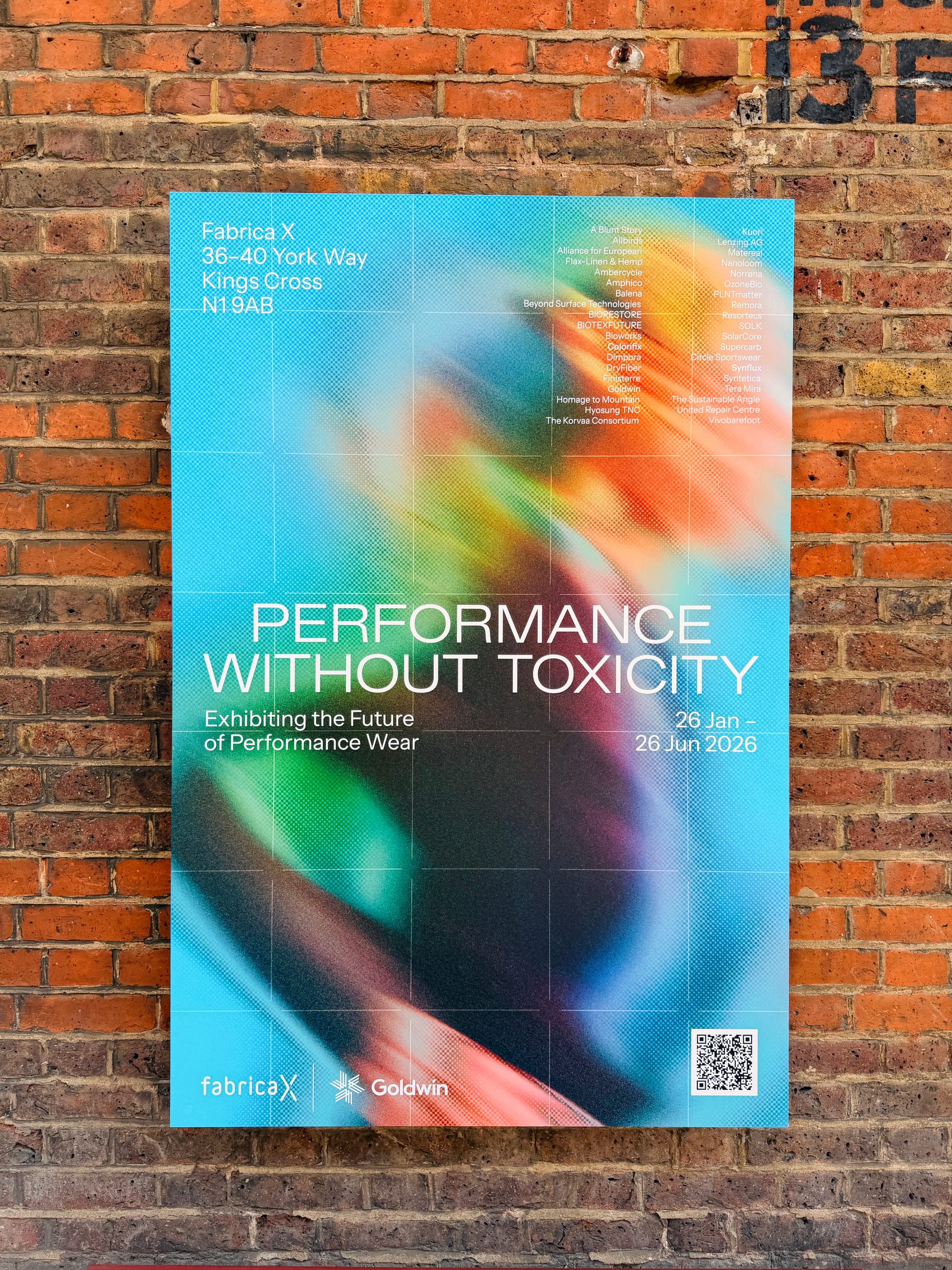
Bringing together innovators from across the global materials ecosystem, The Mills Fabrica's Performance Without Toxicity exhibition explores whether high performance can exist without the chemical intensity that has historically defined it.
Rethinking the Invisible Science of Performance
Performance clothing is often celebrated for its visible features: waterproof jackets, breathable fabrics and garments engineered for extreme environments. But behind these attributes lies an invisible layer of chemistry that has shaped the industry for decades.
Many of the properties that make performance clothing possible, from water repellence to odour control, rely on complex chemical treatments. Some of the most effective of these have also proven to be among the most environmentally persistent.
The Greener Chemistries section of the exhibition highlights the growing effort to redesign systems without sacrificing performance. These efforts broadly fall into three areas: replacing harmful chemistries, reducing process intensity, and rethinking how performance is achieved altogether.
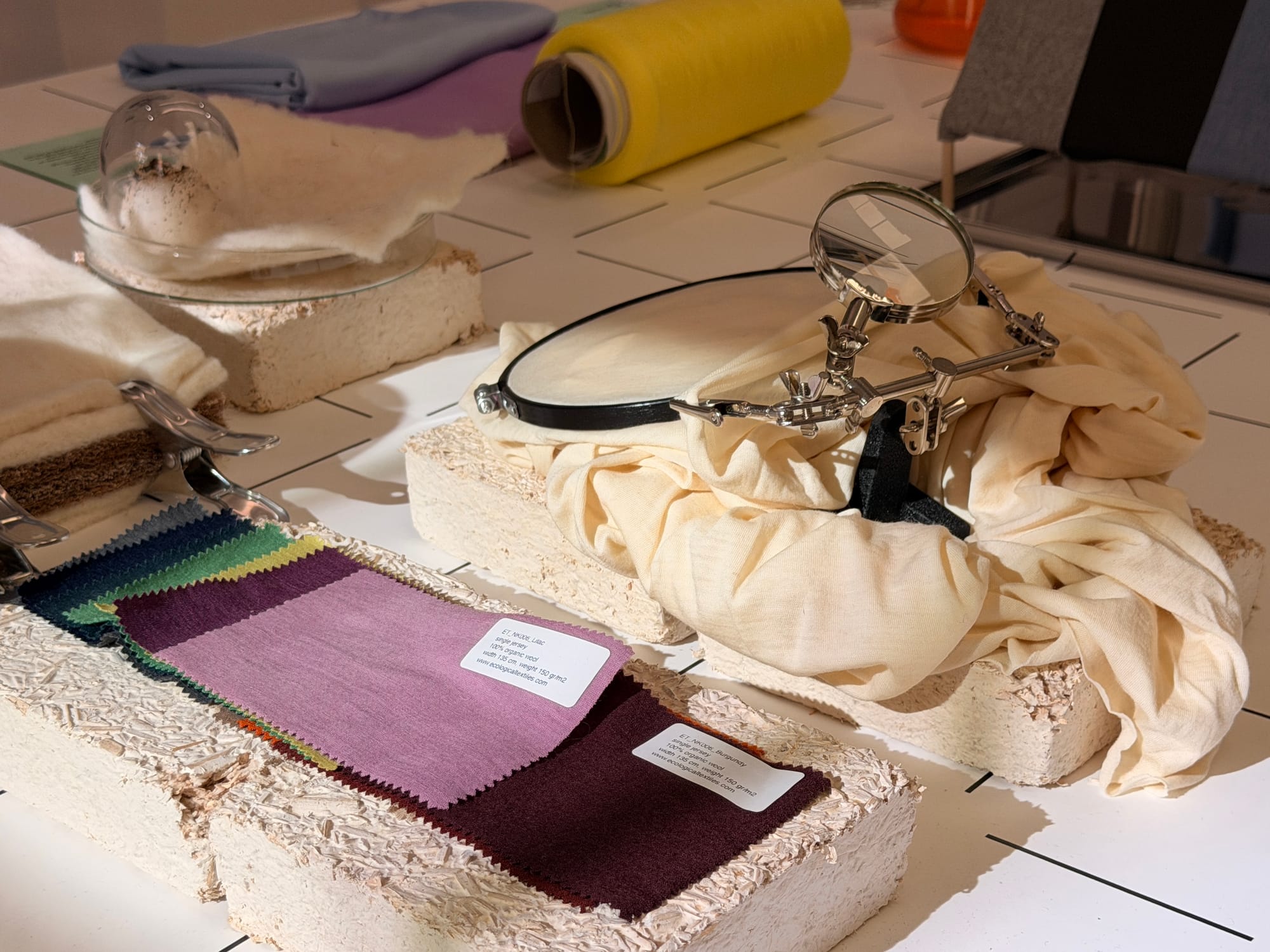
Long dominated by fluorinated chemistry, waterproofing is now seeing rapid innovation. Companies such as DryFiber and Dimpora are developing fluorine-free membranes designed to replicate the durability and breathability of traditional systems without relying on so-called “forever chemicals.”
Colour is another frontier. Textile dyeing remains one of the most resource-intensive stages of garment production, often requiring large volumes of water and energy. Biotechnology company Colorifix is exploring an alternative approach using microorganisms to produce and fix pigments directly onto fabrics, significantly reducing the need for conventional dye chemistry.
Elsewhere, innovators are looking to nature for inspiration. Remora has developed protective coatings derived from seaweed chemistry that prevent biofilms and odours without toxic additives, while Beyond Surface Technologies is advancing bio-based finishing technologies designed to replace petroleum-derived treatments.
Even insulation is being reconsidered. Technologies such as Solarcore, which uses aerogel, deliver extreme thermal performance with far less material bulk and chemical complexity.
The projects suggest that performance does not have to depend on increasingly complex chemical inputs. Yet redesigning chemical treatments is only part of the story. The next frontier lies in the materials themselves.
Designing Performance on the Molecular Level
If the history of performance wear has been written by petrochemistry, its future may increasingly be shaped by biology.
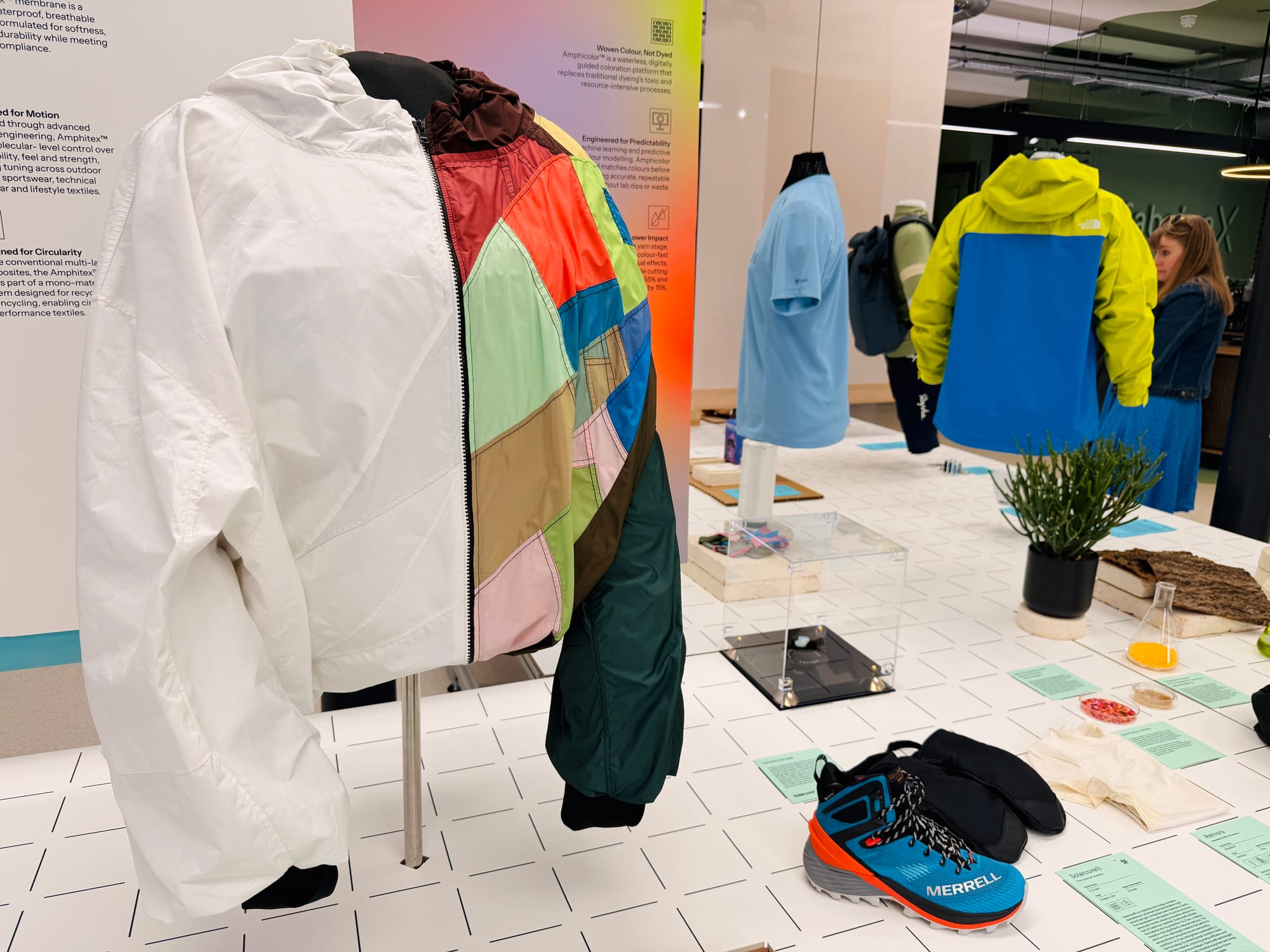
The exhibition's Reimagining Materials section explores a wave of innovators working to redesign the building blocks of performance textiles and footwear. Rather than simply improving existing synthetics, many of these projects attempt to rethink what materials are made from, how they are produced, and how they return to the environment.
Performance products have relied heavily on petroleum-derived polymers such as polyester, nylon and elastane. These materials delivered stretch, durability and weather protection at unprecedented levels, but their production depends on energy-intensive processes and finite resources. At the end of their life, most synthetic fibres persist in the environment for decades.
The innovators featured here are approaching that challenge from multiple angles.

Some are turning to biology as a design partner. New materials derived from fungal structures or marine biomass demonstrate how natural feedstocks can produce fibres with elasticity and durability without relying on the same fossil-based chemical systems. Companies such as Tera Mira are developing stretch fibres derived from marine biomass as alternatives to elastane, while Swiss start-up Kuori is exploring bio-based elastomers made from agricultural by-products.
Others are rethinking polymer design itself. Companies like Matereal are using artificial intelligence and chemical modelling to engineer new polymer structures that maintain performance characteristics while reducing environmental toxicity. Meanwhile fibre innovators such as Bioworks are developing plant-derived alternatives to conventional plastics designed to replicate the performance of synthetics while enabling safer degradation or more viable recycling pathways.
The exhibition also highlights the importance of collaboration. Initiatives such as BIOTEXFUTURE bring together universities, manufacturers and technology developers to accelerate the transition away from fossil-fuel-based fibres.

Transformation will not happen overnight. Existing fibre systems remain deeply embedded in global supply chains, and performance expectations built over decades cannot simply be replaced.
Instead, the projects presented here showcase a gradual shift towards materials designed not only for performance in use, but for performance within ecological systems.
The next challenge is ensuring those systems extend across a product’s full life; not just how it is made, but how long it lasts, and what happens after.
Creating for Longevity and Circularity
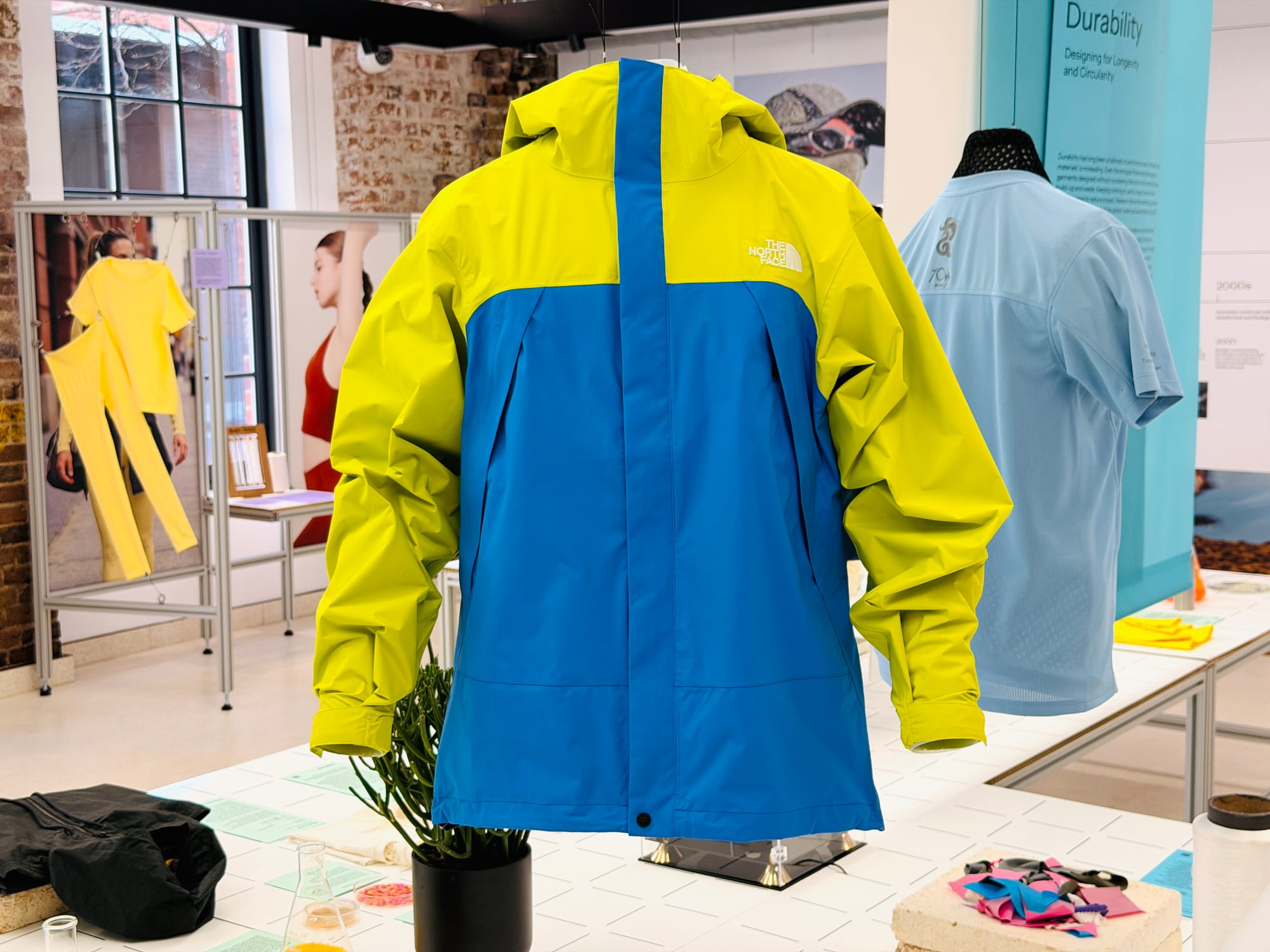
Durability has always been a hallmark of performance wear. But the exhibition reframes durability not simply as resistance to wear, but as part of a broader circular system. Longevity, repairability, recyclability and material recovery become just as important as abrasion resistance or stretch.
The goal is not only to make garments that last longer, but to design products whose value continues even after their first life ends.
The exhibition points to three interconnected challenges: creating new material flows, extending product life, and building the infrastructure to support both.
Companies such as Ambercycle are developing regenerated polyester fibres made from textile waste, transforming discarded garments into new raw materials. Meanwhile Resortecs tackles a less visible challenge: the infrastructure of recycling itself. Their thermally dissolvable stitching threads allow garments to be disassembled quickly at the end of life, enabling materials to be separated and recovered.
Other innovators focus on extending the life of garments already in circulation. Biorestore, for example, has developed enzymatic treatments that restore worn cotton garments by removing pilling and surface damage, allowing clothing to be worn significantly longer before disposal becomes necessary.
Circular thinking is also influencing garment design. The Toyama Marathon running jersey by Goldwin, made with recycled fibres from cycora, demonstrates how performance apparel can integrate recycled materials without compromising technical performance. In parallel, Tokyo-based design studio Synflux applies algorithmic pattern design to reduce fabric waste during production.
Circularity, however, does not end with materials or design. It also requires infrastructure.
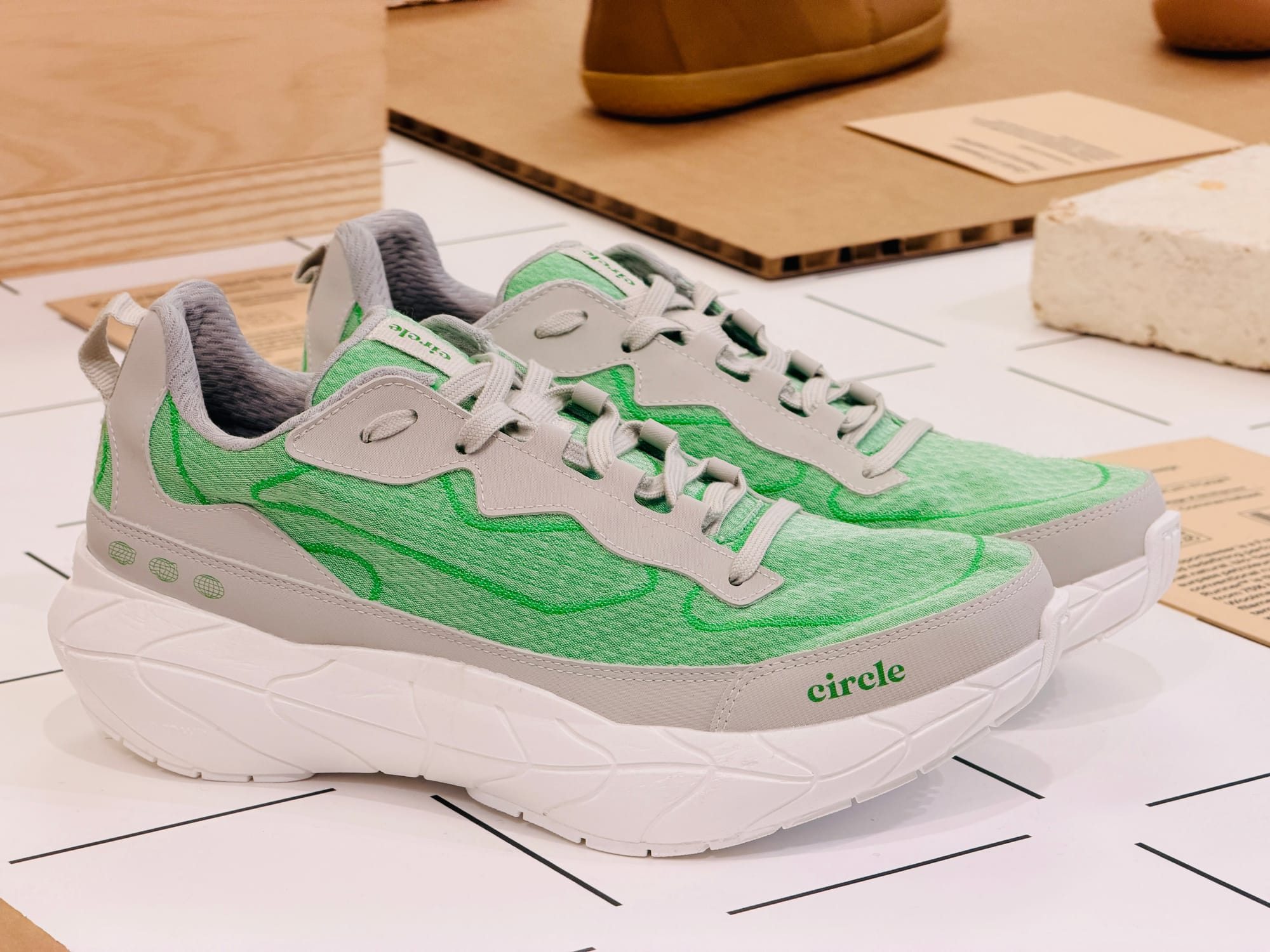
Repair initiatives such as the United Repair Centre highlight the importance of extending garment lifespans through maintenance rather than replacement. Their model combines social impact - employing and training refugees - with large-scale repair services for global brands.
Other collaborative initiatives, including SYN-GRID, are exploring scalable recycling systems and circular design strategies for synthetic textiles.
These initiatives prove that longevity is not a single innovation but a systems challenge. Materials must be recoverable. Products must be repairable. Design must anticipate disassembly. Infrastructure must exist to support each stage of the lifecycle.
If these ideas are challenging in apparel, they become even more complex when applied to one of fashion’s most technically demanding products: footwear.
Innovating the Future Footwear
Footwear has long been one of the most difficult product categories to redesign for sustainability. Unlike garments, which are typically constructed from a handful of fabrics and trims, shoes combine multiple materials, adhesives, foams, rubbers and textiles into tightly integrated structures. Performance demands durability, cushioning, grip and weather resistance, qualities that have traditionally relied on chemically intensive and multi-layered construction.
The Future Footwear section explores how brands and innovators are beginning to rethink that complexity. Their approaches converge around three ideas: simplifying construction, rethinking materials, and redesigning production systems.
Rather than treating sustainability as an add-on, many of these projects start from a different premise: what if footwear were designed from the beginning to be simpler, more recoverable and easier to remake?
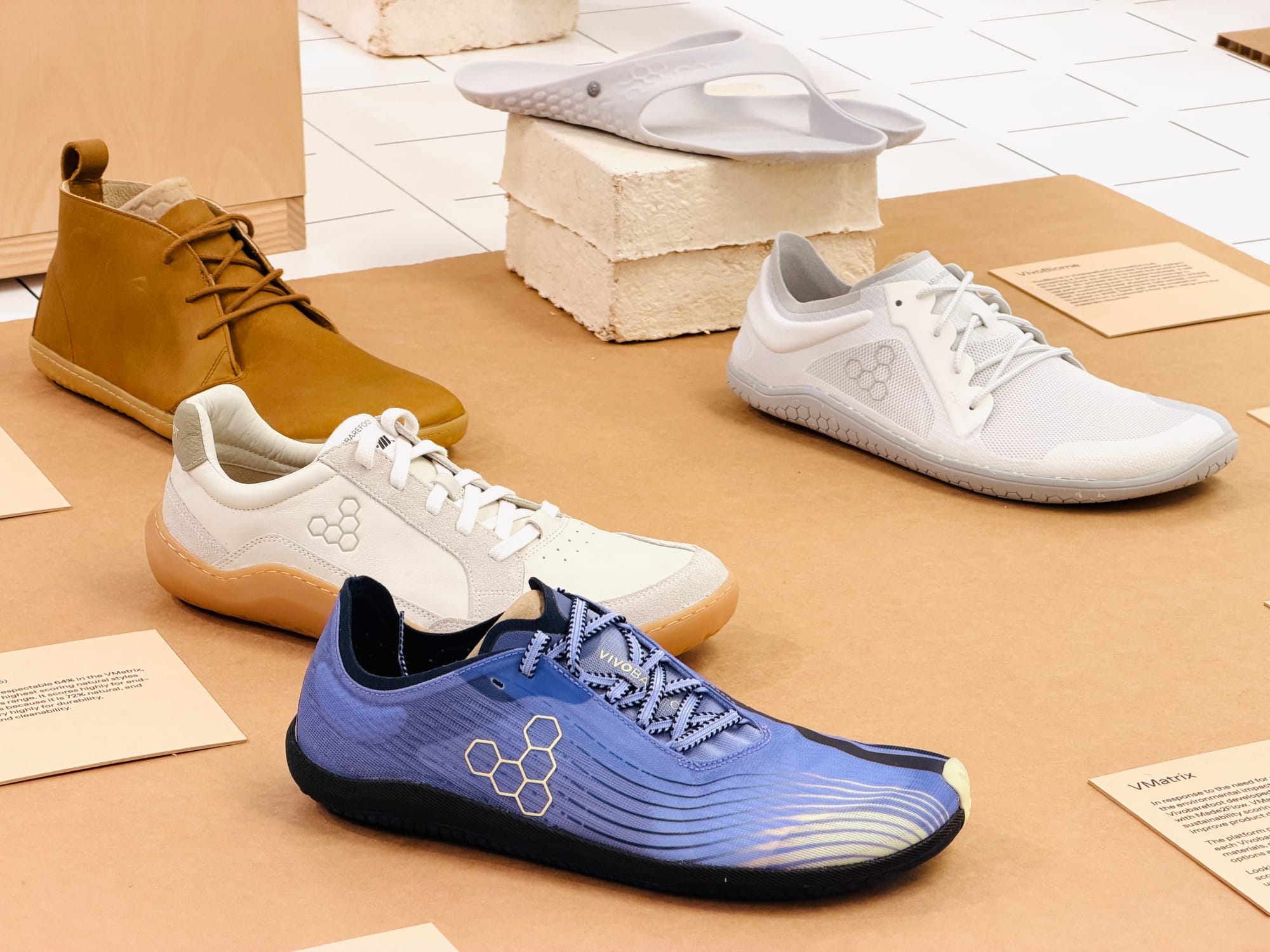
Brands such as Vivobarefoot offer one glimpse of this shift. Known for its minimalist design philosophy, the company is experimenting with ways to reduce material complexity while integrating recycled and bio-based components into core product lines. Its Primus Lite 3.5, for example, incorporates recycled materials across key components, while initiatives such as VivoBiome explore regenerative material systems and circular manufacturing approaches.
Material experimentation is another focus. Projects such as UNCRUDE, developed from bio-based olefins, aim to replicate the performance of synthetic rubbers while reducing environmental impact. Meanwhile unwaste™ demonstrates how industrial waste streams can be reprocessed into durable materials suitable for footwear components.
Other examples highlight efforts to rethink foam systems and recycled materials. Allbirds’ Cruiser Remix incorporates recycled foam materials recovered from production cycles, while the Tree Glider model experiments with lower-impact foam formulations and responsible finishing processes.
Biomaterials are also entering the conversation. Projects such as A Blunt Story explore plant-derived materials that could eventually replace petroleum-based inputs in footwear manufacturing.
These all point to a broader shift in design thinking. Initiatives such as the Korvaa Consortium and companies like Nanoloom are exploring biodegradable materials, bio-fabrication techniques and new manufacturing systems for next-generation textile structures.
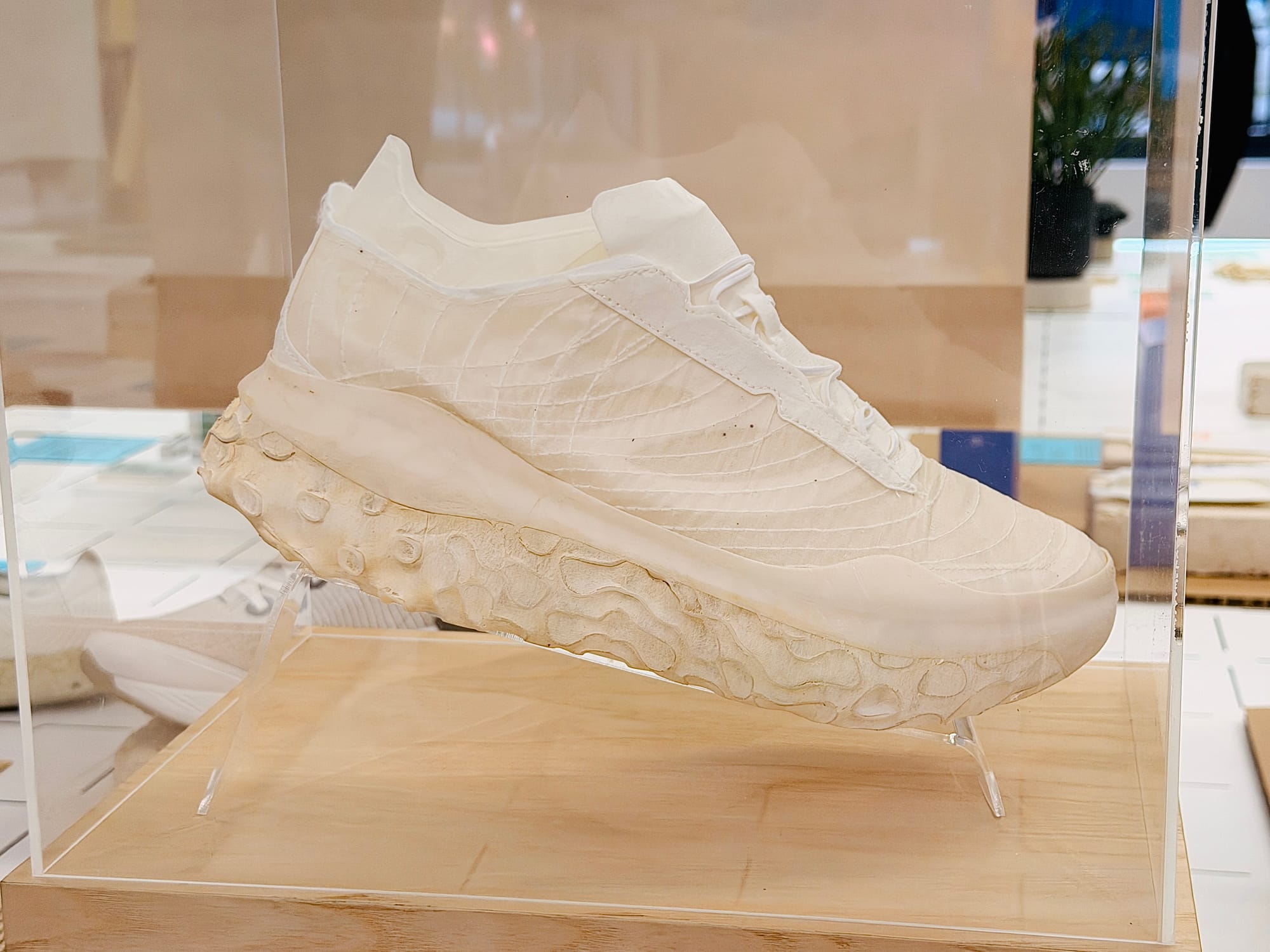
The future of footwear will likely not be defined by a single breakthrough technology. Instead, it will emerge through a combination of simpler construction, bio-based inputs, recyclable components and circular design principles.
If garments are the testing ground for safer chemistries and circular thinking, footwear may be where those ideas face their toughest test. But as the projects in Future Footwear suggest, the industry is beginning to take its first meaningful steps.
Performance Without Toxicity does more than showcase innovation; it reframes how performance itself is defined.
From safer chemistries and bio-based materials to circular systems and reimagined footwear, the projects on display reveal an industry in transition, one moving away from extraction and persistence towards regeneration and responsibility. Progress is neither linear nor complete, but the direction is becoming clearer.
Credit is due to The Mills Fabrica for creating a space that brings these often fragmented efforts into a single, tangible narrative. For anyone working in or around product creation, it offers a rare opportunity to see not just what is possible, but what is already happening.
The London exhibition is free and open to the public until 29 June 2026. If you have the chance, it is well worth experiencing in person.
If performance once meant pushing the limits of the human body, the next chapter may be defined by how carefully we design within the limits of the planet.