

Before a venue was booked, before a single session was programmed, and before a single speaker was invited, I spent several months asking the European footwear industry a simple question: does Stride, an event we launched last year in the USA dedicated to the intersection of technology, craft, and digital transformation in footwear, need to exist here too?
Designers, heads of digital product creation, innovation leads, educators, founders, consultants — people across performance, luxury, outdoor, and lifestyle — all said yes.
European footwear, according to them, is behind on digital transformation. Not because it lacks tools, information, or ambition, but because it hasn't resolved a small set of structural and cultural problems that a gathering like this would help name and tackle.
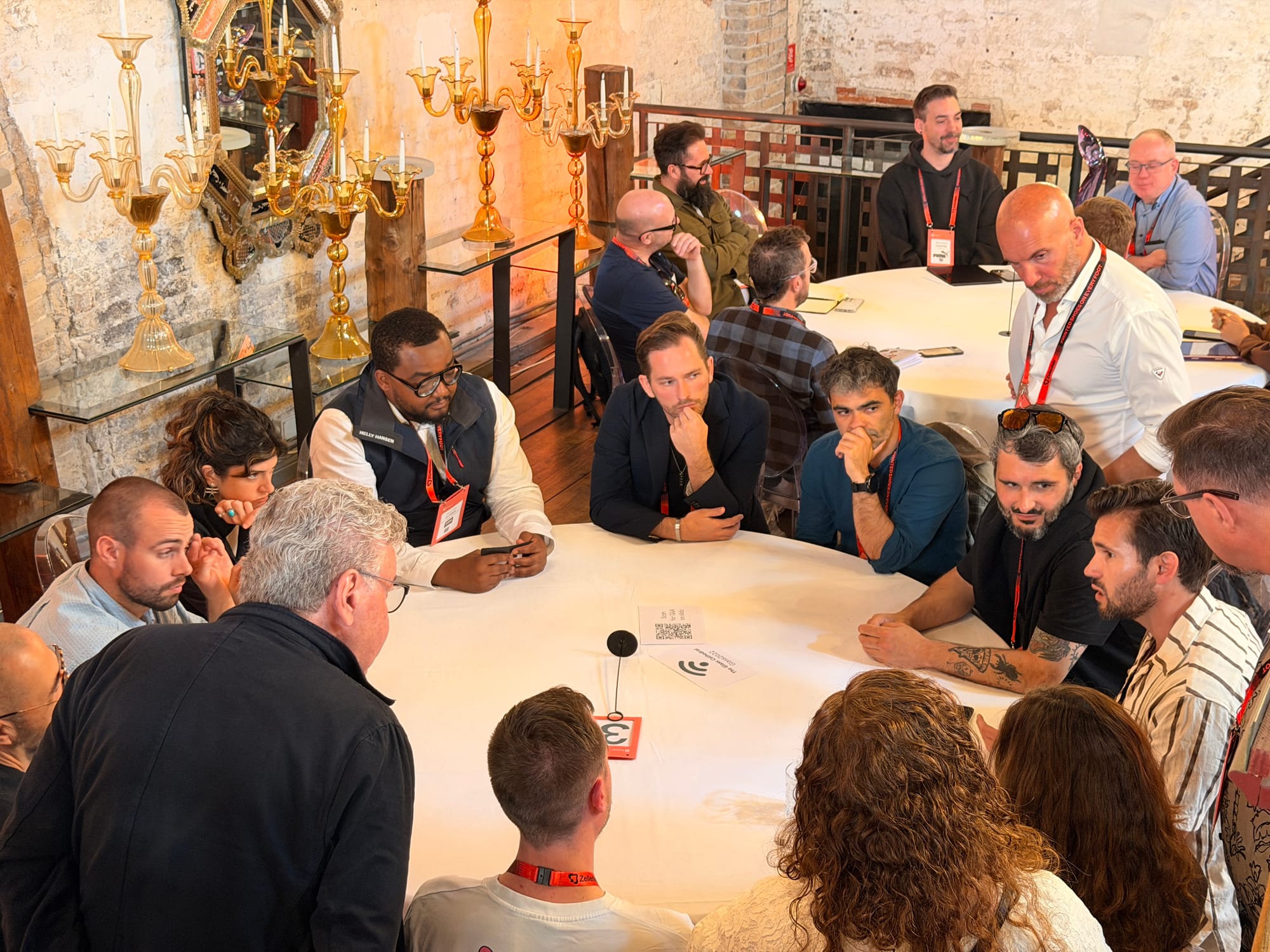
That research didn't just validate the event, it shaped it. And the people who told us it was needed showed up to prove it. Over two days on the island of Murano last month, the industry gave itself permission to be more honest than most had seen before.
What follows is an attempt to distil what was learned into something useful whether you were there or not. The arguments that mattered, the tensions that didn't resolve, and what the industry would need to do differently to close the gap.
I. The Foundation Problem
You Can't Culture Your Way Out of a Structure Problem
Fix the plumbing first
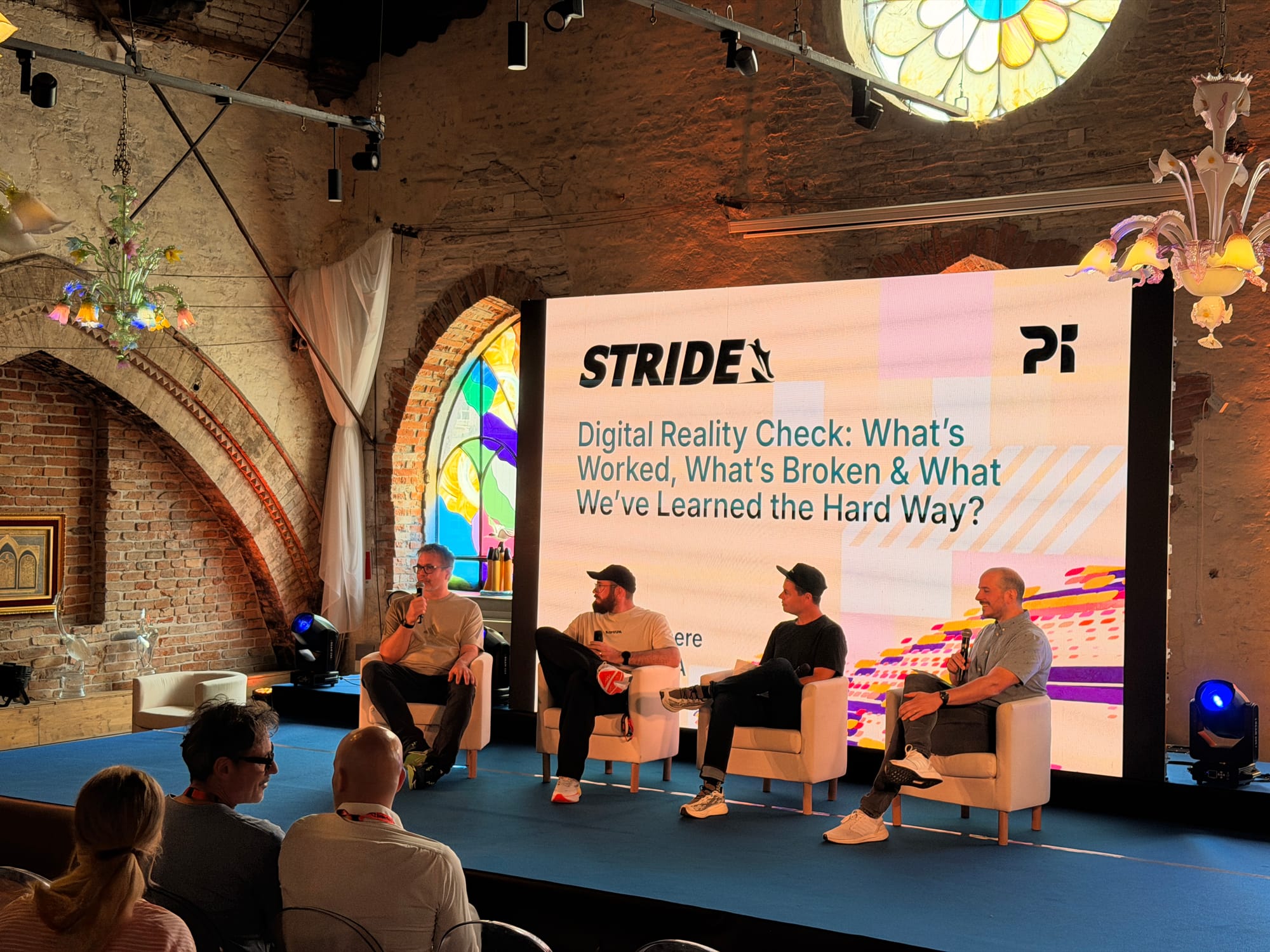
The opening panel asked a question we'd been sitting with since the research began: is Europe's digital transformation primarily a cultural problem or a structural one?
"If the structure isn't ready, human nature is to go back to what is fastest and what works best." – Daniel Gordon, Hugo Boss
Most digital transformation initiatives in European footwear lead with culture — the vision deck, the change management programme, the rallying cry about mindset. Gordon was arguing for the opposite sequence: fix the plumbing first, and culture will follow. Clear pipelines. Define roles. Implement mandatory learning time — not optional HR courses, but everything-stops, structured, this-is-part-of-your-job learning. Infrastructure that makes producing digitally faster than producing manually.
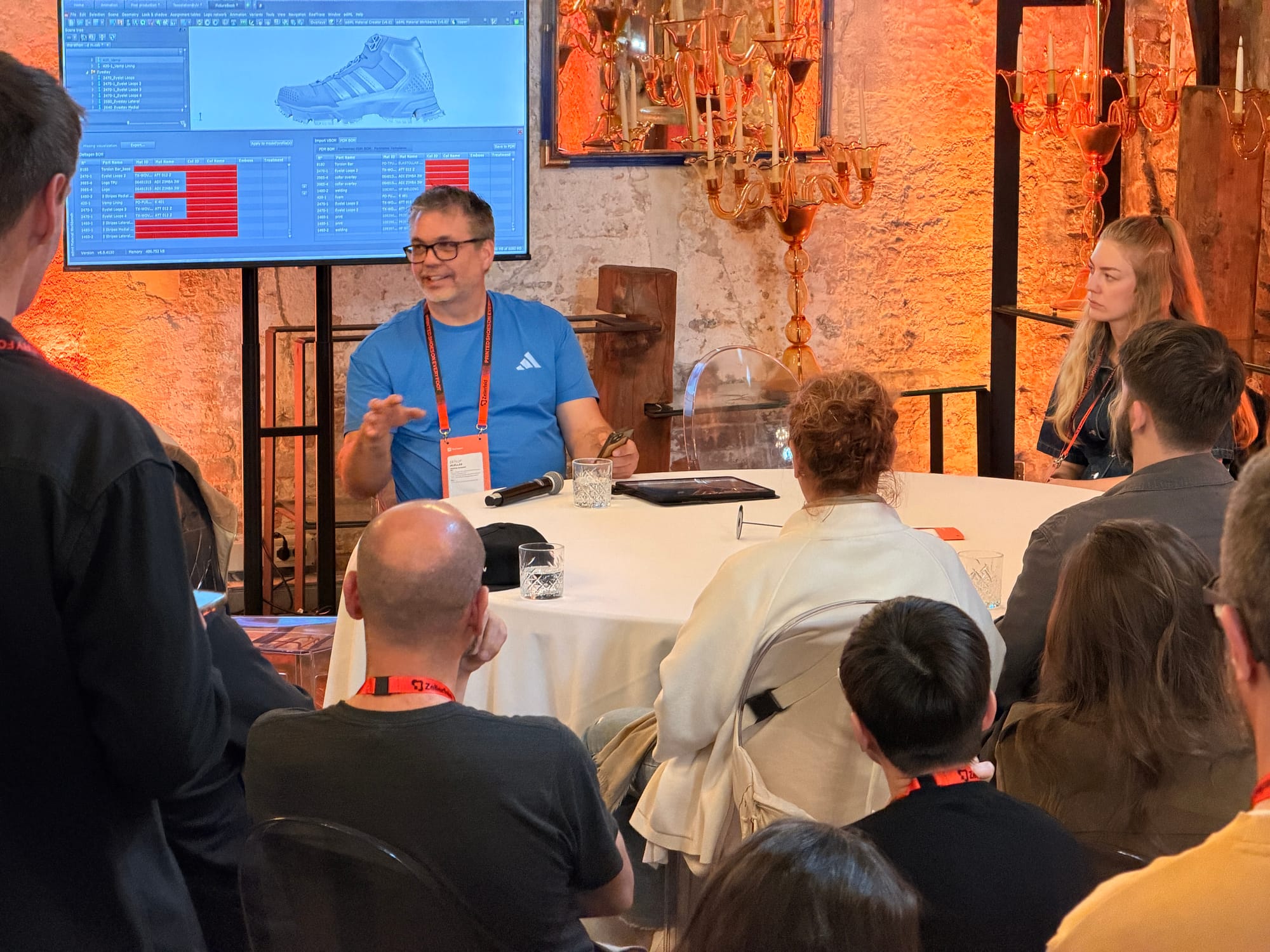
It sounds obvious, and yet the structural fixes are unglamorous enough that most organisations never get around to them. Detlef Mueller, who is twenty-eight years into this at adidas, shared that it took them fifteen years to fund a proper digital material library. Not the 3D tools, not the AI platform, but a searchable, indexed, integrated system that tells a 3D artist whether a digital version of a given material already exists.
Nobody wanted to pay for it and management didn't find it exciting. But without it, every digital sample took longer than it should, every render was a workaround, and the scale everyone kept promising remained theoretical.
"To build this infrastructure is crucial. This is the thing you have to work on." – Detlef Mueller, adidas
The catalyst burden
The structure problem doesn't stop at pipelines and libraries; it runs through how organisations treat the people driving digital change. Every company in the room seemed to have a catalyst: the internal person pulling the entire digital effort forward through enthusiasm, competence, and a willingness to learn on their own time. Often younger, not originally from footwear, and almost always working against institutional inertia without formal authority to change it.
Giustiano Peruzzo from La Sportiva described his version with characteristic candour. He was on a train, saw a TikTok demonstrating a new Illustrator feature that converts 2D sketches to 3D, and started typing a message to a designer on his team to tell her about it. Before he could send it, she had already found the same feature herself and sent him a video of the file converted. "We are slow, guys. This is the truth. But we have history that we are carrying with us." His conclusion was not to try to speed up the older generation but to get out of the younger one's way. Stop being the ceiling. Leave the pencil on the table.
Francesco Torresan from Nice Footwear Group had engineered exactly this tension deliberately. He is, intentionally, the only shoemaker in the room. Everyone else they hire comes from outside footwear, with no preconceptions and no reverence for how things have always been done. His craft knowledge meets their technical fluency. Neither group could produce alone what they produce together.
But the people question has a harder edge: catalysts get given programmes too small to scale, and only enough budget to show intention without building real capability. They burn out. They leave. The institutional knowledge — the workarounds, the integrations, the hard-won relationships with factory teams — goes with them. The company starts again, usually by hiring another catalyst and repeating the cycle. If people have the tools but not the protected time, the shoes will still need to be delivered, but the learning never happens.
Matteo Pasca from Arsutoria brought in the leadership perspective: the experienced people in an organisation need to be the ones driving the search for new resources, new tools, new ways of working — not as an addition to their existing role, but as a redefinition of it.
"If we keep being focused on the emergency, we risk crashing against the wall." – Matteo Pasca, Arsutoria
The practitioner view
On another panel, three independent practitioners distilled the failure patterns they see most often with the precision of people who have been inside many different organisations and watched the same things break in the same ways.
Kata Kanturska: fragmented workflows. Tools that don't talk to each other. Design living in one system, development in email threads and WhatsApp messages, production data somewhere in between. Nobody owning the end-to-end process, so nobody fixing it.
Valentina Zanatta: designers and developers not speaking the same language, and often barely speaking at all. The gap isn't technical, but organisational.
Susanna Zampieri: brands treating 3D as a role when it should be a team. One person hired to "do the 3D" becomes an executor rather than a driver, doing the work nobody else wants to learn while the people who should be adopting the tools don't.
What footwear can learn from apparel
Zanatta also raised the apparel comparison. Apparel has CLO, Browzwear, and more — tools powerful and standardised enough that the industry has done a better job at converging around a small number of shared workflows. The result is that apparel is meaningfully further ahead on digital product creation than footwear, despite footwear having been talking about 3D for longer. The reason, she argued, is that apparel started from a point and agreed on standards to work towards. Footwear, by contrast, has multiple tools for multiple parts of the process and they don't talk to each other. The workflow is not one thing; it is a series of translation problems at every handoff.
"Apparel is more lean — more like a linear workflow. Footwear? Designers and developers are not speaking the same language at all." – Valentina Zanatta, ex-Puma & Hugo Boss
The Foundation Takeaway: before you make the cultural argument, ask whether you have infrastructure that makes changing faster than not changing. Before you hire another digital specialist, define what digital is actually supposed to do in your organisation — design visualisation, development data, retail assets, AI training? These are different jobs. Treating them as one creates a role that is impossible to do well, chronically underfunded, and easy to blame when it inevitably doesn't work.
II. The Identity Crisis
What Is 3D Now That AI Is Here?
What Detlef Mueller actually said
By the end of Day One, a phrase was circulating around the venue that hadn't been said quite the way it was being repeated. Mueller, in a panel on scaling digital product creation, had said something about 3D that people kept reformulating — softening or sharpening depending on their relationship to it — into "3D is dead, long live AI."
That's not what he said. And the gap between what he said and how it was received is worth examining, because it reveals something important about where the industry's anxiety currently lives.
Speaking to him directly at the event, his actual position was more precise and harder to dismiss: 3D as we have known it is dead. Not 3D as a capability. Not 3D as a discipline. But 3D in the specific role it has occupied in footwear design workflows for the past decade — as the primary visualisation tool, as the thing designers were supposed to learn, as the end goal of digital transformation — that version of 3D has already been disrupted, whether the industry is ready to acknowledge it or not.
AI has replaced certain things 3D used to do, and done them faster. It has unlocked certain things 3D struggled to do. The 3D that remains is doing different work than it was five years ago: less about generating the image, more about holding the data, enabling the handoff, connecting design intent to production reality. That's not a smaller role, and in many ways it is a more important one. But it does require a fundamentally different understanding of what 3D is for, and most organisations haven't made that adjustment.
The instinct in the room to reframe the statement as "long live AI" is itself revealing. It is a way of acknowledging disruption while preserving the familiar hierarchy — positioning AI as 3D's successor rather than sitting with the more uncomfortable truth that the two are now doing different things, that the boundary between them is actively shifting, and that nobody yet has a settled map of where one ends and the other begins.
Detlef's original point was an invitation to draw that map honestly. The room's reframing was a way of not having to.
The pipeline has shifted
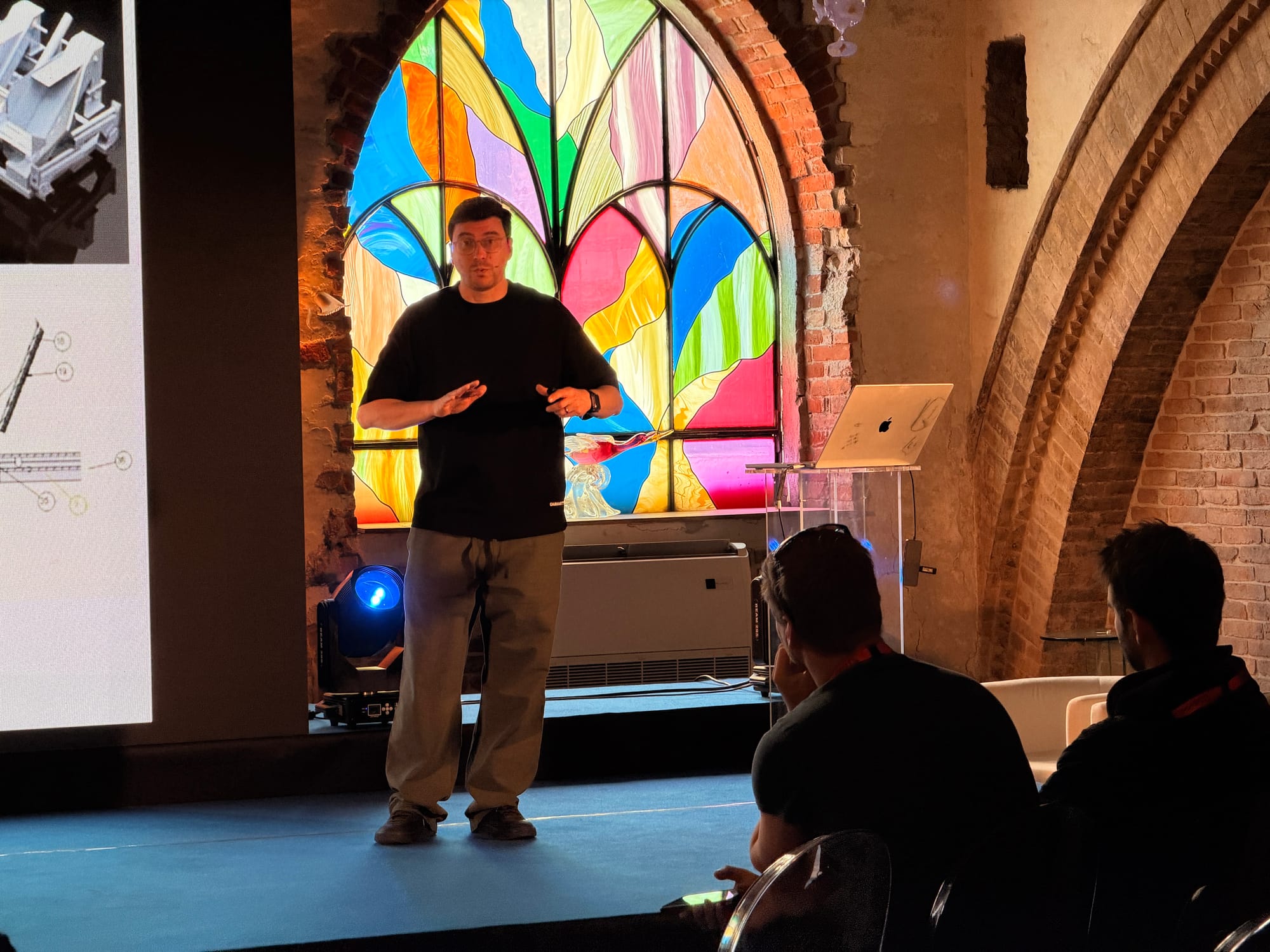
Emilien Arbez from Salomon sharpened the practical consequence from his own team's experience. AI tools are being adopted by designers faster than 3D tools were ever adopted, because they are genuinely useful for the tasks designers actually spend time on. The problem is that this has created a new gap: design is now moving faster than development can follow, and the pipeline bottleneck has shifted downstream. 3D isn't dead, but its job description has changed, and most organisations are still measuring their 3D capability by the old one.
Victor Verquin from Decathlon offered the most practically useful framework for navigating all of this. For any new tool — AI or otherwise — his team asks five questions before committing: Is the product better? Is quality of life better? Is the end result better? Does it connect with your existing ecosystem? Can it scale? If all five are a yes, commit. Anything less, move on. No pilot theatre or permission-seeking presentation. Just a structured way of being honest about whether something is working.
A harder problem the event raised without fully resolving was IP. adidas built its own internal AI system on AWS rather than using third-party generative tools, specifically because of IP security. Two-plus years of unreleased product designs, fed into an external model, is a risk most legal teams won't sanction. Several practitioners noted that the tools they most wanted to use were precisely the ones their policies wouldn't allow them near. The legal and security frameworks for AI in professional design contexts are not settled. This is a genuine structural barrier that is not being talked about openly enough.
Designing for the designer
Davoud Ohadi from lululemon brought in his story of having spent years at adidas building a sketch-to-3D tool designed specifically for designers who had no interest in learning 3D. The tool, which let designers work in their natural medium and see the result projected onto a last in real time, was killed before it could be fully implemented. Internal politics. A project reset. But the logic behind it remains right, and arguably more relevant now than when he was building it. The problem was never that designers wouldn't adopt 3D, but that nobody built 3D in a way that fits how designers actually think.
AI is now doing some of what that tool was trying to do. The lesson hasn't changed: meet people in their workflow, don't ask them to abandon it.
Computational design as the new literacy
On a separate panel, Jesus Marini Parissi from Moon Rabbit Lab, Maia Zheliazkova from On, and René Medel from Framas, made the argument that computational design should not be treated as a speciality. It is a way of thinking that is becoming foundational to advanced footwear creation. The ability to encode design knowledge into parametric systems that respond to new inputs — foot scan data, performance requirements, grading constraints — is moving from competitive advantage to table stakes. And the knowledge required to do it cannot be hired. It has to be built, through collaboration, shared vocabulary, and genuine understanding of how shoes are made.
Medel's entry point for anyone wanting to start: Rhino has a ninety-day free trial and Grasshopper is built in. The community is open and generous. The math is less of a barrier than it looks. "You don't need to be a mathematician. You need to understand the problem you want to solve." That starts with knowing how a shoe is made. Which takes us, as always, back to craft.
The Identity Takeaway: much of the visualisation work that 3D once owned, AI has taken over. What 3D does now — holding data, enabling handoffs, connecting design intent to production reality — is arguably more important than what it did before. Most organisations are still measuring the wrong thing. Rewrite the job description before you evaluate the capability.
III. The Making Problem
When Does the Future Become the Present?
3D printing: current technology, used badly
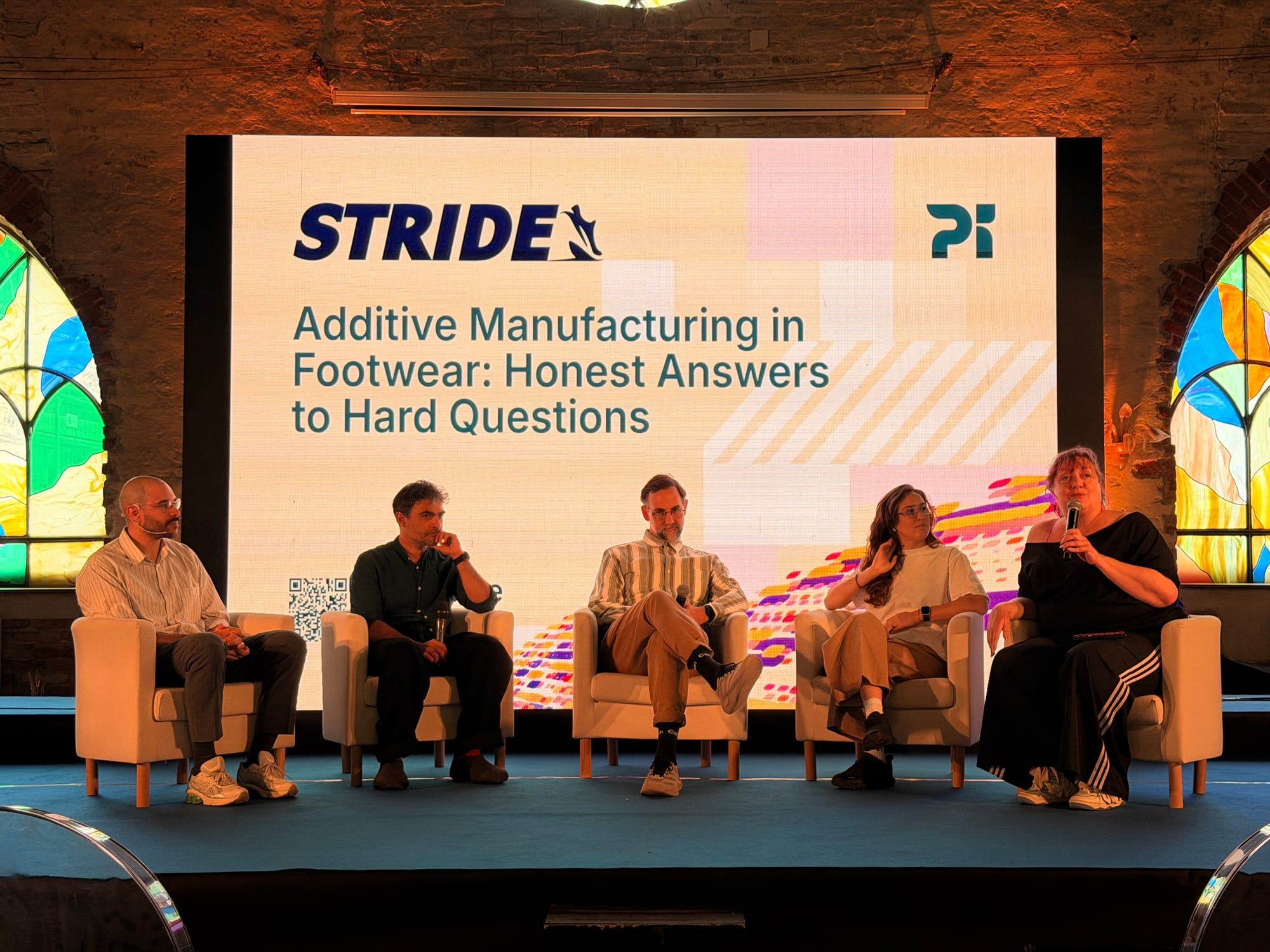
The industry has been saying 3D printing is the future of footwear for fifteen years. But at what point does that become the present, and what does that actually demand of the companies currently making shoes the old way?
Nico van Enter of Footwearise argued that in her assessment, 3D printing has not yet found its place in footwear in any meaningful consumer-facing sense. The barrier to entry has shifted — it is no longer tooling costs, it is computational design knowledge. If you cannot model the shoe fully in 3D, it does not get made. That is a different kind of gatekeeping, but it is still gatekeeping.
Maia Zheliazkova from On, described Light Spray — their proprietary additive technology — as a system that works precisely because it was never conceived as a replacement for traditional manufacturing. Hybrid from the beginning, additive does what it does well, conventional components do what they do well, and the product is designed around that combination rather than forcing printing to do everything.
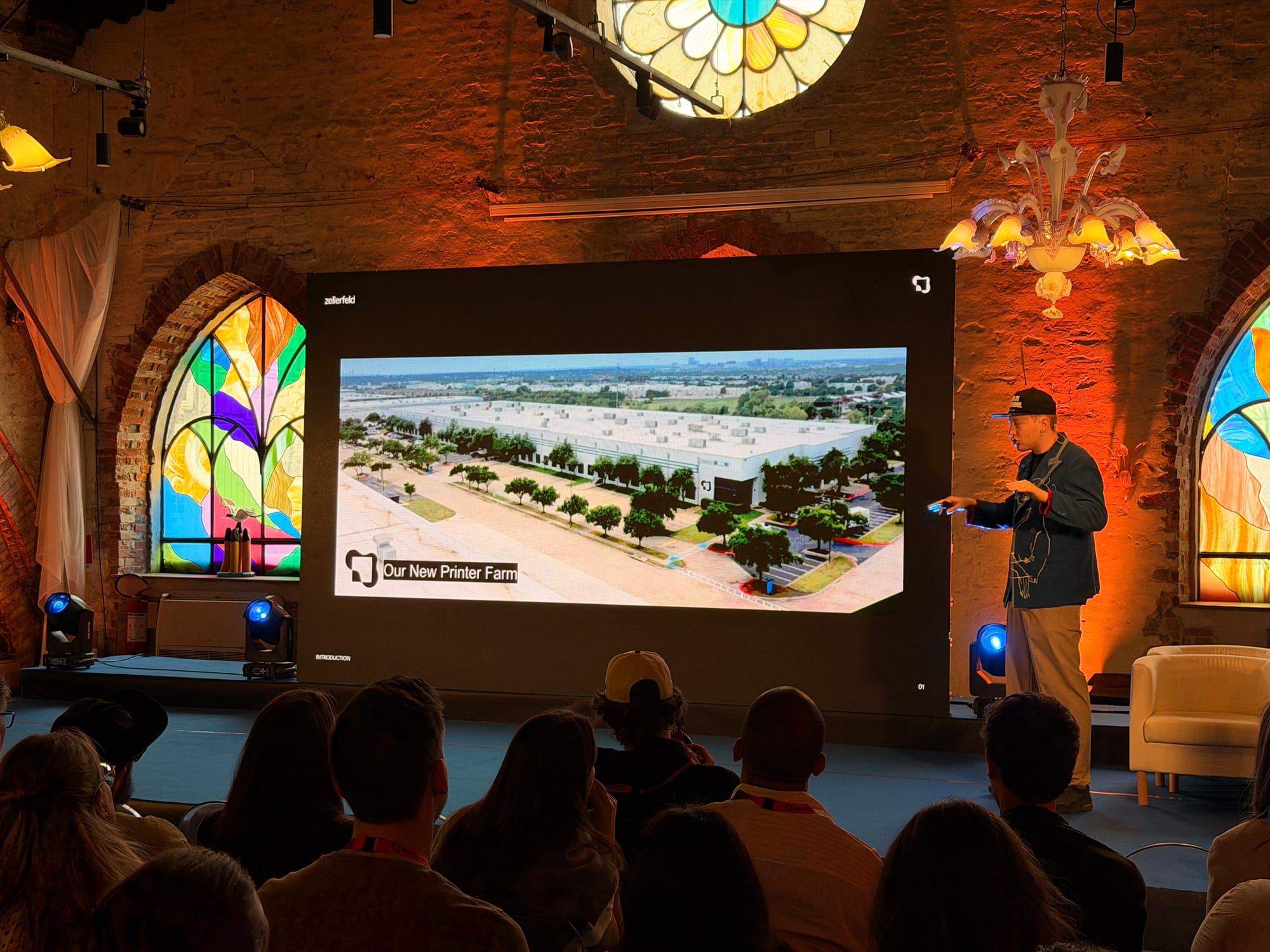
Then Cornelius Schmitt from Zellerfeld took to the stage with energy and honest conviction. Zellerfeld makes fully printed shoes — not as a luxury experiment, but at scale heading toward a million pairs a year across facilities in Hamburg and Austin. The creator platform has multiplied by a factor of eight in a year. From streetwear pioneers to Formula One champions, luxury houses to NBA stars, the names associated with Zellerfeld's platform have stopped being a surprise and started being a signal. His sustainability argument was structural: only what is sold is produced, production happens close to the customer, the product is single-material and fully recyclable. His comparison was Spotify — when piracy makes the product free, the only winning strategy is to make the legitimate version better than free. He is not certain it works at scale for everyone, but he is certain it is the right direction.
The question he raises for established brands is uncomfortable but worth asking: at what point does "not ready for production" stop being a quality argument and start being an inertia argument?
What repair reveals
Then there was the repair angle. Benjamin Thompsett and Marta Amigo founded Nuino, a small studio that repairs sports shoes, scans everything, and is building a dataset of what breaks, when, how, and why — across more than forty brands and twenty-one identified failure types.
They came ready with data. 81% of people they surveyed said they buy new shoes because their existing ones break, not because they want a new model. The most common repairs are worn outsoles, split soles, worn heel tabs, and holes in the upper. They are seeing shoes after six months, twelve months, sometimes twenty years, all well beyond what any product testing programme currently sees.
Their argument is not that shoes shouldn't break, but that where shoes break reveals design decisions made upstream — across materials, constructions, and tolerances — that were never tested against real-world use. Designing with repair in mind from the beginning would produce different decisions. Better ones.
"Wouldn't you want to design a shoe that people want to give a longer life to? Why not design and enable repair?" – Benjamin Thompsett, Nuino
The EU Digital Product Passport is coming. Repairability requirements are coming. The brands that treat repair as a compliance obligation will build products designed to tick boxes. The brands that treat it as a design constraint — like performance or sustainability — will build better products.
The systems argument
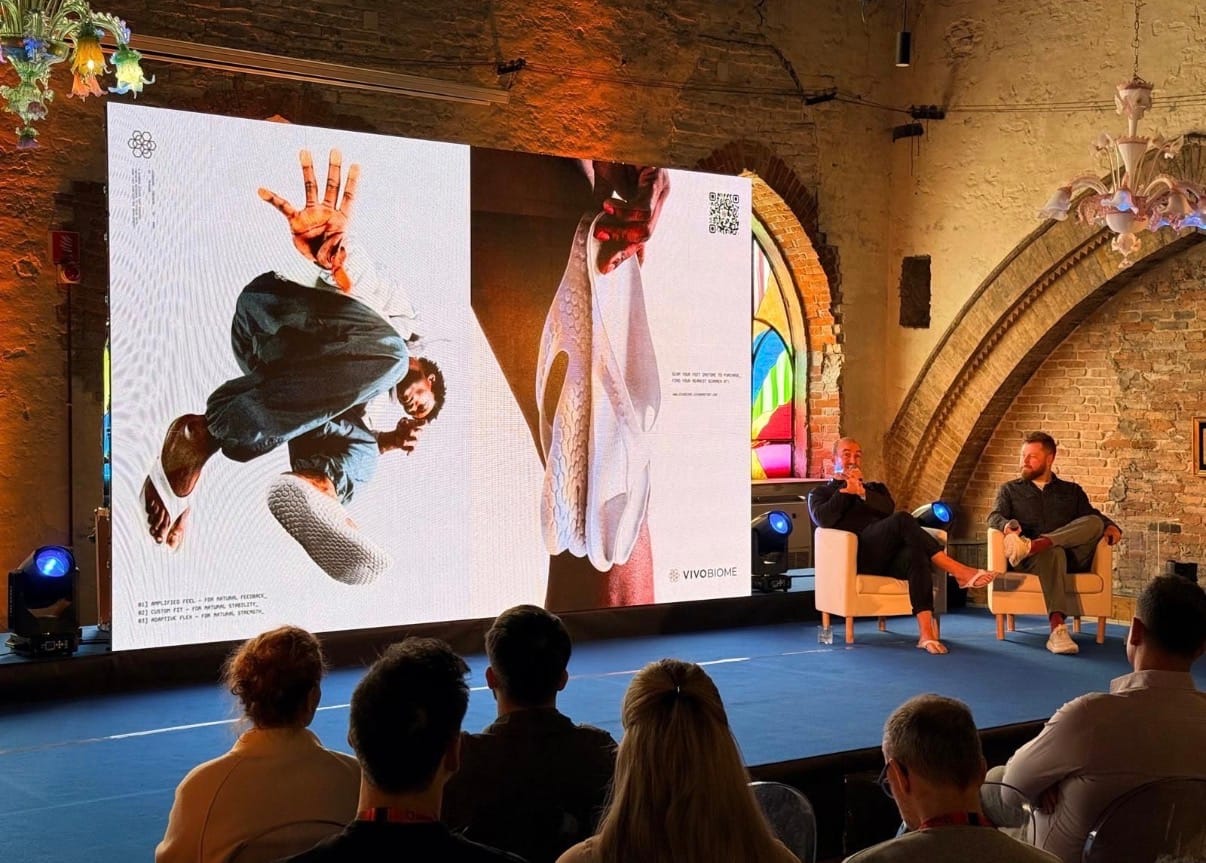
Asher Clark from Vivobarefoot gave the event's most fully-formed argument that these questions — printing, repair, sustainability, local production — are not separate problems. They are the same problem, approached from different angles. His thesis is that traditional shoemaking has been solving the wrong problem for sixty years, optimising for the shoe when it should have been optimising for the foot. His scan-to-print system, whose second commercial product launched the Monday after Stride, is built on seven generations of shoemaking knowledge. The technology is in service of a craft understanding that AI didn't generate and couldn't have — but without the technology, that understanding could never be individualised at scale.
Scan-to-print circular footwear requires rethinking the product, the production model, the distribution model, and the consumer experience simultaneously. You cannot change one and leave the others alone. Most transformation initiatives start and end with the tool. Clark's framing — that the current way shoes are made is simply not fit for the future — is a useful provocation for anyone who thinks digital transformation is complete because their designers are using AI to generate colourways.
The Making Takeaway: stop designing for the first sale. The most useful conversations here weren't about technology, but about what happens after the shoe leaves the factory. Where it breaks. Who repairs it. Whether it can be made closer to the person wearing it. Whether the foot, not the last, should be the starting point. The legislation is coming. The printing scale is coming. The consumer expectation is already here. The brands that treat all of this as one connected challenge will be better placed than the ones solving each piece in isolation.
IV. Craft Meets Innovation
Europe's Real Competitive Advantage
Amplify, don't replace
Europe's relationship to craft is not an obstacle to digital transformation. It is, or should be, its most distinctive asset.
Renaissance, or rebirth, implies that what is being brought forward is not discarded but transformed. The companies present at Stride Europe were living versions of that tension: luxury artisans working with digitally advanced workflows; performance brands whose workers still assemble shoes manually every day; global fashion houses spanning dozens of product categories with very different relationships to craft and digital; and independent studios doing things neither group could do alone.
Torresan stressed an important distinction: in artisan production you can produce thirty pairs of something, completely customised, at a level of quality that no industrialised process can replicate. That is not a problem to be solved. It is a competitive position to be understood and protected. The question is not how to digitise that process, but how to use digital tools to amplify what makes it valuable — the decision-making intelligence, the material knowledge, the construction logic that lives in the hands of craftspeople who have spent decades developing it.
That distinction between digitising craft and amplifying it is one the industry is still working out. The companies that figure it out first will not be the ones that replaced their artisans with software, nor those that reject new tools in favour of heritage alone. They will be the ones that gave their artisans better tools for communicating and scaling what they already know.
What education gets wrong
The Digital Education panel gave the craft argument its most nuanced treatment. Defne Yalkut, who runs the Sole Design Academy, noted that most of her students are mid-career designers who have been working in footwear for years and still don't fully understand sole construction, material selection, or the mold maker's logic. They come back not because they lack tool skills but because they lack depth. Meanwhile younger students are happy to generate AI renders without understanding what the shoe they are designing is actually made of. Schools cannot teach tools that change every six months, but what they can do is teach judgment — the ability to evaluate a tool, understand its limits, and know when a render has diverged from physical reality.
Pierre Kasperczyk of ISD Rubika drew the analogy that automotive design went through exactly this transition decades earlier. When Renault decided to go fully digital and laid off all its clay modellers, they subsequently had to rehire a lot of them. The physical and the digital are not in competition. They are in dialogue. The student who can only do one is less useful than the student who understands why both exist and what each is for.
Louis de Vos of DeVosTalent, who spent years recruiting for performance footwear brands, shared that what companies consistently ask for is not a specific tool but a disposition: openness, curiosity, the willingness to try things before they are validated. He has watched designers with world-class 3D skills struggle to adapt to new workflows because their relationship to learning was fixed. He has watched designers with average technical skills outperform them because they approached new tools the way they approached new problems — with genuine interest in figuring it out.
The Craft Takeaway: the challenge for European footwear is not to replace craft with something digital. Europe's heritage is not a liability to be managed. It is the thing that gives European footwear a reason to exist that no overseas manufacturer can replicate. The question is whether the industry treats it that way — as the foundation for differentiation — or continues treating it as the reason change is difficult. Figure out which parts of that heat you need to keep, and what you can afford, finally, to let the machines handle.
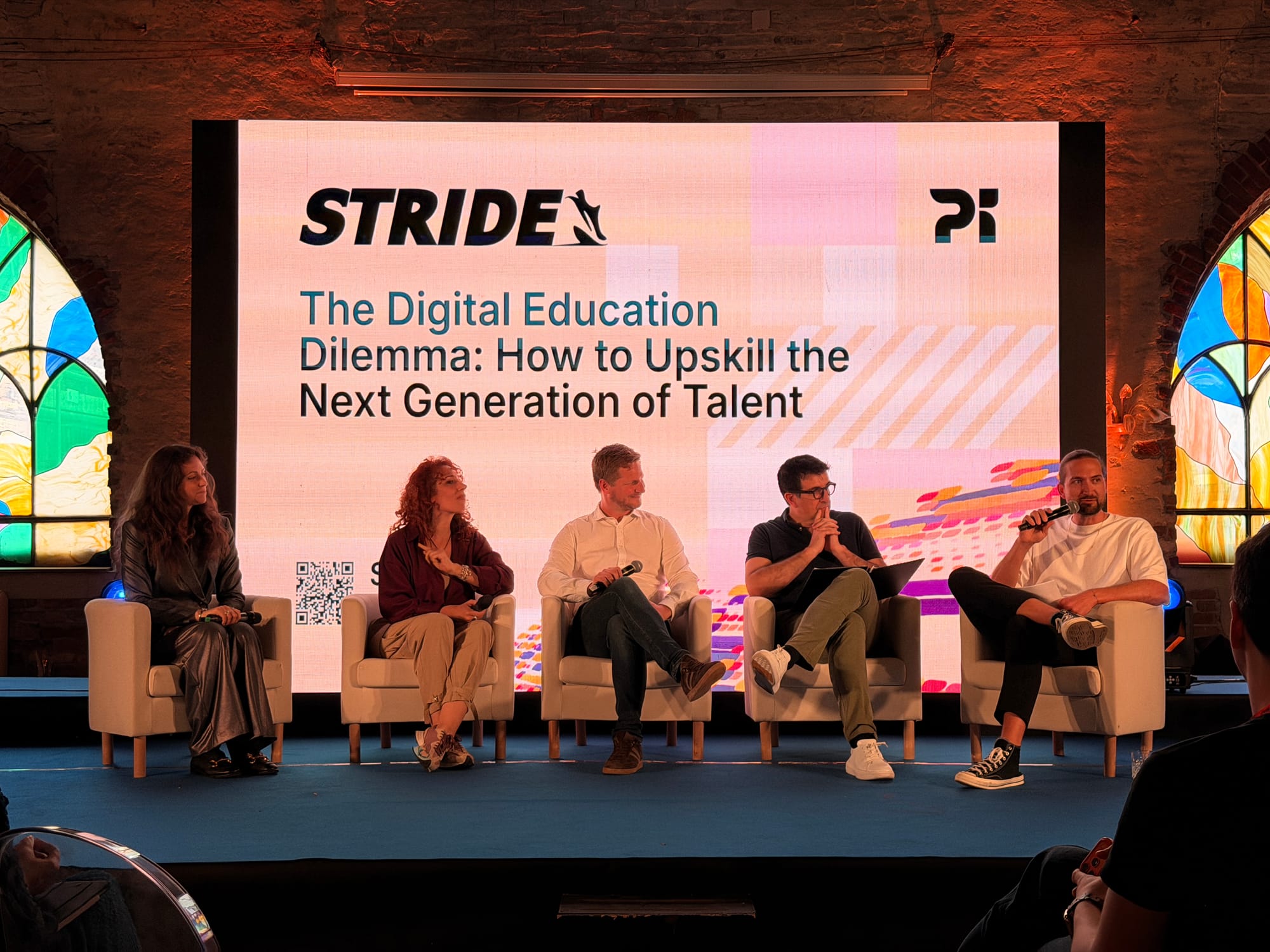
One of the things I was most curious about going into Venice was whether my pre-event research would hold up in the room — whether the things people said privately, in our one-to-one conversations, would be the same things they were willing to say on stage.
They were. And in some cases, they went even further.
What the research didn't fully predict was the appetite in the room for the harder arguments. The willingness to sit with Detlef's point about 3D not as provocation but as genuine diagnosis. The readiness to name the catalyst burnout problem. The ownership gap. The IP barrier to AI adoption. The generational tension that is hard to articulate, never mind solve. Those conversations went further than planned.
The gap in European footwear is not a knowledge gap. The people in the room knew what needs to change. Hell, they are the ones trying to change it. The gap is between knowing and doing — and the thing that sits in that gap, most of the time, is not resistance or incompetence. It is the absence of structure that makes the status quo the path of least resistance.
Two days in Venice didn't close the gap. But they did make it harder to ignore it.
Stride Europe will return in Spring 2027. More details to come soon, but until then, help shape the 2027 agenda at the link below.
Stride Europe's Takeaways at a Glance
8 takeaways for the people trying to make change happen
- Fix the infrastructure before you fix the culture. Build the material library. Define roles. Make learning mandatory. The culture follows the structure if the structure is genuinely faster than the old way. If you are still leading with culture, you have the order wrong.
- Stop treating digital as a role. Start treating it as a capability. Define what 3D, AI, and digital product creation are actually for in your specific context — design visualisation, development data, retail assets, AI training. Resource each function accordingly. One person hired to do all of it will become an executor and eventually leave.
- Rewrite 3D's job description. The visualisation work AI has taken over has changed the role of 3D. Evaluate what it needs to do for you now — holding data, enabling handoffs, connecting design intent to production reality — and evolve its ecosystem accordingly. Most organisations are still measuring the wrong thing.
- Use five questions for every new tool. Is the product better? Is quality of life better? Is the end result better? Does it connect with your existing ecosystem? Can it scale? Not a yes for all five? Move on. This is permission to stop wasting time on pilots that exist to impress management.
- Look at where apparel is and map the distance honestly. Apparel is converging faster on standards. The question is not whether someone will build the equivalent of CLO for shoes, but which specific workflow friction point you could fix with one well-chosen tool. Start there. Build from one fixed point.
- Give your catalyst structural authority, not just cultural permission. Budget, headcount, a mandate that survives quarterly pressure. The alternative is to keep hiring catalysts, watching them burn out, and starting again.
- Ask your repair question. If your product was going to be repaired rather than replaced, what would you design differently? If you cannot answer that clearly, that is a gap in your product understanding. The legislation is coming whether you are ready or not.
- Start computational design today. Download Rhino. Run the ninety-day trial. Open Grasshopper. The barrier is not the math — it is understanding the problem you want to solve clearly enough to define it computationally. That starts with knowing how a shoe is made. Which starts, again, with craft.