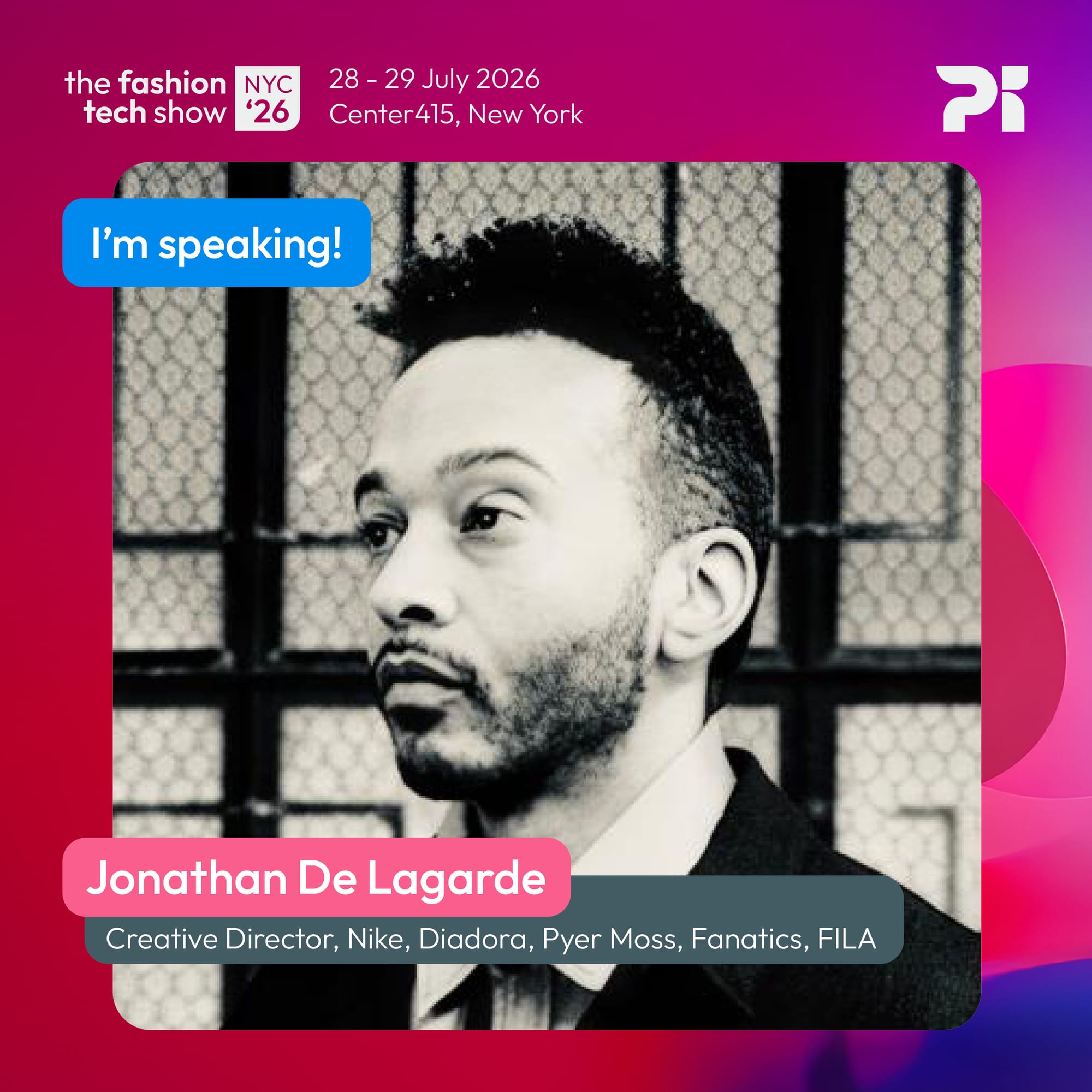


Speakers’ Corner gives you a preview of the voices you’ll hear at upcoming PI events, straight from the people shaping fashion and footwear.
In this edition, Jonathan de Lagarde — fashion designer and creative director with over 20 years of experience across Nike, FILA, Diadora, Pyer Moss, and beyond — brings a rare blend of cultural instinct and commercial rigour to the question of digital transformation.
From why systems thinking is the new superpower, to how AI amplifies vision rather than replacing it, de Lagarde makes the case that the designers winning right now aren't just creating products — they're designing pipelines.
1. What's the most meaningful shift you've seen in digital product creation this past year?
The shift from tool-based creation to system-based thinking. It's no longer about mastering a single platform — it's about orchestrating a workflow across AI, 3D, and storytelling tools. The designers who are winning right now aren't just designing products — they're designing pipelines.
2. How is 3D changing the way your teams design, iterate, and make decisions?
Honestly, 3D is becoming less of a centerpiece tool and more of a supporting layer. Iterative AI is starting to replace early-stage exploration because it moves faster, is more fluid, and removes technical friction. 3D still plays a critical role in validation, precision, and handoff — but it's no longer where the magic starts.
3. What's the biggest friction point still slowing down digital workflows?
Tool selection and fragmentation. Different platforms excel at different outputs — whether that's realism, speed, or aesthetic control — and it takes time to dial in what works for your specific creative vision. That trial-and-error phase is still inefficient and slows momentum.
4. What new skills or mindsets do you think teams need to build today?
Systems thinking and taste calibration. Anyone can generate images now — the differentiator is knowing what's worth making. Teams need to develop sharper creative instincts, faster decision-making, and the ability to direct AI rather than be led by it.
5. If you could instantly fix one bottleneck in the digital product pipeline, what would it be?
The disconnect between creative output and production reality. We can generate incredible concepts instantly — but translating that into scalable, manufacturable product is still too slow. Bridging that gap is the biggest unlock.
6. What does truly seamless collaboration between design, tech, and manufacturing look like to you?
A shared visual language. No PDFs, no guesswork — just real-time, living assets that everyone can interact with. Design, development, and factory teams all working from the same source of truth, with clarity from concept through execution.
7. Will AI become a creative partner — or a creative disruptor — for apparel designers?
Both. It will disrupt anyone relying on execution alone — but it will become a powerful partner for those who lead with vision. AI rewards clarity of thought. The stronger your point of view, the more powerful the output.
8. Do you think the future of product creation will be more human-driven or machine-driven?
Human-directed, machine-accelerated. The machine can generate — but it can't replace cultural intuition, taste, or narrative. The future belongs to creatives who know how to steer the machine.
9. What's currently overhyped in the digital fashion technology space?
The idea that more tools equal better outcomes. In reality, too many tools can dilute clarity. The advantage comes from having a focused, intentional system — not chasing every new platform.
10. What advice would you give to a brand taking its first big step into DPC?
Don't start with tools — start with intent. Define what you want to create, how you want to be perceived, and where digital actually adds value to your process. Then build a system around that. Otherwise, you're just experimenting without direction.
11. One word that sums up where DPC will be next year? Convergent.
12. Finish this sentence: In 2026, digital product creation will… …move from experimentation to expectation. It won't be a competitive advantage anymore — it will be the baseline.
Jonathan will be joining us at FTS NYC, taking place 28-29th July, where he'll be joining the panel on 'AI Has Landed and It’s Messy', as well as leading an interactive roundtable on 'Where Does Leadership Resist Transformation the Most?'