


Elizabeth Semmelhack has spent over 20 years turning footwear into a lens on human history. She argues that a shoe's real job was never just to protect the foot, but to uphold the social structures around it.
What follows is a conversation I had with her in person last week at the Bata Shoe Museum in Toronto, covering everything from a doctoral detour out of Japanese art history to the myth of the American cowboy, why sneaker collecting is quietly a story about masculinity, and what technology can and can't do for the future of footwear.
Before we get into your role as Director and Senior Curator here, what was your path into this kind of work?
I had spent years working on Japanese art history and Japanese language, and I assumed I'd become a professor of Japanese art history. Then life took an unexpected turn; I ended up at the Saint Louis Art Museum, in a position that was half curatorial, half education. I still worked on Japanese art, but I also had a master's in Western art history and was trying to figure out where that fit.
My mother, an international intellectual property lawyer, happened to attend an event for women in business at the Bata Shoe Museum in 1999. Mrs. Bata addressed the group, and my mother was given a tour. She called me that night and said she'd found the perfect place for me to work. I said, "What does this have to do with 18th-century Japanese prints?" She said nothing, just that it was a great place.
Three months later, the curator position was posted, and it actually looked interesting. I applied kind of as a joke, to let my mom know I'd "listened" to her. The next thing I knew, they'd flown me up for an interview. In preparing for it, I tried to read everything that had been written about footwear, but there wasn't much. That's when I realised this was actually a wide-open field.
My own interests have never really been about any unique artist or any unique object. My interests lie in why something was made.
Japanese prints were mass-produced for specific cultural and economic reasons; they were an economic engine in and of themselves. I realised I could take the same set of questions, the ones that had driven my print research, and apply them to footwear. It was a stretch, but 26 years later, I can see that my core line of questioning never changed. I just happened to end up applying it to shoes.
And what is that core question, exactly?
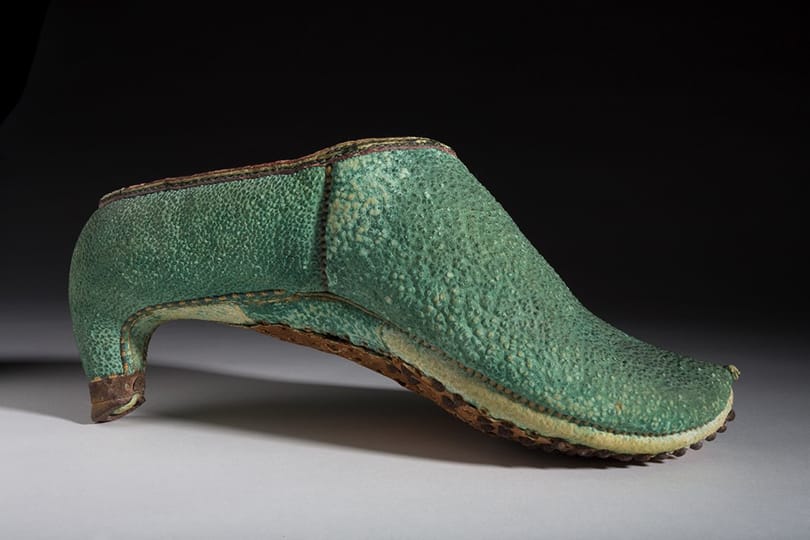
It's a question you can ask about anything: why? My first innocent question when I arrived here was "why the high heel?" No real research had been done and what existed read like fiction. So I started tracing it back, following the breadcrumbs further and further in time. I found the physical answer first: the heel is an equestrian tool innovated in Western Asia hundreds of years before it entered Western fashion. But then the next question was, why didn't Europeans - who were obsessed with everything Asian at the time - embrace the heel until the 17th century? That takes you straight into global economics and trade.
As I say, I’ve never been that interested in the unique object or the unique mind. I'm interested in things that are made to be consumed. Mass consumption tells you that something is scratching an itch a lot of people share. So the question becomes: why are we all itchy? What need is this answering? Is it financial, social, about gender, about status?
People often think a shoe's job is simply to protect the foot. I don't think that's true. I think the principal job of a shoe is to uphold social structure. And that's what I'm interested in; how footwear plays into these larger cultural constructs.
You’ve mentioned your first exhibition was on the high heel, and there was almost no serious scholarship to build on. What was that like starting from near-scratch?
It was an utter joy, honestly. I wasn't studying the Mona Lisa, where scores of scholars had already picked over every detail; it was completely wide open. I was asking multiple questions simultaneously. Because my background was in Asian art history, I knew I'd seen heeled footwear in Persian miniatures, which immediately refuted the idea that Leonardo da Vinci invented the high heel, or that it was even a Western invention to begin with.
One of the hardest things about heel research is that the human foot also has a heel. So when you're combing through historical texts, you can't always tell whether a reference to "the heel" is talking about the shoe or the anatomy. That made tracking the actual object through the historical record a real challenge. And this was 2000, 2001, right when there was a whole popular movement insisting women should wear heels as a "power tool," with studies trying to prove women were biologically predetermined to love them. Meanwhile I'm tracing the real history and finding a lot of men were wearing heels. It completely refuted the popular narrative.
What I do is, at its core, detective work, and it's a joy to piece it together.
I did the same thing later with chopines. The standard fashion-history line was that they were worn to lift women's dresses out of the mud. But the extant chopines told a different story. Venetian chopines have a wooden platform covered in imported white Hungarian leather with tiny pink silk tassels at the base; clearly they were not designed for walking through mud. I also couldn't find any images of women wearing chopines in this way. Instead, I found images of women towering over men with their skirts touching the ground, and sermons condemning women for wearing chopines because of textile consumption. That was when it clicked; chopines were worn under women’s dresses to increase the amount of costly textile needed to make their outfits.
It's that kind of work, questioning what's in front of you, then reading sermons, shoemakers' wills, and every image you can find, and piecing it together.
Two decades in, do you still feel like you're scratching the surface?
Completely. I've realised the information around footwear is integrated into so many different fields that I could spend the rest of my life on it and never run out of questions. I've thought about doing an exhibition where I take a single shoe, put it in the centre of the gallery, and treat it almost like entomology — pin it and unpack everything around it: an 18th-century woman's shoe touches sericulture in China, the shoemaker, the heel-maker, the woman who wore it, the secondhand market it passed through, how it ended up in a museum.
There are probably enough stories in a single pair of shoes to last a lifetime. The number of hands that touch footwear, and help shape what it culturally means, is such a rich vein of investigation.
Some footwear is more physically complex than most people realise. What have you learned about that complexity, and what does it mean for preserving these objects long-term?
Early on, I really started to appreciate the sheer number of components that go into a single pair of shoes, compared to almost any other piece of clothing. It's genuinely staggering once you look closely, and it's something people take completely for granted every time they lace up.
That complexity has real consequences for preservation, and for sustainability. It's currently close to impossible to take something like a sneaker apart into its component materials to recycle them. Those pieces can have what's called inherent vice, meaning they simply degrade and in doing so can also set off other materials in their proximity through off-gassing and reacting over time. So the sneakers sitting on our shelves are, in a sense, cannibalising themselves, which is a serious problem for anyone trying to preserve them for the future.
I've shown a couple of Nike pieces where this is especially visible. We have a Nike Tailwind, the first sneaker built with an air bladder introduced in 1979, without which you don't get the Air Jordan. It's such an important shoe in the history of footwear, and it has crumbled to dust.
So you're left asking two questions at once: how do we preserve these objects, and, given that some of them are now being designed with sustainability in mind and built to fall apart eventually, what does preservation even mean going forward?
You've been called the world's foremost shoe curator. Is that a label you're comfortable with?
I have mixed feelings. On one hand, I've been incredibly fortunate; I can work on ancient footwear, footwear of the future, anything in between. I feel like I got into the field at exactly the right moment.
But when someone says something like that, I think: you understand the pond here is the size of a teardrop, right? I may be a fish of some size in it, but only because the pond is so small. Twenty-six years in, that makes me a little nervous.
The field hasn't exploded the way I'd hoped. I still couldn't get a professorship at a university built around this. I think the field is increasingly being taken seriously, and I've been fortunate to contribute to that, but I wish more people were doing this work.
Let’s talk about the museum. Where does the Bata name actually come from?
The Bata family started a shoe company in what is now the Czech Republic in the 19th century. Tomas Bata Sr. was very taken with Henry Ford, or more specifically, two things Ford was doing: the assembly-line production model, and Ford's stated goal of making cars his own workers could actually afford. Bata set out to do the same thing with shoes, and effectively began the industrialisation of Czech footwear production, which grew into a genuinely major global player.
By the time Bata Sr. died in a plane crash in 1932, the company already had factories across parts of Africa and India. While America was the largest shoe-manufacturing country in the world at the time, it was still mostly exporting, not building satellite factories abroad the way Bata was. It was a very early, very literal form of globalisation.
His son, Tomas Bata Jr., took over the company as a young man after his father's death. In 1939, he left Czechoslovakia with a hundred Czech families, fleeing the Nazis, who wanted the company's shoemaking capacity for the war - you couldn't win a war back then if you couldn't put boots on your soldiers. He came to Canada, bought land that reminded him of home, and set out to build a shoemaking operation here, though he first supported the Canadian war effort instead.
After the war, he married Sonja Bata, and together they turned their attention to rebuilding the company from Canada. World headquarters were here in Toronto for years before eventually moving to Lucerne, Switzerland, which is where the company is now based.
And I understand that Sonja Bata built this museum to be deliberately independent from the Bata company itself. Why, and how has that shaped things?
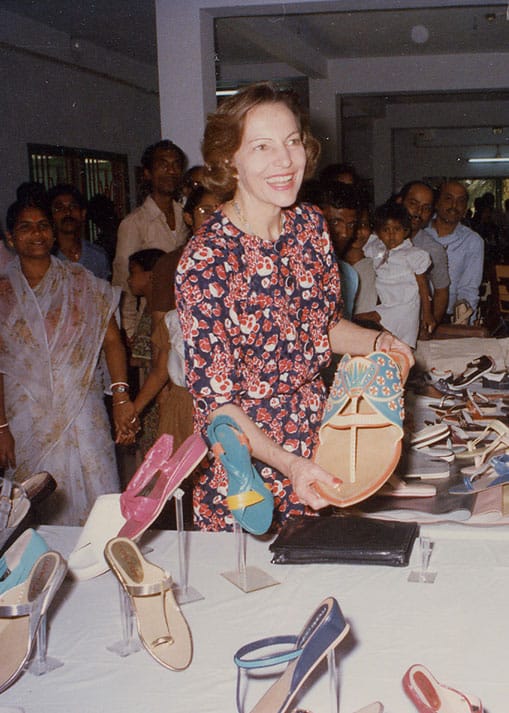
Mrs. Bata married into the Bata shoe company - she liked to say she "married a shoe man" - and she was no shrinking violet; she wanted to be part of the business. She began traveling the world with her husband and started collecting local footwear, initially hoping designers could incorporate traditional, local elements into the shoes Bata was selling, without fully appreciating that in many markets, people bought Bata shoes precisely because they were Western, not despite it. That first small collection grew, then the bug really bit her, and eventually someone suggested she open a museum.
By then she was committed to something bigger: using footwear as a way into larger cultural questions. Our mandate is simple: to tell the history of humanity through footwear.
It was important to her that the museum stay separate from the company, and I'm so glad she made that choice, because it means we have academic integrity. Nobody has to wonder whether we are looking at the history of footwear through a corporate lens.
I'm unfettered. That mattered enormously to me when I decided to take the job. It was a smart, forward-thinking decision that pushed the whole field of footwear research forward.
Is there an object in the collection that's stuck with you on a personal level? Something that stopped feeling like research and started feeling human?
It was actually one of the first pieces I ever worked with. When I was at the Saint Louis Art Museum, I used to walk past a Van Gogh every day on my way to get coffee, and I'd stand in front of it thinking about the fact that I was standing where Van Gogh once stood. But I never once thought about who bought the painting, or who made the paints. I think a lot of art history trains you to focus on the unique maker and the unique object.
When I got to the Bata Shoe Museum, Mrs. Bata asked me to work on a small child's shoe from around 1550. I was holding it, and it looked just like a shoe I'd bought at Target for my own daughter, who was about the same age as the child who had worn the shoe I was holding. I had this moment where the shoe suddenly felt embodied by its wearer rather than its maker; every pair of shoes in this collection was worn by somebody. It was overwhelming.
Because a shoe retains the shape of its wearer, working with these objects collapses history in a way other objects don't. The humanity of the wearer is right there in the footprint left inside the shoe.
That little shoe still speaks to me, and I think I bring that experience to every object I work with.
I think there's something a shoe does that other worn objects don't. Take a dress off, and it collapses back into being just fabric. A shoe holds its shape. It retains the form of the foot that wore it, in a way that keeps the wearer's presence embedded in the object itself, even long after they're gone. These aren't just objects. They're part of someone's lived experience.
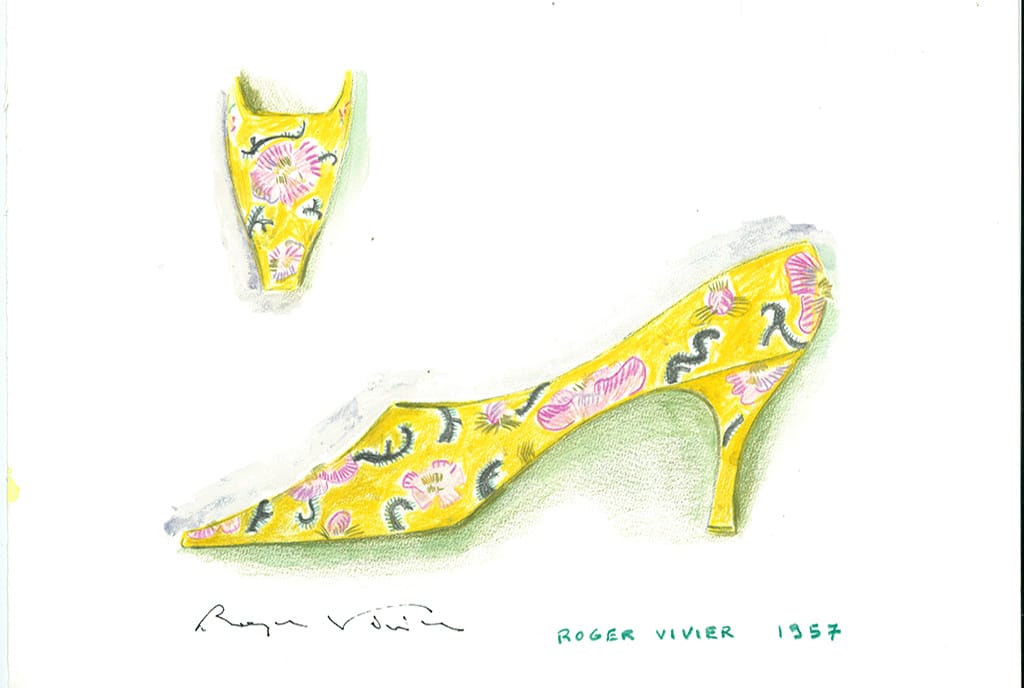
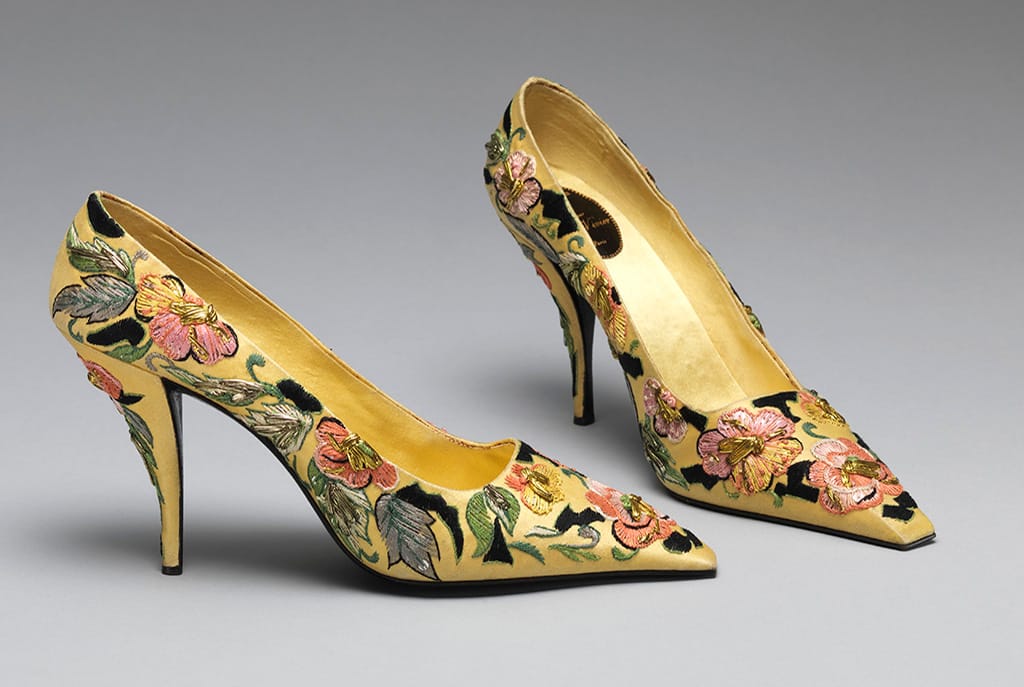
Roger Vivier's yellow silk embroidered shoes (sketch and finished product) (Source: Bata Shoe Museum)
Given how much weight a single object can carry, how do you think about the collection as a whole? How big is it and how do you decide what the public gets to see?
The collection is around 15,000 artifacts, though "artifact" can mean 63 original drawings by Roger Vivier, or a full set of a shoemaker's tools, so the actual object count is much higher. Mrs. Bata wanted us to remain a collecting museum, which I'm grateful for as it keeps us vibrant, especially since footwear is constantly in the news.
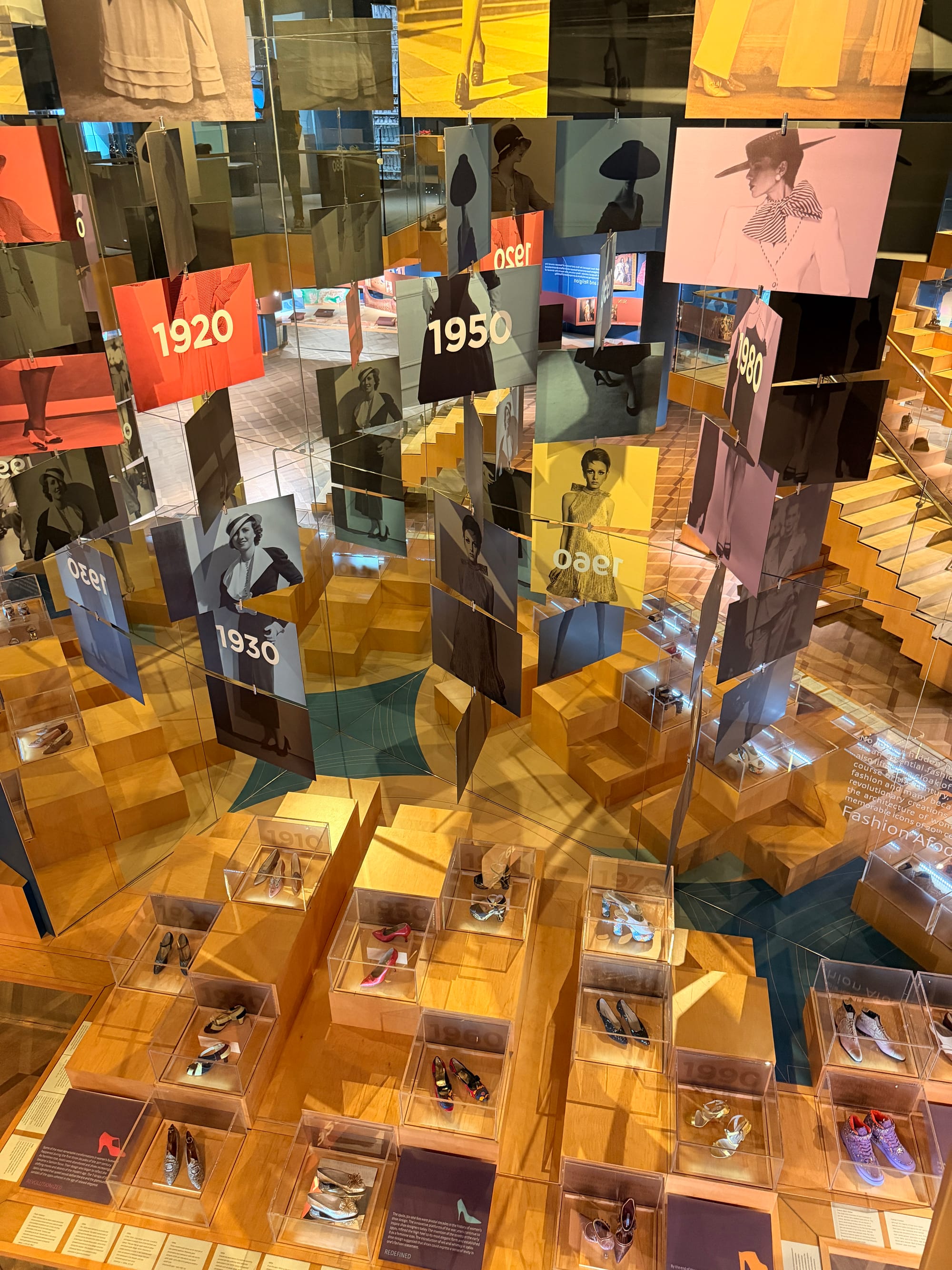
Though people may expect to visit and see the collection in full, that is just not possible, partly because footwear is often made of delicate materials that need rest. We can't do the kind of open storage a museum like the V&A East can. So rotation is one of our responsibilities: we keep pieces for future generations by not overexposing them, and it means no one visits once and feels like they've "seen it all." We have three temporary exhibition spaces plus one permanent space. The permanent space keeps its themes but rotates the specific artifacts; the temporary spaces let us chase ideas.
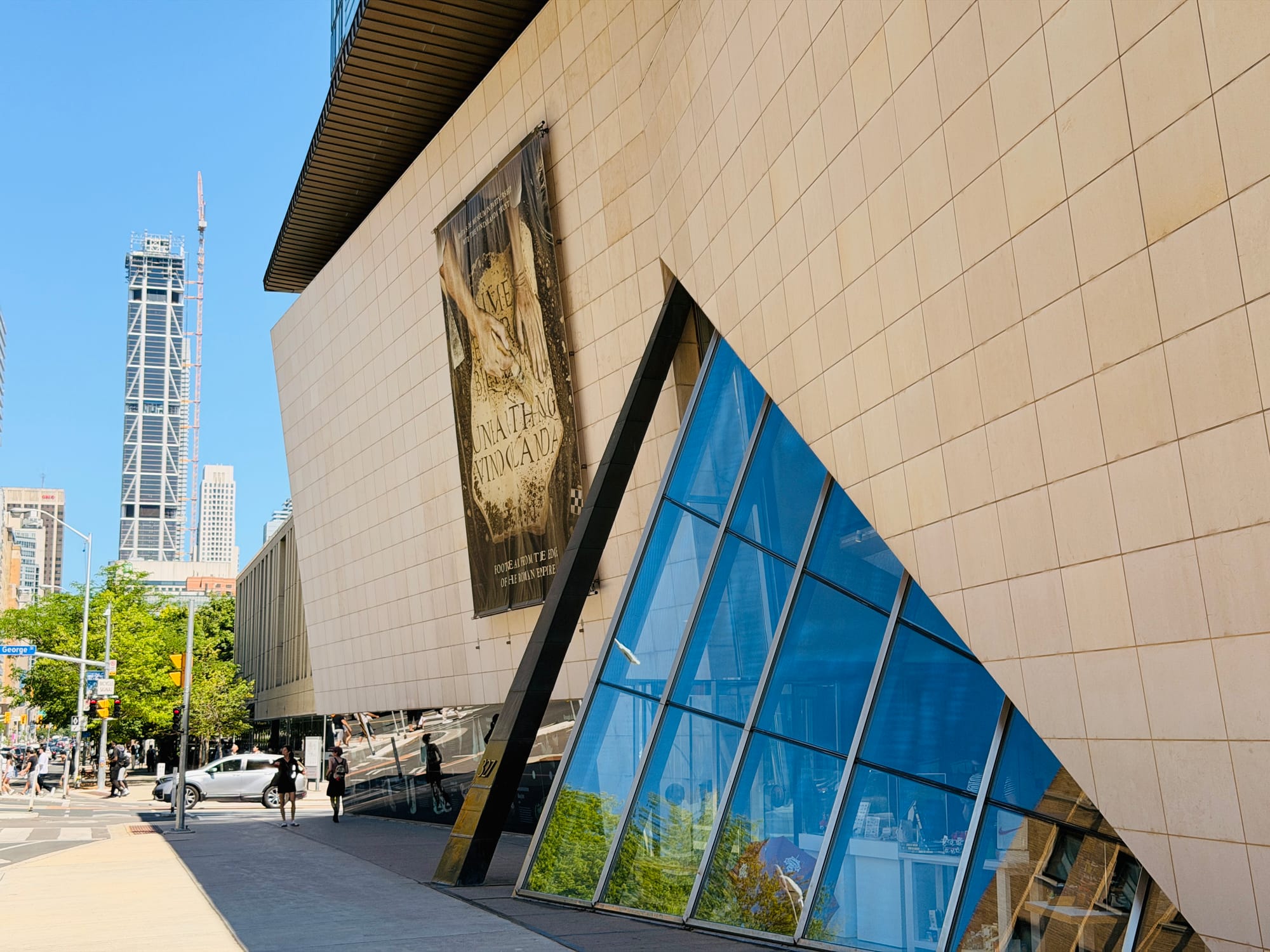
Historically, my approach has just been: what questions do I want to ask? I've been researching the history of the high heel since I started, so the current cowboy boot exhibition is really a continuation of that; cowboy boots have heels because they're an equestrian tool. Temporary exhibitions also open the door to international partnerships like working with the Vindolanda Trust, which has excavated 5,000 Roman shoes, or with Nishi Bassi curating our exhibition on Perugia.
I love research, but I also love putting on a show. I'm not someone who can just do research quietly. I need to write the book, mount the exhibition, and tell people about it.
"Rough and Ready" looks at the cowboy boot and traces origins that are surprisingly global. Why isn't that the version of the story most people know?
I wanted this exhibition to establish two things. First, that so much of what we consider cowboy culture is really the intermingling of ideas from across the globe; tooled leather traces back to Islamic Spain, the heel itself likely traces back to Persia or further. Second, that the first actual cowboys in what was then New Spain were enslaved Black men from Senegambia, brought over specifically because the Spanish didn't want Indigenous people learning to ride. Those men carried a long tradition of horsemanship. Honestly, what could be more American than the blending of that many cultures into one icon?
So why don't we know this history? The real age of the American cowboy was brief, roughly 1865 to 1890, right after the Civil War. Once that era closed, nostalgia kicked in fast, through theatrical Wild West shows that actually featured horsemen from around the world but centred the white cowboy as the face of all of it, at a moment when America was trying to figure out who it was. World War I accelerated that: Europe was devastated, so wealthy Americans went to dude ranches instead and wanted to dress the part. At the same time, many nations, Germany being the clearest example, were reacting against modernity by reviving folk culture and traditional dress. America's answer to "what is our traditional dress" became the cowboy.
It's unfortunate, because at least 25% of cowboys were Black and at least 10% were Indigenous, with many more Mexican vaqueros, but the cowboy that got mythologized was more myth than reality, born in the age of eugenics. I end the exhibition with Pharrell Williams and his effort to remind people, in his words, that "cowboys look like me," reclaiming the actual history.
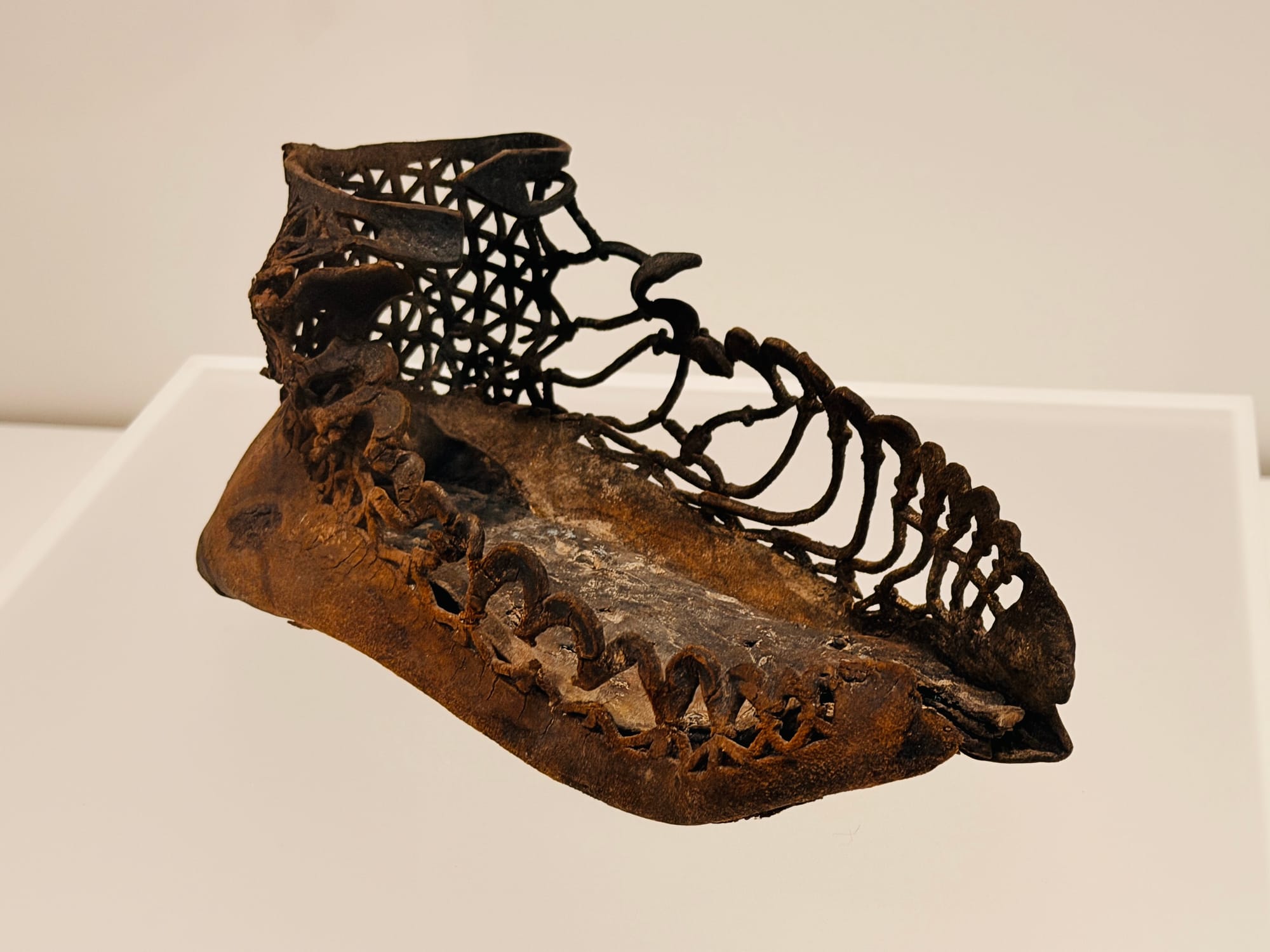
The Vindolanda exhibition draws on 5,000 excavated Roman shoes. What makes that discovery so significant?
Vindolanda was one of the northernmost outposts of the Roman Empire, and archaeologists there have excavated around 5,000 shoes made of leather that survived because the soil there is anaerobic, unlike most of the former Roman Empire. Before this excavation, historians largely assumed Roman forts were places occupied only by men. But once they started uncovering children's and women's shoes, that assumption had to be rewritten; fort life clearly included a full, vibrant community. We open our exhibition with a pair of children's shoes for exactly that reason, and the show as a whole explores that fuller picture of fort life.
I think that's one of the things I love about this field: history keeps getting rewritten as new evidence turns up. Even my own high heel exhibition from 2001 had mistakes in it, simply because I hadn't yet had time to do the research I have now. I try not to beat myself up about that. I just keep correcting it through ongoing research.
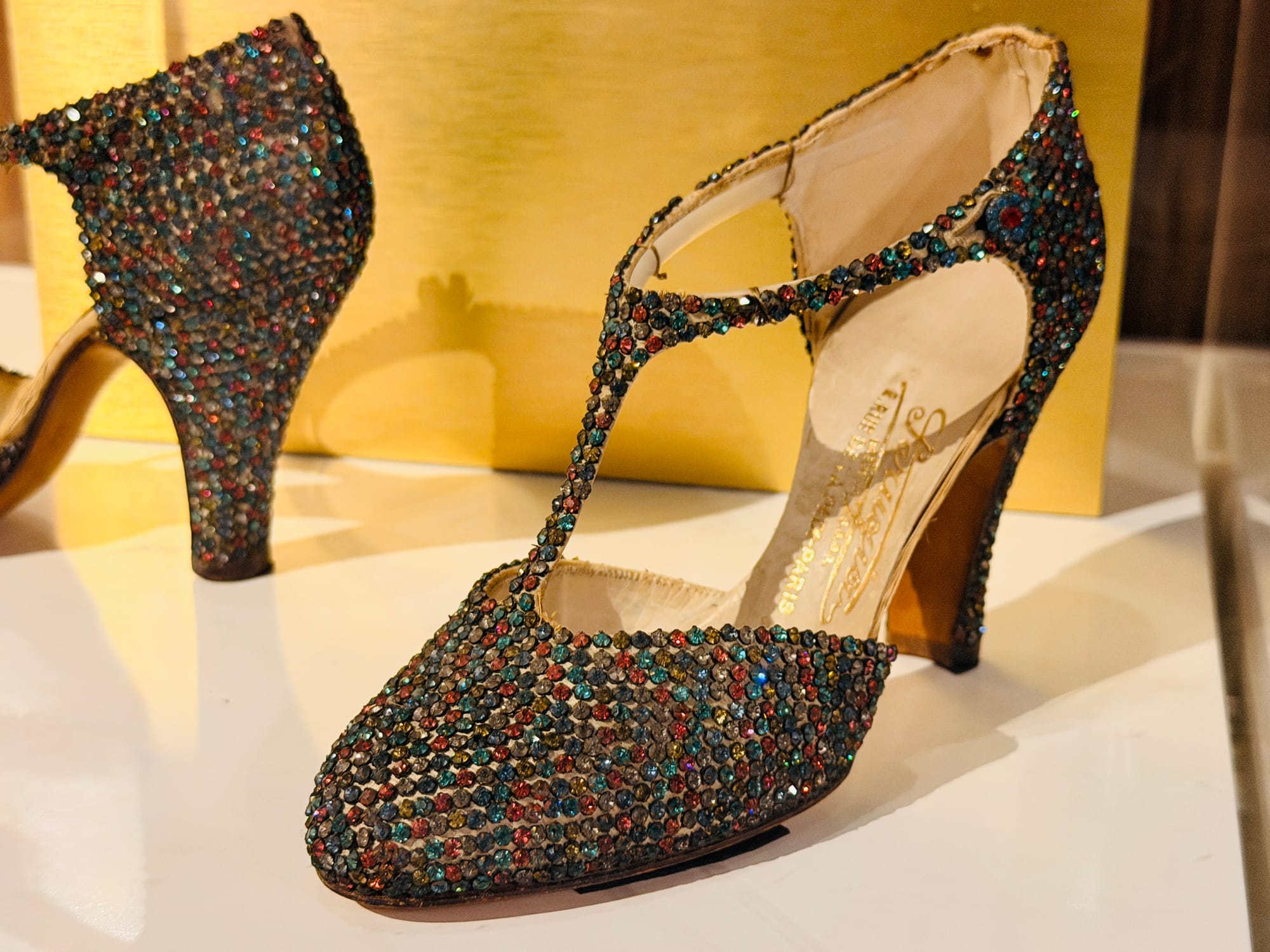
And Perugia — what surprised you most, looking at his work today?
What stands out to me most about Perugia is that he was interested in subtraction, constantly stripping away at the architecture of a shoe to find out what he could remove. That process produced genuinely radical forms: he created the blade heel, the first steel heel, in 1951 - an extremely thin heel that could still support a woman's weight because it was steel. That idea gets refined and translated directly into the stiletto we still wear today.
He was also the first to use rhinestones, he originated the cantilevered heel, and he made the barefoot evening sandal. So many designers today are still working, whether they realise it or not, in a vocabulary he invented.
Your exhibition Future Now took a different approach than most of your work — looking ahead instead of tracing history backward. What was the goal?
Over the years, my research kept showing me the same pattern: nascent ideas that don't come to fruition for decades.
I'm always looking backward to figure out the "why." Future Now was a challenge to myself to look forward instead. What's being done right now, and where might it take us?
That said, in the traveling version of the exhibition I still included a strong section on industrialisation, so people could see the arc from bespoke and secondhand shoes to mass production; what mass production gave us, and what problems it created. We now make roughly 20 billion pairs of shoes a year, so overproduction has become a massive issue.
I broke the exhibition into five sections. The first was the history of industrialisation. The second looked at innovation with things like 3D printing and the Nike Vapor Fly, and where those technologies might take us. There was a section on sustainability, from mushroom leather to materials designed to be taken apart and reused, including work with Parley for the Oceans using reclaimed ocean gillnets.
A section called "Transformative" looked at things like the Nike GO FlyEase, which uses universal design to serve people who have difficulty tying shoes, but has such strong design that everyone wants a pair. I also used that section to highlight a shift I was seeing in the industry. Designers like Dwayne Edwards stepping out of a company like Nike to start his own school and his own brand, echoing a shift that had already happened in women's footwear: designers being named, identified, and valued as individuals.
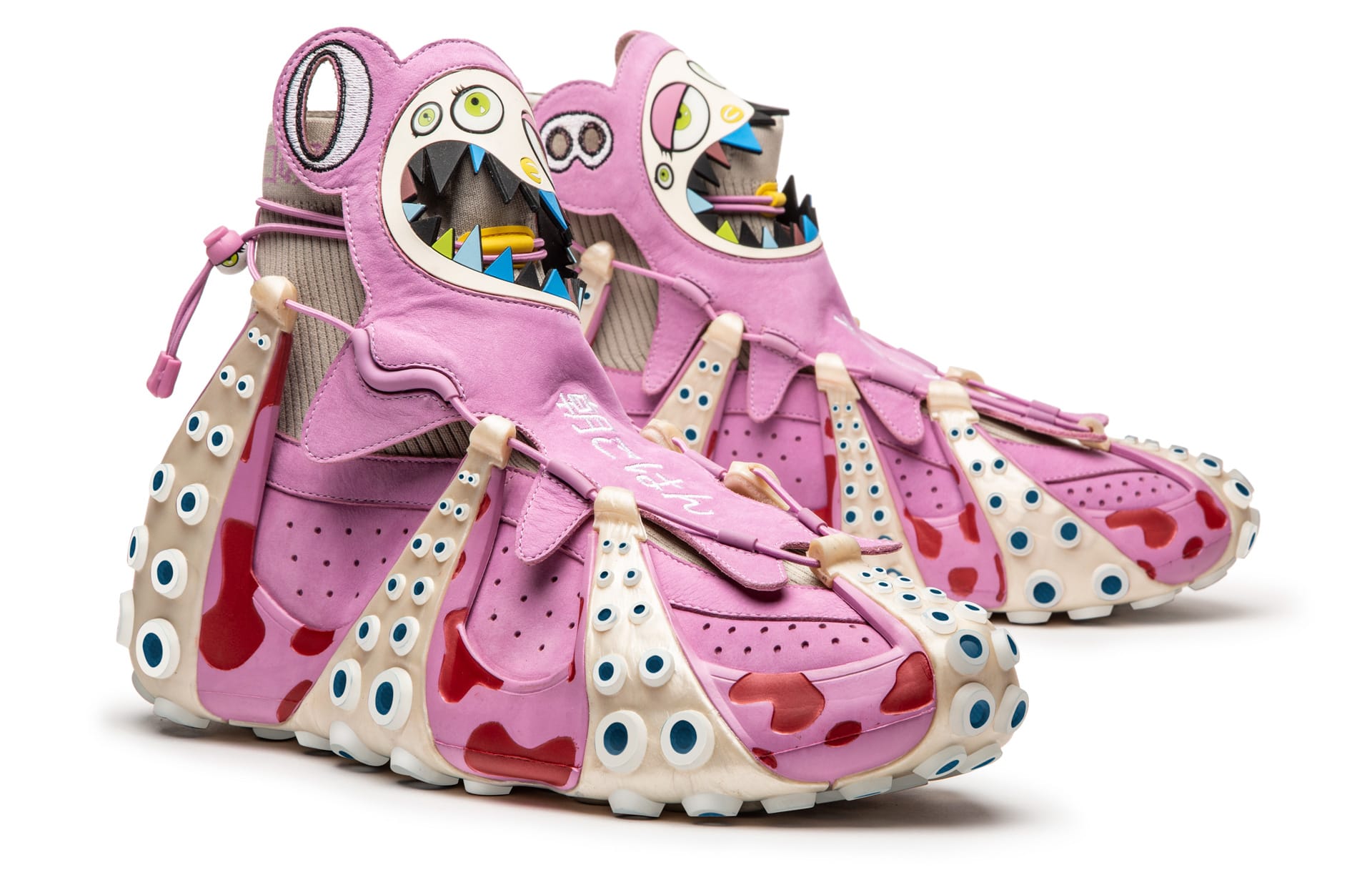
I also included a piece by Mr. Bailey, the "octopus shoe", that everyone photographed. What struck me about it was the story behind it: he made it for an invitation from Murakami to take part in Complex Con's "Sneakers for Breakfast" project, where a few designers were invited to make whatever shoe they wanted. The result was inspired by Murakami's work but also entirely scalable - a sculptural piece that could go into mass production. I found that really exciting as a possible future: we don't have to keep doing rubber and canvas, then foams and plastics, forever. There's a real path toward "art for your feet" at scale.
The last section looked at NFTs and digital fashion. I found it fascinating that Fortnite had Jordan skins. We are in the midst of “colonising” a new frontier and immediately started replicating the same behaviors from the physical world, so I wanted to look at how that was being monetised and how it actually functioned. I think part of why NFTs didn't take off the way people hoped is that the metaverse worlds were created as isolated spaces, where you could only wear Nike skins in Nike's world, adidas in adidas' world, and so on.
What was missing was a common space where digital fashion could function the way real fashion does, by letting people interact across brands. I'd reached out to the RTFKT team behind the "cyber shoe" right after they made it, and they were generous about sharing what they were doing. I was genuinely intrigued by how much money people were willing to spend on these things. NFTs as a moment may have passed, but I don't think that's the end of digital fashion. Years ago Second Life did some genuinely interesting things in this space, NFTs pushed things forward. I think it just hasn't found its legs yet.
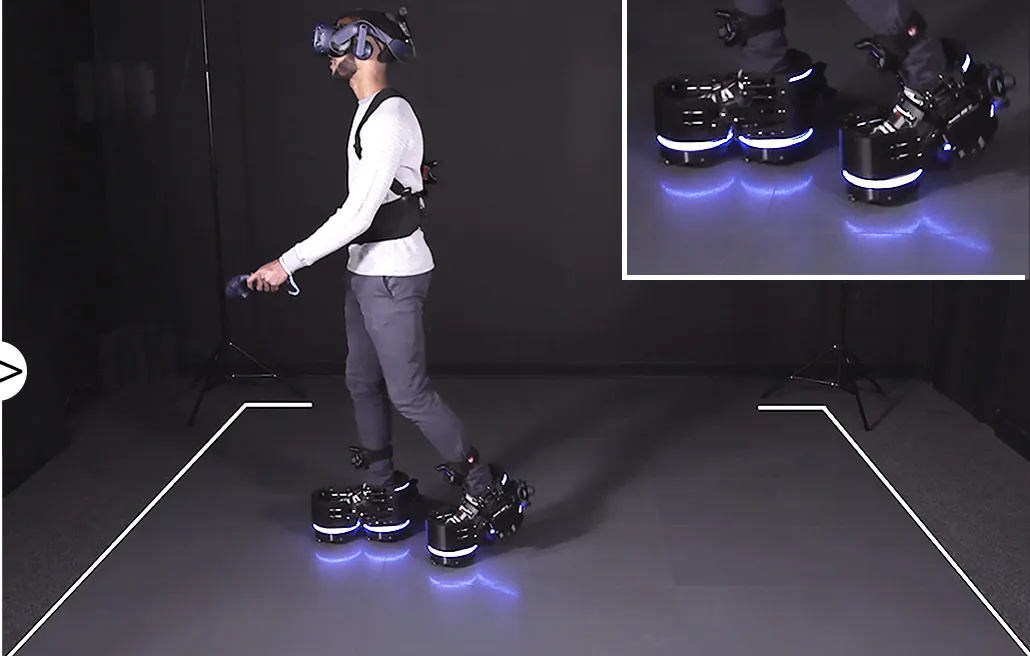
The final piece was footwear within VR. I featured Antonio Hernandez, who makes footwear meant to be worn on the body while in VR. Instead of just watching your avatar wear something in a space like Decentraland, you physically wear it.
That raises real questions about how it changes comportment and feel. Haptics obviously haven't been solved yet, but Antonio was experimenting with water as a material to explore haptic sensation.
I also included Brad Factor's work, which is far more practical: footwear that keeps you physically anchored in one place while in VR so you don't walk into walls. He's building it for industrial training, mapping something like an oil rig, a very high-risk environment, so workers can physically walk through the space in VR, learn where the safety equipment and muster points are, and build physical memory of the layout before they ever set foot on the real rig.
I think the virtual side of all this is absolutely going to be part of our future. Consider plastics: the first plastics were cellulose nitrate billiard balls, an attempt to replace ivory, and they were explosively unstable. At that moment, you could easily have written plastics off as a failure. Instead they went on to change the world.
I think the virtual world remains similarly untapped.
I also think there's a real future in things like AR for trying on shoes before buying. That's not going anywhere. And it's not just the big brands; smaller design studios are already using VR heavily in their design process. Tools like Gravity Sketch have genuinely changed how shoe design can happen. There's a lot more coming on that front.
Do you think 3D printing could actually bring back bespoke fit at scale?
I don't know that 3D printing alone gets us there. But there was a concept piece in Future Now by Julian Zach that I loved, even though it's just a concept: a 3D-printed last, bespoke to your individual feet. You could still download a brand's style, say, Nike's next design, for the upper. Then instead of conventional material, you'd introduce mushroom spores with corn and water, and the shoe would essentially grow overnight: stretchy, mushroom-leather, and fully compostable.
If we can actually solve that, it would be extraordinary, because true custom fit needs the breathability and elasticity that leather or a comparable fabric offers. Rigid 3D printing needs to get a lot more flexible before that's real at scale.
There's a bigger point I make in Future Now with real confidence: industrialization gave us more shoes for more people, and more shoes for specific purposes, but it also changed how we think about our own bodies. In the 18th century, if I were wealthy, I'd have gone to my shoemaker and he'd have made me Elizabeth-sized shoes, full stop. Industrialization turned me into "a size ten." That's a strange way to think about your body, and it creates real friction. You go into a store needing blue shoes for a wedding that afternoon, and you're stuck hoping something in "your size" happens to exist, the way one of the ugly stepsisters is stuck trying to force her foot into a shoe that was never made for her.
I think we're going to look back on this industrial moment and find it strange that we ever thought of ourselves as a size.
That said, we've also built enormous cultural infrastructure and brand identity around this system. Bespoke shoemaking doesn't just struggle because of cost, though the cost is real on both sides. It struggles because when you spend $5,000 on bespoke shoes, what social work is that purchase doing for you? Compare that to spending far less on a pair of Louboutins that everyone immediately recognises. That purchase does a lot of identity work, both for how you see yourself and how others read you.
It'll be interesting to see how bespoke and brand-driven fashion continue to negotiate that tension.
Designers have apparently come through the archive to study historic pieces like Louboutin, Converse, Nike, among others. What's the most unexpected thing you've watched someone take from a centuries-old shoe into footwear being made today?
A team from Converse spent time with our large circumpolar collection, and what intrigued them most wasn't the shoes themselves but the placement of pattern pieces on the hide. When you're working with hide, waste is created by how you lay out your pattern. They found pattern placement on reindeer hide that answered production questions for them in ways they hadn't expected.
I think that's part of what's so valuable about this collection: the human form hasn't changed since time immemorial, so people have been solving the same problems, sometimes in remarkably similar ways, across history.
Even a Roman marching boot in the exhibition laces up almost exactly like a contemporary military boot; not identical problems, but very similar ones. It's genuinely inspiring to see how other cultures and time periods solved problems we're still solving today; there's real value in revisiting, reviving, or reinterpreting those solutions rather than assuming we're starting from zero.
You've said the most radical ideas in footwear tend to come from outside the industry. Who outside of footwear should brands actually be paying attention to right now?
I've said that partly in response to designers like Beth Levine, who wasn't trained as a shoe designer. Her instinct was simply, let's make shoes out of paper, let's just try it. Or Alexander Taylor, when he was developing the knit upper for Adidas - he was looking at knit furniture construction, not other shoes. There's real value in looking at what's happening in adjacent fields and figuring out how it translates.
As for where to look now, I keep coming back to things like packaging and shipping, even waste management at a place like a grocery store: industries that generate too much and have had to find real answers for what to do with it. There might be genuine solutions in that world worth borrowing.
Have you looked at 3D technology to preserve or extend the collection?
The challenge with current 3D technology and our collection is that footwear is soft and tactile in ways that resist replication. Some pieces are wooden; you could 3D-print a Dutch clog and it would be fine to run around in. But if you 3D-printed an ancient Roman shoe, you'd get a shoe-shaped paperweight, not anything that captures the qualities of the original. The technology isn't there yet for our historic pieces, though I do collect contemporary 3D-printed footwear made for actual wear today.
We did work with 3D photography and what was great about it was that you could rotate a piece and zoom in enough to count stitches.
That kind of access, for objects too fragile or old for the public to handle, is genuinely valuable, and I think there's real potential there still, including the idea of pure 3D model files rather than physical printing.
Where do you see AI actually having a lasting impact versus where it's just noise right now?
It's a hard question. I'm dyslexic - I read perfectly well and I write books, but the physical act of writing is a struggle. I retype constantly. When spellcheck first appeared, some people called it cheating. But spellcheck lets my clarity of thought come through on the page without doing the thinking for me.
That's the frame I bring to AI: can it be exploited the way I exploit spellcheck? A tool that clears the path, not one that does the work.
My real worry is sameness and redundancy. I can tell when someone is responding to me through AI. And we already overproduce more than we can sell. If AI just accelerates more schlocky iterations, that's a problem. But if it can be turned toward genuine problem-solving, like "I need a sneaker that hits these performance targets using only recyclable materials", that's where I think it could actually help.
Right now the bigger issue is that everyone in the industry is experimenting in isolated, non-standardised ways, so no one can really learn from anyone else. We don't have it figured out yet.
You've argued the sneaker resale market is built on something fundamentally flawed, since the shoes themselves degrade. What does that mean for an industry that's made real money off resale and "investment" sneakers?
I do have real concerns about sneakers as investments, precisely because of their fleeting physical nature. Our job here is to preserve things, so we're working hard on that conservation problem. Sneakers from the mid-80s onward, in particular, are literally falling apart, and that includes pieces as significant as the 1979 Nike Tailwind. I don't want to sound dismissive of sneaker collecting; it grows out of genuine cultural appreciation, and collectible sneakers absolutely are cultural artifacts. I'm more interested in the emotional and cultural investment they represent than the monetary one, but all of that disappears if the industry can't find a way to sustain the physical objects.
There's a deeper layer to this too. Western culture, starting in the 17th and 18th centuries, constructed gender differences in ways that coded fashion, and emotional attachment to fashion, as specifically feminine. So when men started collecting sneakers, that interest couldn't be framed in emotional terms without feeling feminising. Instead, a framework was built that let men participate in fashion consumption while reinforcing rather than challenging masculinity. Sneakers got positioned more like watches, cars, and fine wine: rational, financially sound purchases, rather than "I saw a pair of red sneakers and had to have them."
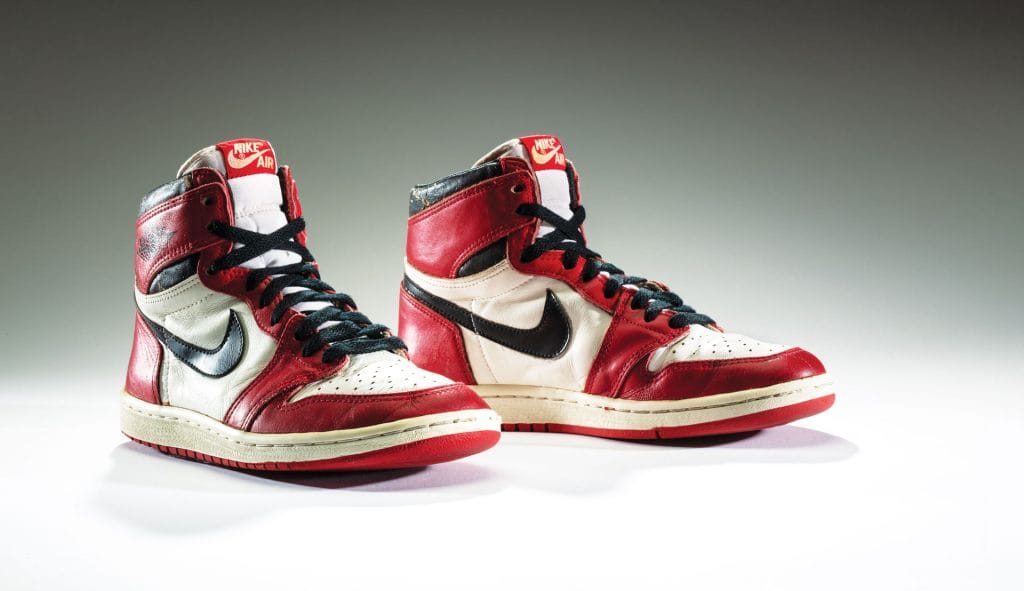
The Air Jordan lineage is a perfect example. The Jordan 2 didn't look like the 1, the 3 didn't look like the 2, which created a rational, collectible system: now you need the set. Add the resale market on top, and suddenly buying a sneaker isn't "I liked it," it's "I'm a collector and it's a good investment." That framework has pulled men into a level of fashion consumption on par with what's long been expected of women, just through a different, more "acceptable" lens.
Even how sneakers are worn reflects this. Women have long dealt with the unwritten rule that you can't show up to work, or an evening event, in the same outfit as another woman in the room which drives enormous consumption. Men, since the three-piece suit, could show up in near-identical outfits without comment.
There's actually a story of an Australian news anchor whose female co-anchor was criticised daily for what she wore; comments on whether she looked great or terrible, every single broadcast. So, without telling anyone, he wore the exact same outfit every day for a year, just to see what would happen. Nobody said a word. At the end of the year, he told everyone what he'd done.
But once sneakers entered the picture, that changed. Suddenly guys didn't want to be seen in the same pair as someone else. And sneakers came loaded with a kind of narrative women's fashion historically lacked - "I remember when Michael Jordan won wearing those" - which gives men a story-driven, historically legitimised way into fashion consumption that still doesn't threaten their masculinity.
You've also coined a term the "de-sneakerification" of sneakers. What's that about?
I'm seeing sneakers pulled toward two different poles right now. On one side, sneakers are dissolving into other silhouettes entirely: the sneaker loafer, the sneaker ballerina flat. On the other, there's a real push toward more overtly masculine, business-coded silhouettes, a continuation of something that started even ten years ago, when men's oxfords started showing up with sneaker soles.
Both directions are, in their own way, a retreat from the sneaker as its own distinct category. I don't know if that's simply sneaker fatigue after decades of dominance, or something tied to a broader, more conservative political moment, even as someone like Bad Bunny will wear a ballerina flat.
But that bifurcation, where some sneakers are drifting toward "menswear" and others toward "women's fashion", feels symptomatic of a larger shift I don't love. I want to write something on it properly. I need to go stand in a big shoe shop and really look at what's happening.
I’d love to end with this: has there been a pair of shoes in your own life that you've been emotionally connected to?
Years ago, the Met invited me to spend two summers going through their shoe collection. I used my vacation time to spend weeks there, going through every shoe. That's when I really understood how incredible the Costume Institute's Roger Vivier holdings are.
One day, someone mentioned Saks was having an amazing shoe sale, so that night I went down and found a rose suede Roger Vivier heel that I hadn't even known the brand had relaunched. I'm a size ten, and it fit. It felt like fate, except it was a sample from the sale rack, so there was only one shoe.
I asked the salesperson to look for the match. They couldn't find it. We looked under chairs, everywhere. I told them, "I know this sounds insane, but I am working at the Met, I work on Vivier, I have to have this pair." They said they'd call me, and for three weeks, I called back religiously. Nothing. I gave up.
Then that November, Saks called: they'd found it, sitting in a buyer's office as a display piece. Did I still want them? Of course I did. I still have them, and I've gone on to work on Roger Vivier many times since including an exhibition I did reuniting the incredible shoes held in the Met’s collection with Vivier’s drawings and pullovers in our collection I've since written books for both Dior Heritage and Maison Vivier as well.
So yes, I'll always have those shoes and they’ll always have a special place.
A very special thank you to Elizabeth for welcoming me to the Bata Shoe Museum and taking the time to speak with me. Launching our Stride events gave me a newfound appreciation for the world of footwear, and the way Elizabeth talks about its emotional weight and humanity is something I find genuinely fascinating.
So the next time you put your shoes on, pause for a second; they aren't just covers for your feet. As Elizabeth put it, unlike anything else we wear, a shoe holds your shape. In a very real sense, it becomes an extension of you.