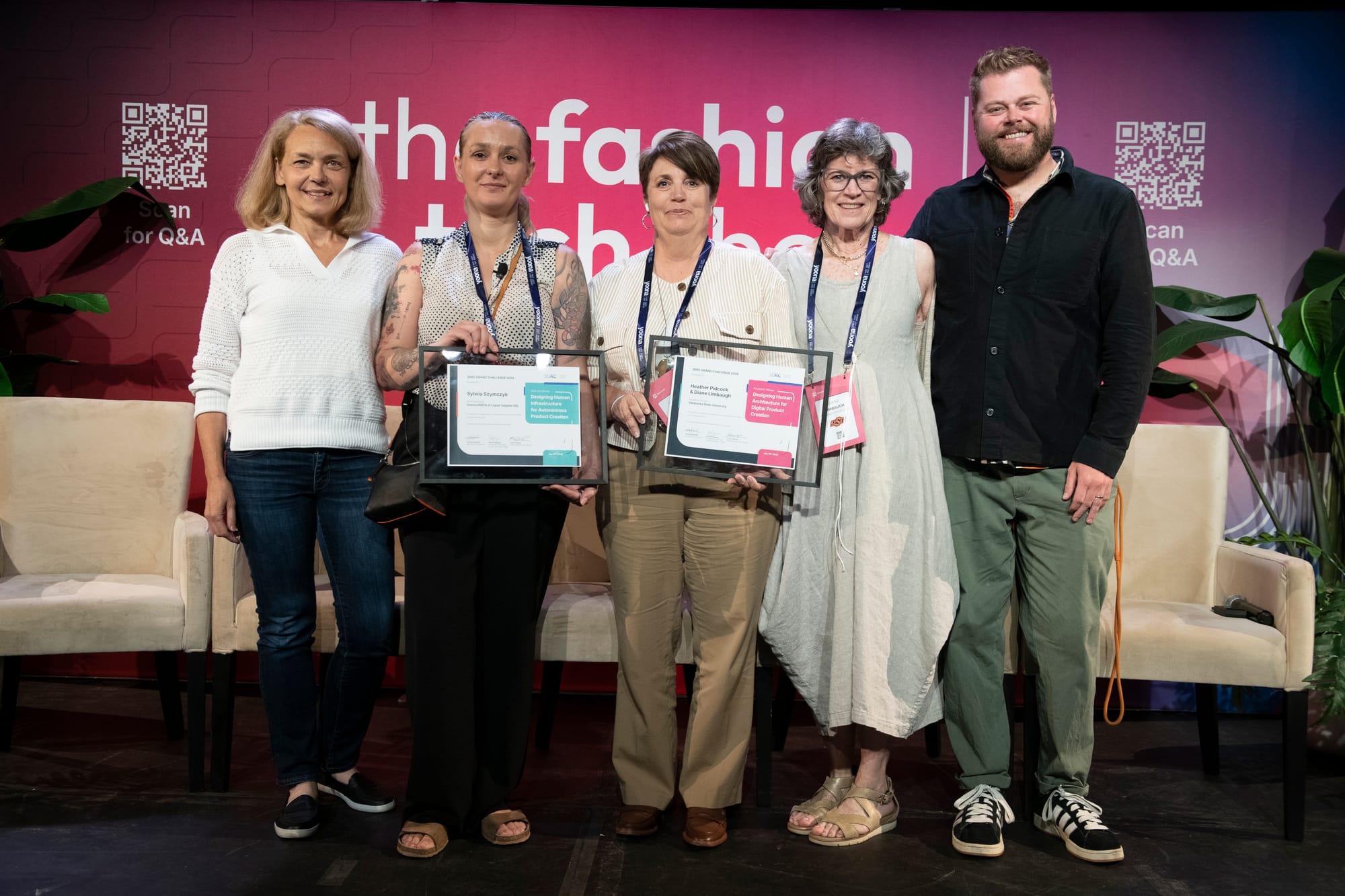


Forget hand-me-down knowledge, what if the reasoning inside a master patternmaker's head never had to leave the building?
As the Start-up Winner of the 2026 3DRC Grand Challenge, fashionINSTA is confronting one of fashion's quietest crises: master pattern engineers are retiring faster than the industry can train their replacements. The judgment behind every seam, curve, and allowance has never been written down. fashionINSTA’s AI infrastructure layer turns a sketch into a manufacturable pattern in minutes, but the deeper work is capturing the technical reasoning of a brand's most experienced people and making it a permanent, teachable asset.
We spoke with Sylwia Szymczyk, Founder & CEO of fashionINSTA, to understand how sixteen years on the pattern room floor at Max Mara, Armani, and VF/Timberland shaped a system built to preserve craft, not replace it. Along the way, she makes the case that the real challenge for the industry isn't generating more design options, but building the human infrastructure to actually produce them.
It's not just faster patternmaking; it's a way of making sure fashion's most valuable knowledge outlives the people who hold it.
The problem wasn't the software
Szymczyk didn't arrive at this through a single dramatic moment in a pattern room. It came from watching her own LinkedIn community, now over 23,000 people, and realising how few young people were interested in this side of the craft at all.
Fashion school makes design look like the easier path in, while the technical side, including patternmaking and construction, gets taught in a theoretical way that has little to do with what actually happens inside a company. Meanwhile, senior technical people are retiring, and nobody is arriving behind them. The knowledge was never written down; it was transferred by standing next to someone at a table.
Almost no young people are interested in this knowledge.
That's what convinced her the real problem wasn't 3D software. Tools like CLO3D, Browzwear, and Style3D are genuinely powerful, she says, but they were sold as design tools while quietly requiring deep technical fluency to use well. Brands bought world-class 3D and discovered the bottleneck simply moved: visualisation that used to take a week now takes an afternoon, but the number of people who can produce a competent pattern keeps shrinking.
Better simulation on top of a shrinking pool of pattern engineers just makes that small group a harder bottleneck, faster.
What it actually does
In plain terms, a designer describes what they want in everyday language, and fashionINSTA returns production geometry - a .DXF file on the brand's own block, in their own fit language - along with the technical package around it. The system is built conversationally rather than as another CAD interface, deliberately, because watching a pattern change in response to a request is how the underlying rule becomes visible.
A CAD tool executes your command. This one shows you what the command did and why.
Crucially, nothing is invented from nothing. Every pattern is derived from a brand's own existing, already-approved work.
Capturing judgment, not just output
The company's core mechanism is a "capture, preserve, transfer" loop, but not in the form of interviews or documentation projects. Senior patternmakers put their methods into the system simply by solving real problems inside it, the way they'd solve them anyway, and the system learns to notice how they did it.
The clearest example is moving a shoulder line. A junior patternmaker moves the shoulder and stops. A senior one knows the sleeve cap has to move with it; the height, curvature, then a check against the armhole, or the garment pulls and nobody finds out until fitting. Once that dependency is captured, it stops being tribal knowledge a junior has to already possess and becomes something the system surfaces automatically.
The unit of knowledge is never the operation itself. It's the dependency and the reason behind it.
This raised an obvious question for the judges: what stops the system from simply industrialising a brand's existing habits, good or bad? Szymczyk doesn't dodge that tension; if a captured method is flawed, industrialising it means industrialising that flaw along with the speed. But she pushes back on the premise a little. Most brands can't currently even state what their method is, because it lives in several people's heads, each with a slightly different version, and those versions don't always agree. Nobody can improve a method that's never been written down. Once it's explicit, someone can finally argue with it, and that argument, in her view, is where quality actually starts to improve, not something that was possible while the knowledge stayed tacit.
Onboarding is usually where this becomes visible. Going through a brand's methods with them routinely turns up garments assumed to be identical that are actually built differently, or sizing that has quietly drifted over years. The kind of thing nobody inside the company had the time or mandate to audit. fashionINSTA doesn't smooth that over but it does put it in front of the brand and leaves the decision to them.
The one thing she won't leave open to interpretation is geometry. Stylistic choices, such as a house's particular finishing or a signature construction detail, stay entirely the brand's own, and fashionINSTA doesn't second-guess them. Plurality across brands is also protected structurally: every client runs in an isolated tenant with no cross-client learning, so one brand's method can never bleed into another's. Where the system does intervene is on objective failures; seams that don't reconcile and grading that fails at size extremes.
Stylistic judgment belongs to the brand and we don't second-guess it. Geometric validity is objective and we do guarantee it.
The honest gap: does it teach?
Today, the learning that happens inside fashionINSTA is closer to ambient than deliberate, querying the system, watching a pattern change step by step, having the reasoning available throughout. What doesn't exist yet is assessment: any way to measure whether a junior patternmaker is actually progressing.
Without it, 'the tool teaches' is an assumption rather than a design.
It's now explicit on her roadmap, and the measure she wants is drawn from real work rather than exercises. Whether a junior's overrides start converging on what senior people at their own company do, and eventually whether they start catching things the system missed.
Szymczyk is equally direct with anyone worried the tool lets people skip understanding entirely. Unlike a black-box generator, every operation and dependency in fashionINSTA's output is visible and interrogable. A student who can't explain why the ease was distributed a certain way is caught immediately. But she also doesn’t oversell it:
I can give people the tools to learn, but I can't make someone learn who's looking for a shortcut.
She's open to building an assignment mode that withholds the answer until a student commits to a decision first, something she'd rather build with educators than guess at alone.
Proof in the field
fashionINSTA has been live since January 2026, with JD Sports as its one publicly nameable customer (others remain under NDA) and more in the pipeline, all entirely through referral and inbound interest, with zero marketing spend.
The scale of what feasibility scoring actually catches is stark: of five hundred designs JD Sports submitted, four hundred and seventy were flagged as not manufacturable as drawn. That's not a rejection engine; the score always comes with a reason, and often a suggested fix, whether that's a different fabric for a margin problem or a construction change for a complexity one. Nothing is a veto; everything is a flag with a reason attached.
The strongest adoption hasn't come from where she expected. Not small designers without a technical background, but established companies that outsourced their pattern development years ago and have since lost the ability to properly evaluate what comes back to them. They experience that as a strategic problem, not just a productivity one. Heritage brands with intact patternmaking teams use it differently: to take mechanical work off skilled people's desks so they can focus on the judgment calls that actually need a human.
That original plan, in fact, looked nothing like where the company ended up. Szymczyk had assumed large fashion corporations would move too slowly to be an early market, and built for young designers and small brands instead.
It's less that I changed my mind and more that the industry corrected me. I badly underestimated how acutely they feel this problem.
What surprised her most day-to-day wasn't the automation use case she expected from seasoned patternmakers, but the opposite.
They want to talk to it. They challenge it. They try to teach it, and they argue with it. Like, genuinely argue, and at length. They're using it as someone to think alongside.
What the Grand Challenge changed
The exposure was useful, Szymczyk says, because it signals to the large companies she's selling into that fashionINSTA is a serious, lasting effort rather than another startup that disappears in a few months. But what she values more is the critique. It was the judges pushing hard on how fashionINSTA captures and transfers knowledge, not just how it automates, that reshaped her own priorities: upskilling, once treated as something that would happen as a side effect, is now explicit on the roadmap.
Informed, unflattering critique from people who genuinely understand this industry is scarce, and it's worth much more at our stage.
For anyone weighing whether to enter next year's Grand Challenge, that's her pitch in one line: the visibility is real, but the feedback is what actually moves a company forward.
What's next
Top of her list is turning "the reasoning is visible" into something that actually measures whether a junior is getting better. She's also focused on interoperability; pattern data still moves between systems in lossy, proprietary ways, and she sees fashionINSTA in an unusual position to push the industry toward something more open.
Asked what she'd tell another founder trying to encode human expertise into an AI system, in a craft where "correct" is genuinely contested, Szymczyk replied:
Don't try to make it correct. Try to see and enjoy the heritage this industry has, and take the time to understand the why behind what people do. If you skip that and go straight to encoding, you'll build something that imitates the actions and loses the reasoning. And the reasoning was the whole thing you were trying to save.