


Fashion tech conversations tend to live on screens: 3D pipelines, PLM integrations, whichever AI model shipped last week. Where The Fashion Tech Show New York dug into that digital pipeline this summer, September’s show in LA followed it through to the physical world, from robot-bonded T-shirts to printed parts on Mars.
As we seem to say after every event, the technology was the easy part. What kept coming up was everything around it: what’s worth making, where to make it, and whether the business is set up to use what’s now possible.
Two days of sharing and discussion at The Fashion Tech Show LA 2026 left us with seven questions worth asking.
1. Is it worth making?
Every wave of tooling has made making cheaper. 3D printing did it for prototypes, parametric design for variations, generative AI for ideas. AI agents are now starting to do it for execution itself. In the opening keynote, AETEX Co-founder Sean Guo showed a running shoe he’d designed with an AI model in six hours, then had printed for about $50.
But cheaper making doesn’t automatically mean better products. More often, it just means more of them.
When execution becomes more accessible, the question starts to shift. Not just can I make this, but why am I making this, and is this worth making?
— Sean Guo, AETEX
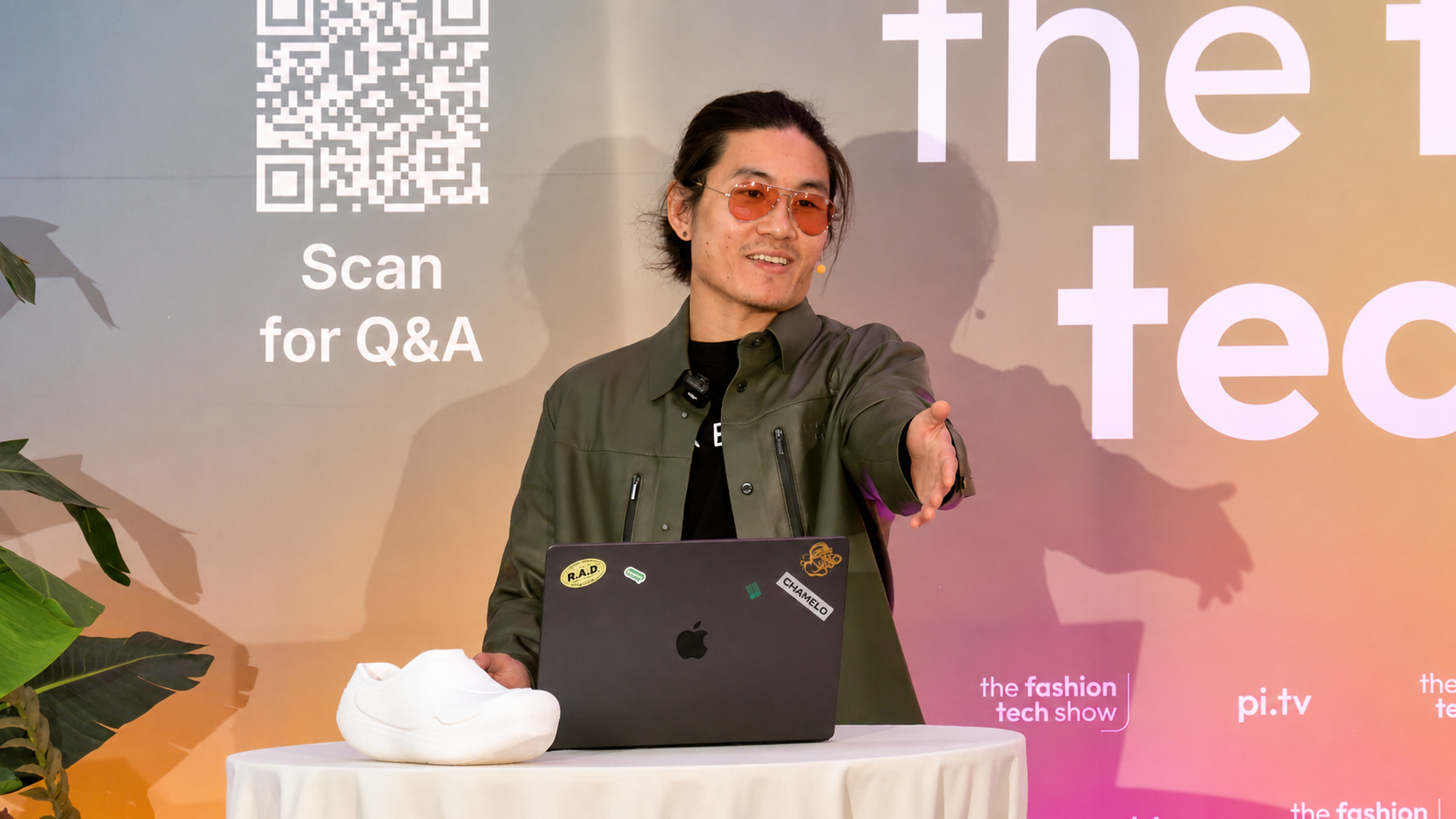
Thomas Belhacene, a partner at 1A Studios whose CV runs through Bugatti, Nike innovation and Google X, has watched plenty of projects get funded and plenty die. The first test the survivors passed was the bluntest: does the idea deserve to exist, with a real need and a real customer behind it? Sometimes, he admitted, that's hard to face. Timing came next: is it worth making now? Good ideas die when they launch too early, and great companies will sit on an innovation for years until the market is ready for it.
The test he thinks teams skip most is purpose: does this idea fit what the company is actually for? When designing and prototyping a product costs this little, it’s the easiest one to ignore.
2. Where should it be made?
Local production was the topic LA came back to most. And whilst many brands still picture reshoring as moving the existing model closer to home, almost every speaker started by dismissing that idea.
Many people try to onshore and bring a [China-made] product to the US hoping to get close to the prices of China. That has never worked and it will never work.
— Alexander Zar, Lalaland Production and Design
Zar has run a footwear factory in Los Angeles for 30 years. The US imports around 2.3 billion pairs of shoes a year, he said, and nobody is going to rebuild the infrastructure to make a real share of them the old way. Luxury can work locally now, with fewer pattern pieces and materials that carry the design. Anything at volume needs different methods altogether: knitted uppers, 3D printing, and factories that run around the clock with very little labour.
Four things have long kept production from coming home: labour, water, materials and people. Two of them now have working answers.
For labour, CreateMe replaces sewing lines with robots that bond garments with adhesive instead of thread. Founder and CEO Campbell Myers quoted minimums of 100 units, turnaround of 7 to 21 days, and a T-shirt at roughly $7 to $10 today, falling to about $5 by 2028.
For water, WTRLSS has developed a dye process that colours cotton through a digital printer in a single step, with almost no water. CEO Dustin White and Design Director Marina Leight described brands keeping one undyed fabric in stock and dyeing it to order, down to a single piece.

The other two are harder. Keith Hoover, President of Black Swan Textiles, pointed out that the US is the world’s third-largest cotton grower and exports most of its crop, and that spinners, mills and dye houses are thin on the ground. Jen Guarino, President of ISAIC in Detroit, added that none of it scales if young people don’t want the jobs, which is why ISAIC trains operators across several skills and brings local kids in to make their own denim.
3. Can the business keep up?
Even when production can move fast, the business around it often can't. Hoover saw that first-hand during his Under Armour days. His team's Lighthouse project used local, digitally driven manufacturing to cut the calendar from 18 months to six weeks, and got product into the company's Baltimore store. But it wasn't adopted, because buyers had no open-to-buy money for anything that arrived that quickly.
It's not the technology. It's the process.
— Keith Hoover, Black Swan Textiles
The calendar is the obvious culprit, and it's expensive. Planning a season 18 months out means guessing, and guessing wrong in both directions. Caitrin Watson, an independent advisor who spent three years on sustainable product development at Shein, put a number on it: in traditional retail, 60% sell-through counts as good, which builds 40% waste into the plan from day one. Her alternative, and Hoover's, is small batches made on demand: test, then scale only what sells.
So why don’t more businesses make that switch? Kaveen Ratnaweera, who leads integration and transformation for bodywear at MAS Holdings, sees the same pattern from the supplier’s side. Some of MAS’s biggest gains with brand partners, like placing their teams right next to the sample room or trusting MAS’s technical designers to sign off fit, only worked once those brands changed how they planned their calendars. Hoover's Lighthouse project had the same problem: the capability was ready long before the organisation was.
Part of the reason is ownership. Amanda Hodor, formerly VP of Product and Production at Active Apparel Group, has worked with more than 30 brands, and the failure she sees most often is that nobody owns a single critical path from kickoff to delivery, which leaves no one with the authority to change it. Leila Kerze, Director of Design and Production at R0AM, agreed that everyone should have input, but argued that one person needs the final say, or the product ends up designed by committee.

4. Does it fit?
More than half of returns come down to fit, according to Rust Coast CEO Kyle Valade, and most efforts to fix it focus on the shopper: better size advice, better visualisation. Even Guo, fresh from showing his AI-designed shoe, admitted he orders two sizes and sends one back. LA kept pointing further back, to the factory floor.
Valade's point is that much of the problem is built in before anything ships. Measuring a pair of trousers properly can take a trained quality team 20 minutes, so in practice only the waist and inseam get checked, on a small sample. Waistband tolerances can run to half an inch or more either way, which means two pairs labelled 34/32 can be more than an inch apart and both pass. Rust Coast uses cameras on the factory floor to measure every garment in around 30 seconds, so a fit return can be traced back to the batch and the step that caused it.
The other answer is to make for the person. Christopher Calo, giving his personal view, sees 3D printing's real value in footwear as shoes shaped to an individual's foot and weight, rather than to a last that matches nobody in particular. Myers said CreateMe can already make half sizes, and eventually custom sizes, without changing any tooling.
New York called fit the problem nobody's AI plan is solving. LA showed why: no front-end technology can fix trousers that left the factory an inch out and still passed inspection.
5. Why would anyone buy it?
Fashion has spent years marketing sustainability with numbers: emissions cut, waste diverted, percentages of recycled content. Alan Lugo thinks most of that is aimed at the wrong audience.
Lugo spent 13 years at Wolverine Worldwide, much of it on Merrell, and now advises brands on product sustainability. Those figures are how a corporation holds itself to account, he said, but they count for almost nothing at the till. His example was a lotion bottle: dermatologist tested, 90% more skin moisture, non-greasy and, at the bottom, "bottle made of 50% recycled plastic". None of it is untrue, and none of it is why anyone buys lotion.
It may no longer be enough that a brand fulfils someone's desire to look good or be part of a fashion trend, if that brand does not make choices that support more meaningful values.
— Alan Lugo, Alanandres
So what does move shoppers? LA offered three answers: what touches their body, how well it performs, and what it's worth later.
On the body, Lugo pointed to growing public awareness of what's in everyday products, from BPA in sports bras to microplastics, and expects clothing to face the scrutiny that food and personal care already do.
On performance, Zoe Abel, Founder and CEO of Natra, built her plant-based lace after worrying about the petroleum-based materials in her own underwear. She was frank that sustainability alone rarely gets a product adopted, and used the paper straw that goes limp in two minutes as her warning. So Natra leads with performance: comparable to polyester, three times more breathable, still holding up after 20 washes.
On value, Nicole Shah, CMO of Maxuria, said about half of luxury shoppers now weigh up resale value when they buy. Resale is growing in her corner of the market because it pays.

6. Would you trust it?
New materials, machines and processes don't get adopted because they're exciting. They get adopted when someone can prove they work, and that usually takes longer than anyone expects.
Bear with us for a short detour to Mars. NASA's Jet Propulsion Laboratory team, including Deputy Chief Technologist Douglas Hofmann and Robotics Engineer Kalind Carpenter, talked about 3D printing. JPL has been printing metal since around 2009, but getting printed parts trusted enough to fly took years, millions of dollars and a formal standard. Twelve of them are now on the Perseverance rover, and Hofmann still gets asked whether a printed part will explode in space.
We can qualify anything that needs to be qualified to be able to be used in space.
— Douglas Hofmann, NASA JPL
The parallel with fashion is closer than it looks. Hofmann pointed out that the aluminium alloy everyone uses isn't the best one available, just the one you can buy in volume. Natra, WTRLSS and CreateMe are up against the same thing: the incumbent wins on availability until someone does the slow, expensive work of proving the alternative.
That work is already happening, whether it's proving a new method works or proving a product is what it claims to be. Rust Coast spends much of its time checking machine measurements against a set of images it knows were measured correctly. At Maxuria, every bag goes through an AI check, then human authenticators, then two more AI checks on different systems, because some tools are better with certain bags and years than others. Shah said that stack is what lets the company offer three times the customer's money back if anything turns out to be fake.
7. How do you keep learning?
Most companies still treat change as a project with a start and an end. Safir Bellali has run one: he opened the closing keynote panel by recalling the digital transformation he led at VF Corporation a decade ago. Now teaching at USC’s Iovine and Young Academy and running his own design and innovation programme, Aliph, he argues that technology moves too fast for one transformation after another. What a company needs instead is the ability to keep learning on its own.
That depends on people sharing what they know, which doesn’t come naturally. Jae Min, who teaches at ArtCenter College of Design after years as Chief Designer at Audi, VW and Porsche USA and VP of Advanced Innovation at Samsung, came from a car industry that calls its market a battleground and guards knowledge to match (you don’t want the German police at your door at 2am, he joked). Teaching and hiring changed his mind, once he accepted that the person he trained might become his replacement, or his boss.
Once you realise how that’s going to make your job easier and make your creative environment sustainable, you come to terms with it.
— Jae Min, ArtCenter College of Design
Small teams already work this way because they have no choice, as Belhacene pointed out: everyone has to know what everyone else knows. Bigger organisations have to build the habit. Bellali opens each of his classes with a weekly signal from the students: one recent development that could change how products get made, with anything useful going straight into the workflow. Nova Lorraine, Founder and CEO of House of Nova, suggests testing every new tool on one simple product, such as a T-shirt, before rolling it out. And Kristine Bowne, who ran industry partnerships at ArtCenter for two decades, said mentoring has to run both ways, since newer staff often bring technical skills their seniors lack.
Bellali ended the panel by pointing out that knowledge is the one thing that doesn’t shrink when you give it away.
Yes, tools can make a product faster and cheaper to create, but none can tell you whether to make it, where to make it, or whether the business around it is ready to use it. Those decisions still sit with people, and most organisations are still making them the way they always have.
So before your next pilot, platform or factory visit, try a simple test. Take one product from your current line and ask the seven questions of it, and of the team that made it. If you can’t answer most of them with confidence, no new tool is going to fix that. That part is still up to you.
The Fashion Tech Show LA will return in 2027. Register your interest here.