


This year's 3D Retail Coalition Grand Challenge was less about technology than about people. It asked how the industry builds the skills, roles, workflows and learning systems that let people work well with 3D, AI and digital product systems at scale.
One team proposed teaching designers to audit AI and 3D output before it reaches a sample room. The other proposed capturing the reasoning of master patternmakers before it retires with them. Both won the same challenge, in the Academic and Start-up categories respectively.
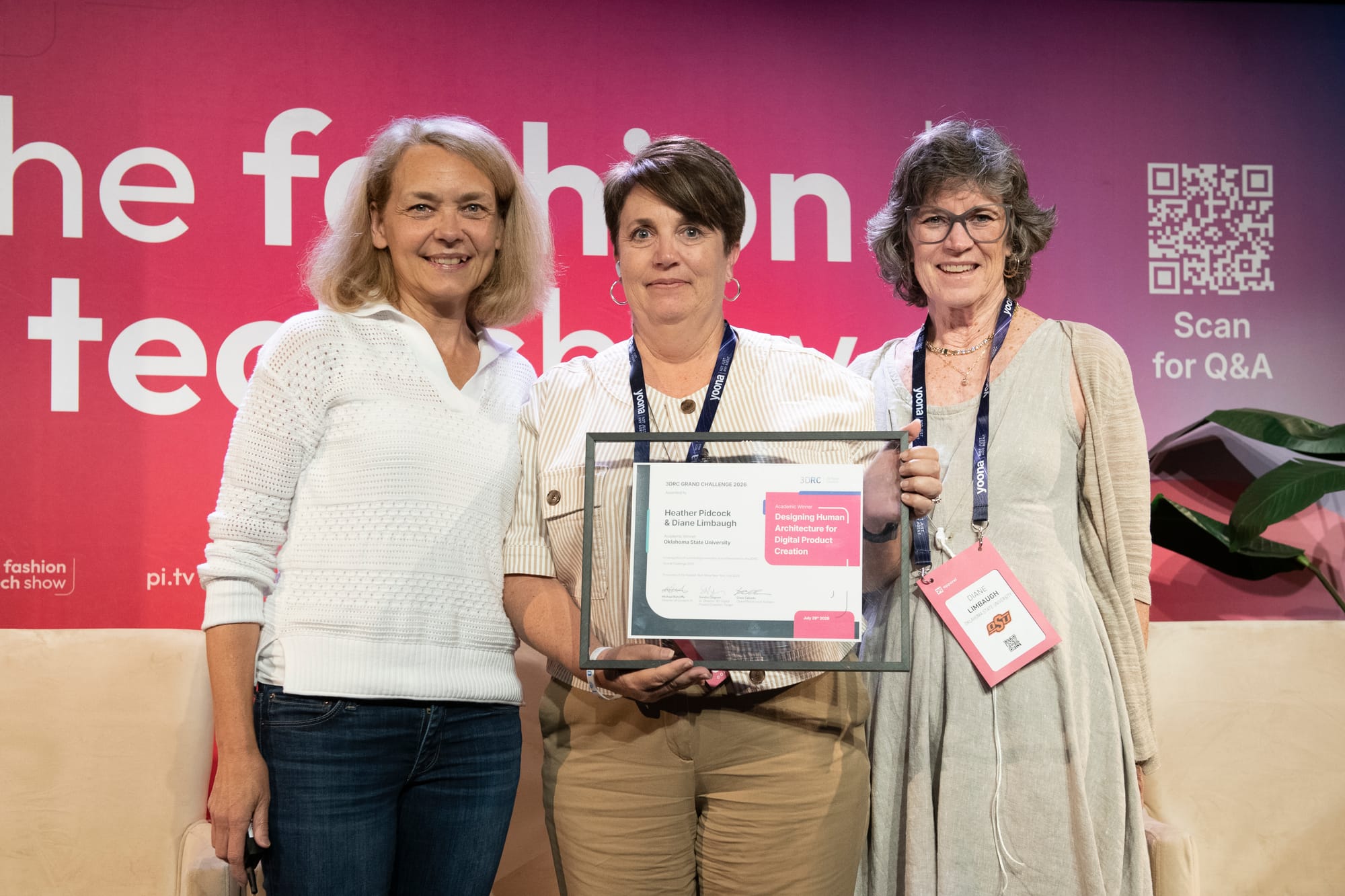
Oklahoma State University and fashionINSTA recently presented their work live to the PI community. Here's what they shared, with the full recording at the end.
Jump to: Oklahoma State University · fashionINSTA · Watch the video
Oklahoma State University (Academic Winner)
Teaching Designers to Audit AI & 3D
Presented by Graduate Researcher Heather Pidcock & Professor Diane Limbaugh
Where it started
Diane Limbaugh describes her class as one built to "pivot when the industry pivots." Several years ago, after PI Apparel New York put digital product creation top of the agenda, she built a 3D DPC certificate, now also offered online to industry professionals. When last year's conversation turned to AI, she and her graduate student Heather Pidcock found the real gap wasn't software. Students could sketch a garment but struggled to put the construction behind it into words: the closure, the seams, the fit, the fabric. Without those details, AI and 3D tools fill the gaps with their own guesses.
Pidcock saw it first-hand while building an AI fashion show from students' sketches. "AI gave me what it thought it should be," she said. "How do you fix that? What do you do with that?" That question shaped a set of drop-in modules on using AI in design courses, and when the Grand Challenge came along, Limbaugh said, "Heather took it and ran with it."
Auditing, not operating
The proposal is a 16-week certificate programme for students and industry professionals. Rather than teaching any one platform, it teaches what OSU calls Critical Auditing: the critical thinking, technical literacy and decision-making needed to judge AI- and 3D-generated designs, and to catch failures before anything goes to physical sampling. It builds hybrid skills that combine physical and digital know-how without weakening either. The question behind every one is whether the output is genuinely manufacturable, or whether it just looks plausible.
After feedback from the judges in Round 1, the team turned that idea into a five-stage workflow: AI generation, construction review, 3D validation, feasibility decision and, finally, an approved digital asset. Each stage is a set of questions for the learner. Is it technically accurate? Can you take an image and deconstruct it into the parts you'd need? Pidcock's test is simple: if you can do it in the physical, you should be able to do it in the digital.
Crucially, learners aren't simply handed a checklist. "We're actually having them add to their checklist," Pidcock said, "so they are forming their checklist for whatever project they're working on."
She also made a wider point about the industry. Unlike many professions, fashion has never really had to do continuing education. With technology moving this fast, she believes that has to change.
Built for brands as well as students
The programme can run as the full 16 weeks or as targeted modules. When it's delivered for a brand, a senior "corporate auditor" from the company joins at around week eight, once learners have the foundations, to bring in brand-specific standards and requirements.
OSU already runs its own learning management system for the 3D certificate, so onboarding needs nothing new. The framework is also deliberately platform-agnostic. Whether a team uses CLO, Browzwear, Gerber or anything else "doesn't make any difference," Pidcock said. It doesn't change the steps inside the software. It adds human validation on top of them.
A habit that starts in freshman year
Limbaugh explained how the team plans to build that habit across the whole degree. Freshmen will start creating their own checklists during two semesters of construction, measuring garments against specs as they go. The draping course already hands out a checklist: did you balance your seams, is your bust point in the right place?
The reason is something she sees every year. Once students move onto avatars, "that thought process goes out the window, because they assume whatever they see on the screen is correct and that it would fit and that it would hang right." When a fit fails, she takes them back to first principles. Is the avatar the right size? What does the fit map show? Is it the right fabric?
That last question comes up a lot. Pidcock said students still need reminding to use a fabric that's relevant to their project rather than the software default, which causes problems later in production. The aim, Limbaugh said, is that by graduation the checklist is embedded in their brain.
What comes next
The team is candid about where the work stands. There are no industry benchmarks yet, because this began as a proposal, not a pilot. They expect better decision-making, less rework, faster development cycles and more confidence in AI, but the next step is a pilot study to gather the data that proves it.
That's where they want industry involved. Some students on the 3D certificate have already offered to contribute, but the team is looking for brands willing to review the modules, flag what they're seeing that academia isn't, and help keep the teaching aligned with what the industry needs. Brand-specific information would be protected. "If we had brands that would say, yes, we'll come alongside of you so that we can get this figured out and moving forward, we would be really excited about it," Limbaugh said.
The same thinking shaped their advice for companies. Pairing newcomers with a senior colleague matters, the team said, because brand-specific experience is something academia simply can’t teach.
On students who object to AI, Limbaugh's answer was about how it's used. Too many students ask AI to write their papers. OSU teaches them to start with an idea or a sketch of their own and use AI to refine or iterate on it, not to generate the work. On the environmental question, she said it's too early to know how AI's footprint will compare with the garments that end up in landfill.
Asked for the biggest risk to the project, the team pointed to the pace of change itself. The skill that matters most today may not be the one that matters tomorrow, so the framework has to keep pivoting. The goal is a workflow that holds whether the work is done by hand, in 3D or with AI.
Reach out to Heather and Diane to find out more.
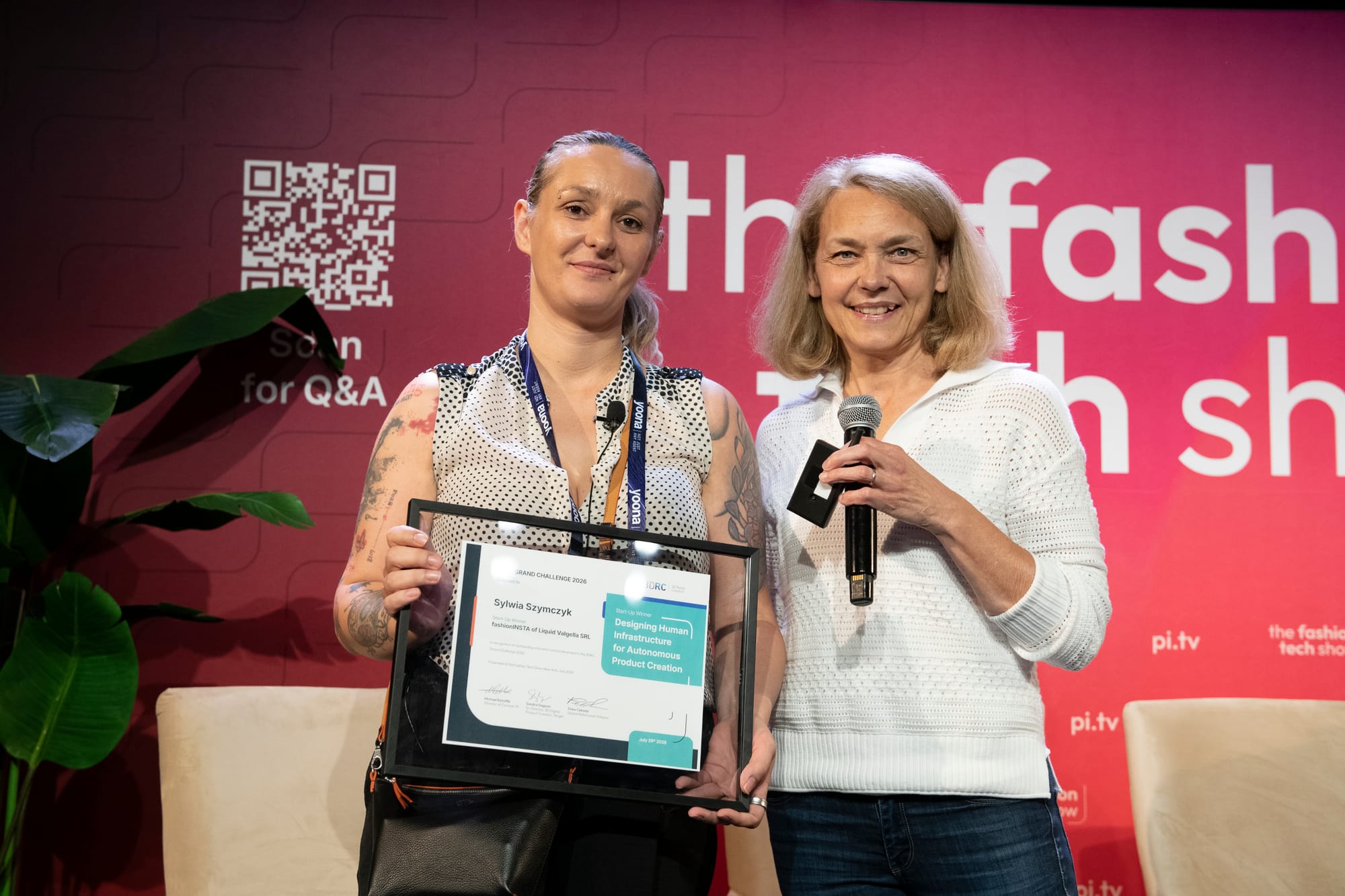
fashionINSTA (Start-up Winner)
Preserving Patternmaking Expertise With AI
Presented by Co-Founder & CEO Sylwia Szymczyk
The bill for outsourcing
Sylwia Szymczyk's starting point is lost expertise. For 30 years, brands outsourced product development overseas, sometimes the entire process, because they thought it would cost less. "What we actually got is the bill that we are paying today," she said. Wages there have risen, and the knowledge of how to develop a garment and make its patterns went with the work.
Few young people are stepping in to replace it. Most arrive dreaming of creative director roles rather than the harder technical path. Meanwhile, trends now start on social media and customers want to buy immediately. Szymczyk was clear this isn't a case for fast fashion. It's about not spending 12 to 18 months developing a product whose moment has already passed.
The proposal is an AI infrastructure layer that turns a sketch into a manufacturable pattern in minutes, built on each brand's own archive. Alongside the pattern it produces the tech pack and a feasibility score. Rather than replacing patternmakers, it captures how a brand's most experienced people work, the reasoning behind a seam or a curve, and makes it available to everyone who comes after them.
A private model of each brand's method
fashionINSTA starts by parsing a brand's own pattern archive to distil its methods and geometry, so it can regenerate a new neckline or armhole exactly the way that brand would. That data trains a private model for each brand on top of fashionINSTA's base system, which she compared to a LoRA. A designer brings in a sketch, and the system analyses it and generates the matching pattern.
Having spent 15 years inside fashion brands, Szymczyk insists it stays software-agnostic. "We really can't stand any more getting into another closed environment where we are not able to export anything outside of that," she said. "We want interoperability."
Nor is everything AI. She explained that a lot of fashionINSTA runs on conventional code, because AI isn't always the best tool. Pattern geometry is the clearest example. "AI is just approximation," she said. "Geometry has to be generated from code. There is no other way to do it precisely."
One system, four kinds of user
The interface is a chat that sits beside the pattern canvas, 3D preview or sketch. Ask for something longer, add sleeves, or drop in an image of a colour, and the system works on the pattern to get there. How people use it depends on their role.
- Senior patternmakers use it as an assistant. They explain what they want, and it learns from those explanations. "One thing you can do in 100 different ways," Szymczyk said, so over time it learns the right way for that brand and that patternmaker.
- Junior patternmakers and interns learn from the knowledge their senior colleagues have put in. After any operation they can ask, for example, how a raglan was done, and get a step-by-step answer.
- Designers get a new release in November that lets them work directly on their sketch. Erase a pocket, draw a new one, and the system pulls the right pocket from the library, places its markings on the pattern and hands it on to a patternmaker for refinement.
- Product development and tech teams get the pattern, bill of materials, fabric details, nesting and stitch information in one place. With vendor data such as cost per minute of operation, the system can also estimate what the garment will cost to make.
The overproduction nobody talks about
That cost estimate is where Szymczyk thinks the biggest waste is hiding. The industry talks about overproduction after launch: make 1,000 pieces of a style, sell 20 and the other 980 are left over. Far less is said about the overproduction that happens during development.
"How many garments are we dropping during the product development?" she asked. Styles often get close to the end of an expensive process before being dropped because they no longer fit the story marketing wants to tell, or because they can't hit the margin. fashionINSTA aims to surface those problems before development starts.
AI-generated design makes this more pressing. It lets designers explore far more ideas, which she welcomes, "but then who is going to check on all of those images and decide what has to be developed?" In fashionINSTA, the system flags straight away which images are technically impossible or too complex to make.
That doesn't mean reining designers in. Asked whether brands should retrain designers to produce fewer unmakeable ideas, Szymczyk pushed back. Patternmakers are every bit as creative as designers, she said, just in a different way. Iterating with AI is fun, even if "it costs a lot of tokens to the companies," and it has given designers back the creative freedom they'd lost to drawing lines over Illustrator templates.
"They can try impossible things," she said. "And with these impossible things, maybe they will find something that is actually technically feasible but has this story behind it." The best companies, in her view, let designers explore and check the results later, whether through the system or a more technical colleague.
From pilot to production
Today, fashionINSTA works with 23 brands, most of them fashion companies with revenue over $1 billion. Around 90% of those relationships are under NDA.
Engagements start with a 10-week proof of concept. The first four weeks go on cleaning the brand's data, which is rarely tidy. DXF is meant to be an exchange format, Szymczyk said, but "every CAD software is exporting DXF in a different way," every brand builds its tech packs differently, and some don't have up-to-date sketches at all. The brand then spends six weeks testing it on real styles to find its real use cases. Moving to production typically takes around three months more.
Some brands are already there, creating patterns in fashionINSTA and sending them straight to manufacturers for samples and bulk production. JD Sports, one of the few customers she can name, reported that product development dropped from four months to four weeks, with most of the remaining time spent waiting for fabric. Around 80 to 90% of its AI-generated designs are dropped before a human checks them. What's left, she said, is what's genuinely worth developing, and that part is still checked and developed by people.
Making the craft fun again
Szymczyk ended with a story. A champion at one client brand sent her a WhatsApp message about designers who had studied patternmaking at school and hated it. It had been something to pass an exam, not something they wanted to do. After using fashionINSTA, they told her that "making patterns is actually fun."
Watching the geometry change in response to a request turns out to be a good way to learn. Ask for a garment to be longer, and you see exactly which pieces change. That matters in an industry where, she said, some designers now struggle to tell a front piece from a back. "It is really a joy to see how people are starting again to enjoy the craft," she said, "and the math which is behind the well-made garment."
Advice, objections and the hardest problem
Asked for one piece of advice for companies adopting these tools, Szymczyk pointed to a line she'd heard at PI Apparel New York last year: the juniors of today are the seniors of tomorrow. AI may soon be able to do much of a junior's job, but companies that stop hiring and teaching juniors will have no seniors when today's retire. "There is a lot of context that only humans have," she said. "We still need people, and we will need people."
On the environmental objection to AI, she didn't dismiss the cost. Computing takes real resources, "there is nothing to say against that." But she asked how many resources go into producing garments nobody wears, and samples that are stitched only to be thrown away. Europe is already banning the destruction of unsold clothing, and unsold stock is a cost while it sits in a warehouse. She called for industry research into where AI genuinely earns its footprint, and where it's simply doing too much.
The biggest risk to fashionINSTA, she said, is also its moat: edge cases. A simple instruction like "make it longer" means something different for every garment. A four-piece shirt needs every piece lengthened. A circle skirt just needs a longer radius. Multiply that across every operation and there are countless edge cases. Building them is the hard part, and it's why fashionINSTA isn't yet available to small and medium-sized brands.
Reach out to Sylwia to find out more.
The tools can now render, generate and pattern almost anything. What they can't supply is the knowledge to tell whether the result will sew, fit and sell, and that knowledge is becoming the skill that matters most. Whether it's taught from freshman year or captured from a retiring master patternmaker, it has to come from people.
Session host, Sandra Gagnon of the 3DRC and Target, picked up on one unexpected result. Tools built to speed up product creation may also be sending people back to foundations the industry let slip under deadline pressure, from checking whether a seam balances to understanding why a pattern piece changes shape. AI, she suggested, may be cross-training us back to skills we once had.
The 3DRC is free to join, and its next (free and virtual) session, in early November, will share work from its innovation, education and technical fit subcommittees.


