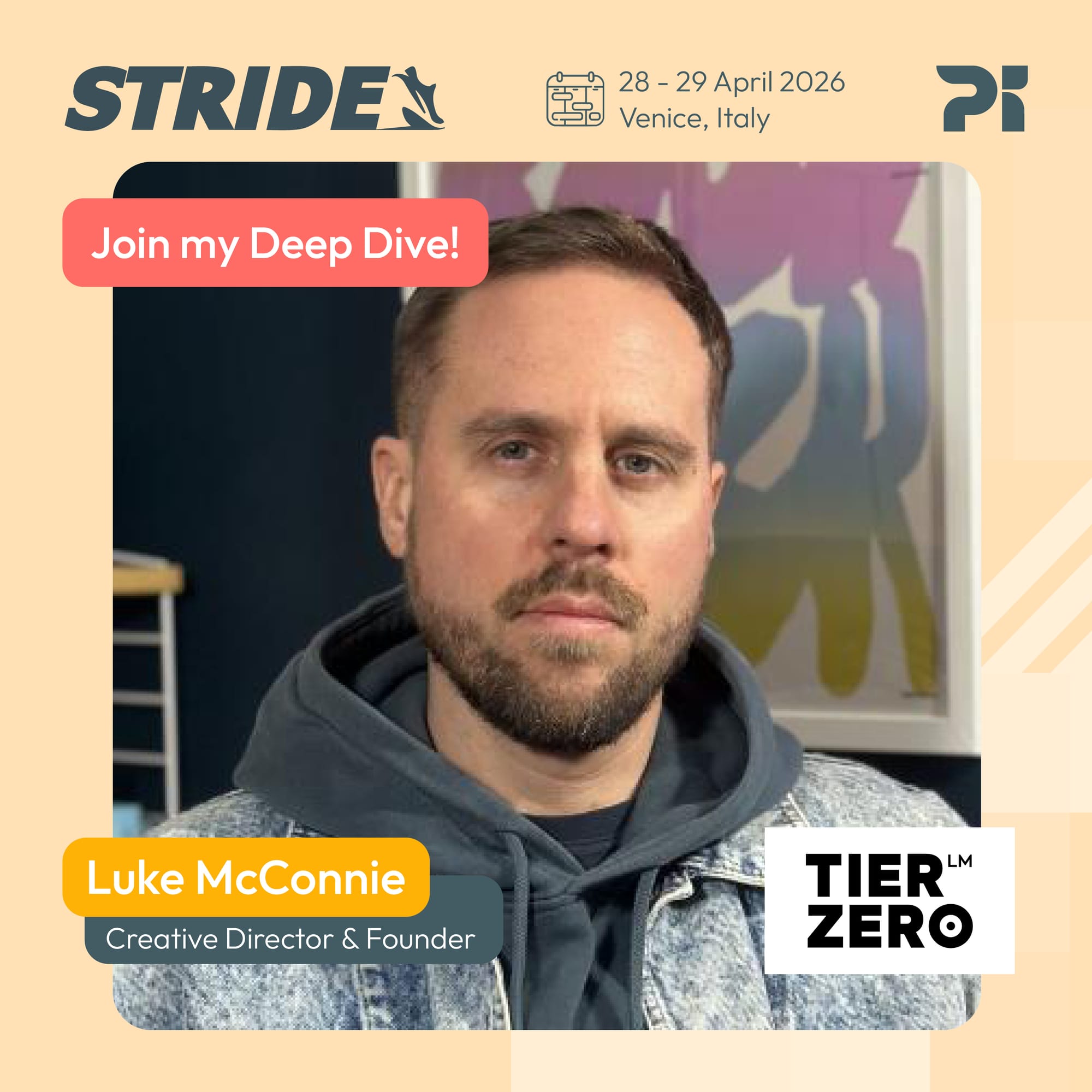


Speakers’ Corner gives you a preview of the voices you’ll hear at upcoming PI events, straight from the people shaping fashion and footwear.
In this edition, Luke McConnie, Creative Director and Founder of Tier Zero, shares his perspective on what it really takes to think creatively in a digital-first world. From building the story and context around an idea before anyone's touched a physical product, to why curiosity beats hierarchy every time, and what an Iranian filmmaker taught him about the value of play.
What excites you most about the intersection of craft and technology right now?
The speed at which I can turn an idea or vision into something tangible is incredible, but more than that, it’s the accuracy. Then there's the ability to build context around an idea, by defining the world it exists in: the story, the setting, the attitude, the reason it matters. What’s exciting is that the result doesn't just exist as a product, but lives in someone's imagination before they've even touched it.
What does great collaboration between design, development, and manufacturing look like to you?
It looks like ego being parked at the door. The best work happens when design, development, and manufacturing stop protecting their territory and start building something together. Curiosity beats hierarchy every time. If everyone’s aligned on the outcome, the process becomes a shared challenge rather than a series of handovers.
What’s one misconception people have about digital design or 3D workflows?
That it’s expensive or inaccessible. For me, tools like Gravity Sketch and Blender were real enablers, but success didn’t happen overnight, it was the hours of figuring them out when no one was asking me to. The real investment was time and persistence, not money.
What’s one lesson you wish you’d learned earlier in your career?
That you don’t need to be the loudest voice in the room. As an introvert, that took time to accept. Confidence isn’t something you fake, it’s built through experience, through seeing how things really work, and knowing when to back yourself and call things out when something doesn’t feel right.
Favourite shoe of all time - and why?
My favourite shoe happens to be turning 30 this year: the Nike Footscape OG. It aligns perfectly with my design sensibilities, distinctive and a little unconventional, yet versatile and easy to wear with anything. The asymmetric lacing felt progressive at the time, but the overall execution remains simple and timeless. Every element on the shoe has its place; nothing feels over-engineered.
Do you think AI will replace or empower footwear designers?
I don’t see AI replacing designers outright, but it will reshape what being a designer looks like. The people who learn how to use it thoughtfully will simply operate at a different level of speed and output. And like every technological shift before it, it probably won’t give us more free time, it’ll just raise the bar on what’s expected.
What’s one piece of advice you’d give to a brand trying to modernise its development pipeline?
I think modernisation starts with a willingness to explore new ways of working, even when there’s some risk involved. The bigger risk is doing nothing, standing still while everything else moves forward. Give passionate people the space to experiment, and they’ll help drive meaningful change.
The most inspiring person you’ve worked with recently?
Reza Bird, an Iranian filmmaker and writer. He’s doing some great work in the space of creative direction and is a strong advocate for storytelling. He has a great Substack and often writes daily on LinkedIn. While others are debating about AI, he’s racing ahead exploring on the fringes and boundaries of what it can do. Like a kid opening a box of new toys, his sense of play and curiosity is infectious and genuinely inspiring.
Luke will be joining us at Stride Europe, taking place on 28-29th April in Venice, where he'll be leading a deep dive session on 'Combining AI, xR and Craft Into a Coherent & Modern Design Workflow'.