


Two weeks. That's how quickly, Safir Bellali said, the tools he teaches can be overtaken by a new version of GPT or Claude.
He was speaking at the 2026 shareout of the 3D Retail Coalition (3DRC), where its volunteer subcommittees reported on a year of work on interoperability, skills and fit. For those unfamiliar, the 3DRC brings global brands and retailers together to solve shared problems in digital product creation. In its tenth year, every presentation came back to AI.
So the subcommittees have spent the year building things that won't go out of date in a fortnight. Innovation is developing the industry's first digital fabric standard. Education is giving schools and brands a shared language for digital skills. Technical Fit has mapped the digital fit workflow, showing where AI helps and where it still needs an expert.
Here’s what they shared, what’s coming in 2027, and where they need your help.
Jump to: Innovation · Education · Technical Fit · Watch the Video
I. Innovation is developing the first digital fabric standard
The Innovation subcommittee’s goal hasn’t changed in five years: measure a fabric once, use that data in any 3D software, and have people trust the result. What has changed is the workload. Alongside its usual exploratory work, the subcommittee now runs a second stream that’s developing an ASTM standard for validating digital fabric drape. The exploratory side keeps an eye on what’s next, from digital colour to AI-generated fabric physics, which becomes its focus in 2027.
The standard sits under ASTM D13.67 Digital Fabrics, which Michelle Greenhouse, Senior 3D Artist and Materials Manager at Target and subcommittee chair, described as the first standard in the digital fabric space. The name is broad on purpose, so texture or file-format standards could sit under it later. So far the group has agreed the avatar dimensions and a 50 cm × 50 cm fabric specimen. Small details, Michelle admitted, but every platform needs the same starting point. The group has also 3D printed its first avatars in several materials to see how finish and rigidity change the way fabric falls. She held one up on camera. It comes apart into three pieces, and a number of their brand members have helped develop the prototypes.
The aim is a common method for checking digital drape, comparing accuracy across testing methods and setting digital tolerances, so a fabric can be trusted whether its physics came from a lab test or from AI.
We want to help people have confidence in digital materials, especially with all the different tools out there, and now that AI is penetrating the market.
Esteban Garza, Innovation Subcommittee PM, Kalypso
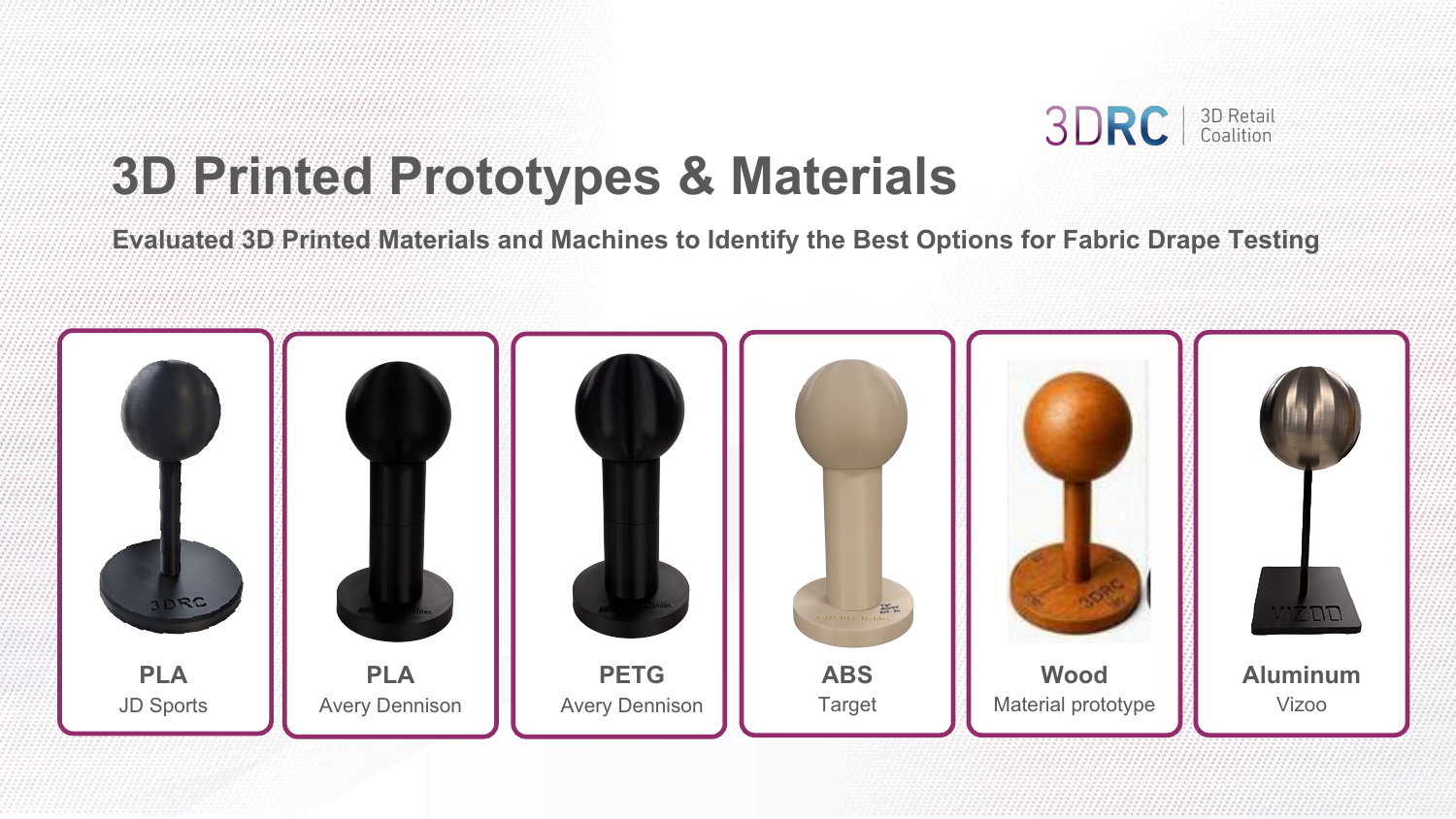
Support is growing. Ralph Lauren, Old Navy, Reitmans and Avery Dennison have been involved for a long time. This year JD Sports, Sam's Club and Nordstrom joined, and more brands have asked to come in.
Asked what will change for brands once the standard is published, Michelle called it “one more piece of the pie.” Suppliers will send a test report with each digital fabric file to show the digital version matches the physical one. When someone in the Q&A asked whether factories had been involved, Michelle explained that brands are already asking suppliers to create and validate digital materials, but every software tool validates them differently today. One shared method would end that.
The measurements are still being worked out, but they will probably include drape volume, the number of nodes draped over the avatar and elongation. A later phase checks whether a fabric that behaves on the avatar also behaves in a garment. Even as tools change, Esteban hopes the standard becomes the foundation, so brands aren’t “starting over from scratch.”
Next comes the lab work. In January 2027 the group is planning to meet at NC State University, with six brands confirmed so far. They'll drape the chosen fabrics over seven avatars in a humidity-controlled lab, start round-robin testing and begin writing the standard itself, with a full draft due by Q4 2027.
We have moved from discussion and planning into tangible progress.
Michelle Greenhouse, Innovation Subcommittee Chair
But the subcommittee needs help to get there. It’s looking for a co-lead, ideally someone curious about AI physics who’d work with Technical Fit on workflows, for about two hours a month. The ASTM stream wants anyone who has written a standard before, especially through ASTM balloting, and more software vendors to review the method. Textile mills and factories are welcome too.
To find out more, visit the Innovation subcommittee page.
II. Education has built three free resources you can start using today
Safir Bellali, who teaches design and innovation at ArtCenter and USC, among other roles, opened with the problem the Education subcommittee exists to solve:
Today, a school and a brand can use the same job title, say 3D designer, and mean two completely different skill sets.
Safir Bellali, Education Subcommittee Co-Chair
The subcommittee’s answer is a shared vocabulary, so education and industry describe digital product creation (DPC) skills and roles in the same words. It works in three streams: Certification & Standards, Technology & Education Partnerships, and Leadership & Upskilling. A core team, mostly from academia, does the work, and a brand council reviews and validates it. With AI reshaping roles faster than job descriptions can keep up, that gap is only getting wider.
This year's biggest output is three resources that are live now:
- The DPC Technology Navigator lists about 74 tools from 65 vendors across six lifecycle phases: plan, create, make, deliver, sell and experience. Seventeen already support OpenUSD, linking it to Innovation’s interoperability work. Filters for phase, file format, price and learning curve let a school find free, easy-to-learn tools and a brand check what fits its systems.
- The Fashion Design Education Directory does the same for schools, listing 281 programmes in 86 countries, 160 of them new this edition. For brands it's a recruiting and partnership map. For the subcommittee, it's the starting list for promoting accreditation, because "you can't raise awareness with institutions you can't name."
- The third is the Weekly Signals Roundup. Each week about 60 of Safir’s students pick out the developments that change what's possible, what gets cheaper or what becomes expected. In 11 weeks they logged 357 signals from 171 sources across 13 topics.
Scheduled routines keep all three resources up to date, with new additions reviewed before they go live. Alongside them, a draft footwear software assessment rates each tool 1–10 on control, UI/UX and learning curve, and the subcommittee has begun asking the recommended vendors to better support educators.
The resources help people find their way around the tools and schools. Certification goes after the “3D designer” problem directly, by defining what someone in that role should actually be able to do.
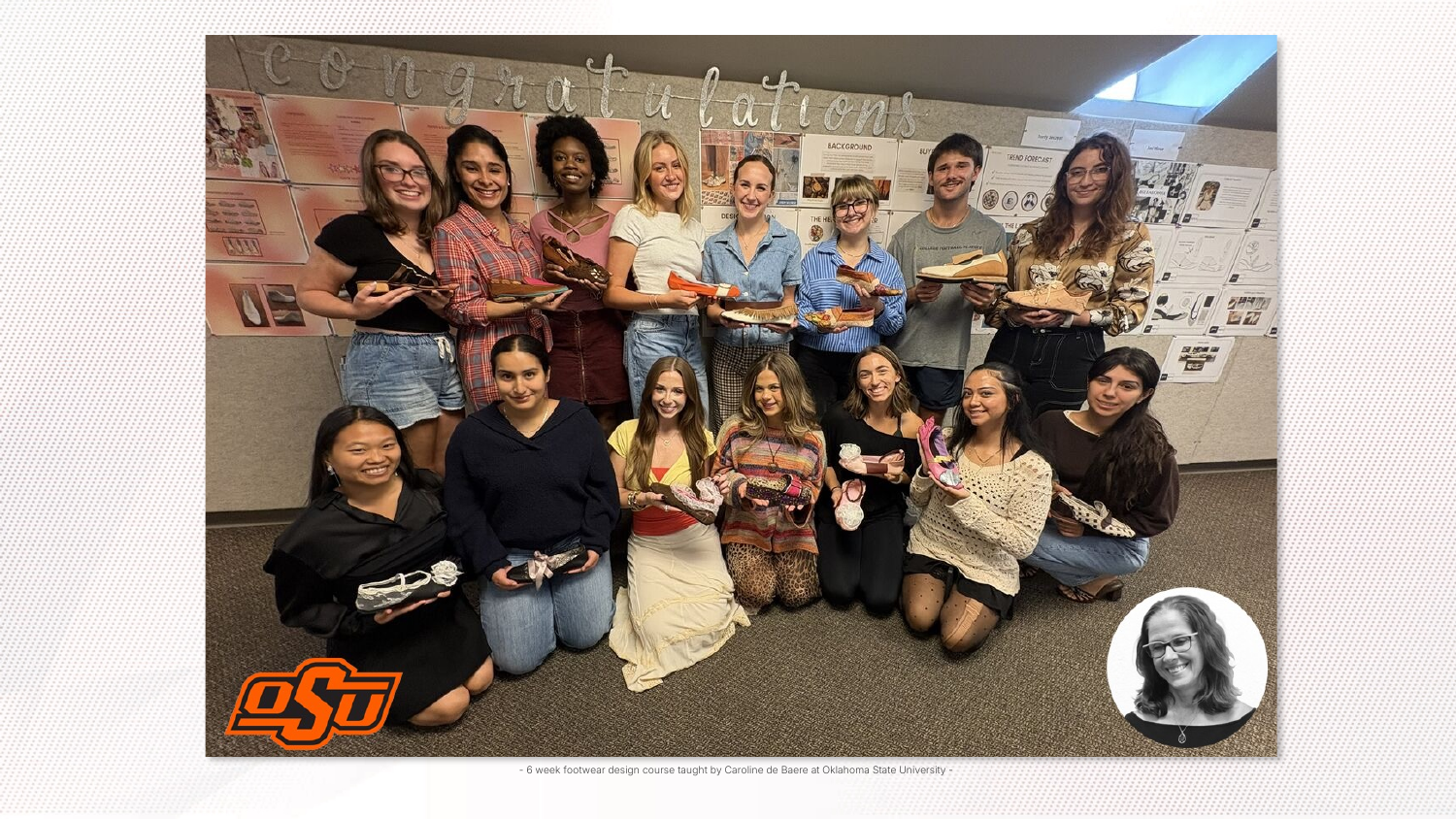
The subcommittee is extending its DPC skill matrices beyond apparel, starting with footwear. Its prototype is a six-week footwear design course taught by Caroline de Baere at Oklahoma State University, hosted by subcommittee co-chair Lynn Boorady, where students designed and made their own shoes. As Safir put it, “it’s much easier to define a standard when you can point to a classroom where it’s already working.”
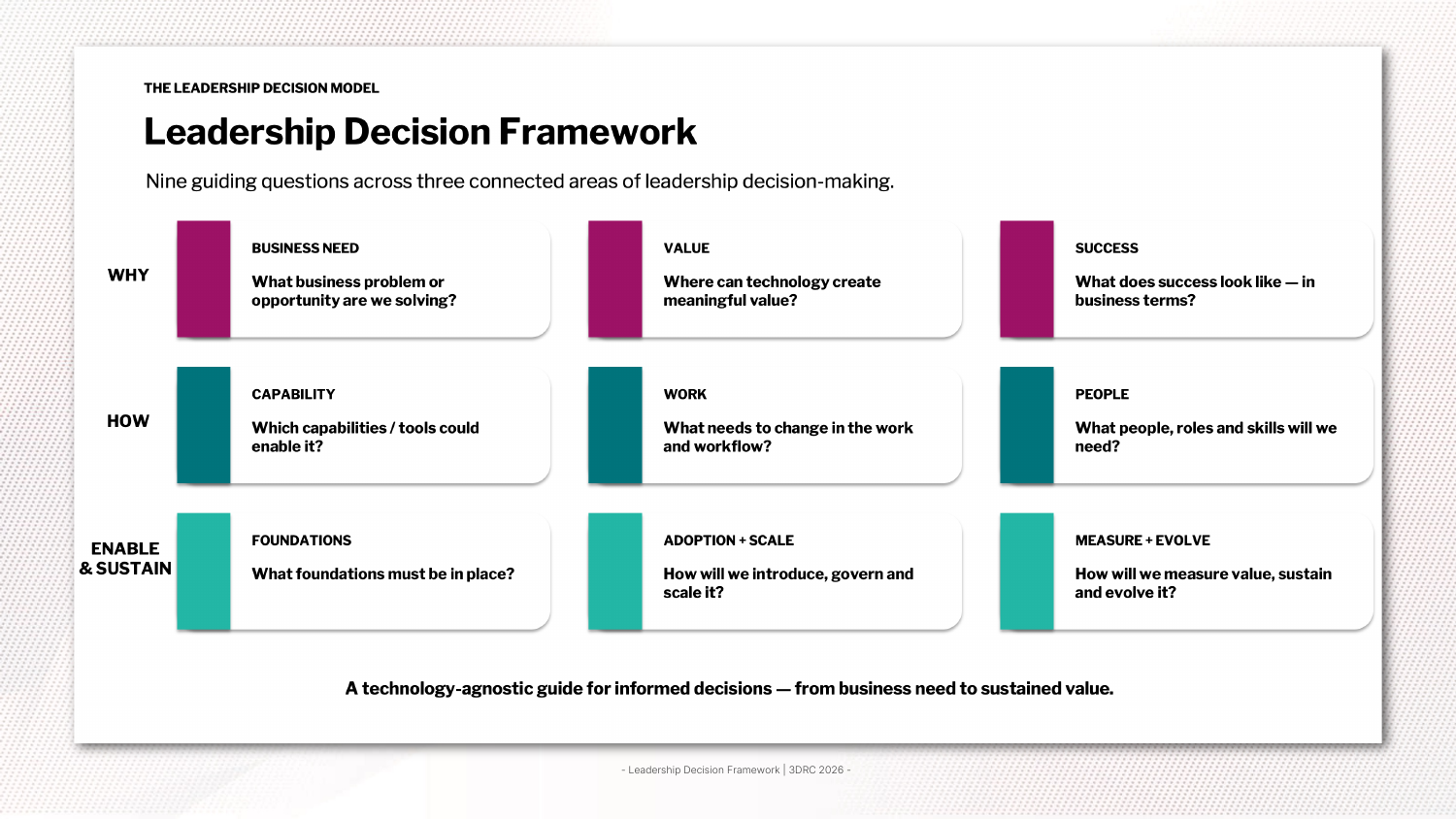
The leadership stream started from one recurring research finding: teams often pick the tool first and look for the problem second. Its Leadership Decision Framework turns that around with nine guiding questions in three areas. Why covers business need, value and success. How covers capabilities, workflows and people. Enable & Sustain covers foundations, adoption, measurement and evolution. It’s a repeatable approach, not a rigid process, and covers AI and emerging technology as well as 3D. Leaders, Safir argued, are too often forgotten in upskilling, despite making the biggest technology calls.
Footwear is the next big step. In 2027 the subcommittee will build a dedicated footwear team and turn lessons from the Oklahoma State course into footwear DPC skill matrices. It will also promote the apparel certification to more schools, finish and validate version 1 of the decision framework, publish an interactive DPC ontology guide, run technology showcase sessions, and share partnership stories on LinkedIn for the roughly 90% of programmes that don’t yet have one. If it all works, the next time a school and a brand say “3D designer”, they’ll mean the same thing.
Without institutional buy-in, a certification is really just a PDF.
Safir Bellali, Education Subcommittee Co-Chair
But it too needs help to get there. It wants academic contributors and professionals for the new footwear team, and universities willing to back accreditation. It’s looking for leaders of 3D or DPC functions to pilot the decision framework on a real decision and report where it breaks. And it’s asking schools and tool providers to review the resources, say what’s missing, and build a partnership worth showcasing next year.
To find out more, visit the Education subcommittee page.
III. Technical Fit has mapped the digital fit workflow for the AI era
We exist at the intersection of the design intent, the garment and the wearer.
That's how Phillip Sidberry, Technical Fit subcommittee chair, described his discipline, one he admits he sees as among the most critical parts of making a garment, if not the most critical. Tech designers manage the fit standards, blocks, measurement specs, grading, construction and fabric properties that make a garment fit and perform the same way in every size.
That role is under pressure. Industry attention is shifting fast towards AI, while trust in 3D digital fit still hasn’t caught up. And though practitioners know their tools save time, leaders want proof, so the subcommittee plans to define KPIs and metrics that show what each tool delivers.
This year, the subcommittee set out to map how the work actually happens, from the traditional apparel development workflow to today's mix of technologies, then on to a future 3D process and a future AI process. Early on, the two futures were easy to discuss separately, and the subcommittee even split into two teams with a workflow each. By the end of the year they conceded that they couldn't.
The convergence had already happened while we were working on the workflows.
Chris Clerkin-Zenz, Technical Fit Subcommittee Co-Chair
What the subcommittee wants is an industry-wide view of how digital fit should work. That means the general workflow, not any brand's proprietary fit, and it matters because brands share vendors. It focused on where platforms such as CLO and Browzwear overlap, where steps can be cut, and how to build trust with cross-functional partners who still doubt virtual fits. Getting there meant settling on shared terminology, and Phillip thanked members for the debates it took to produce a workflow general enough for everyone.
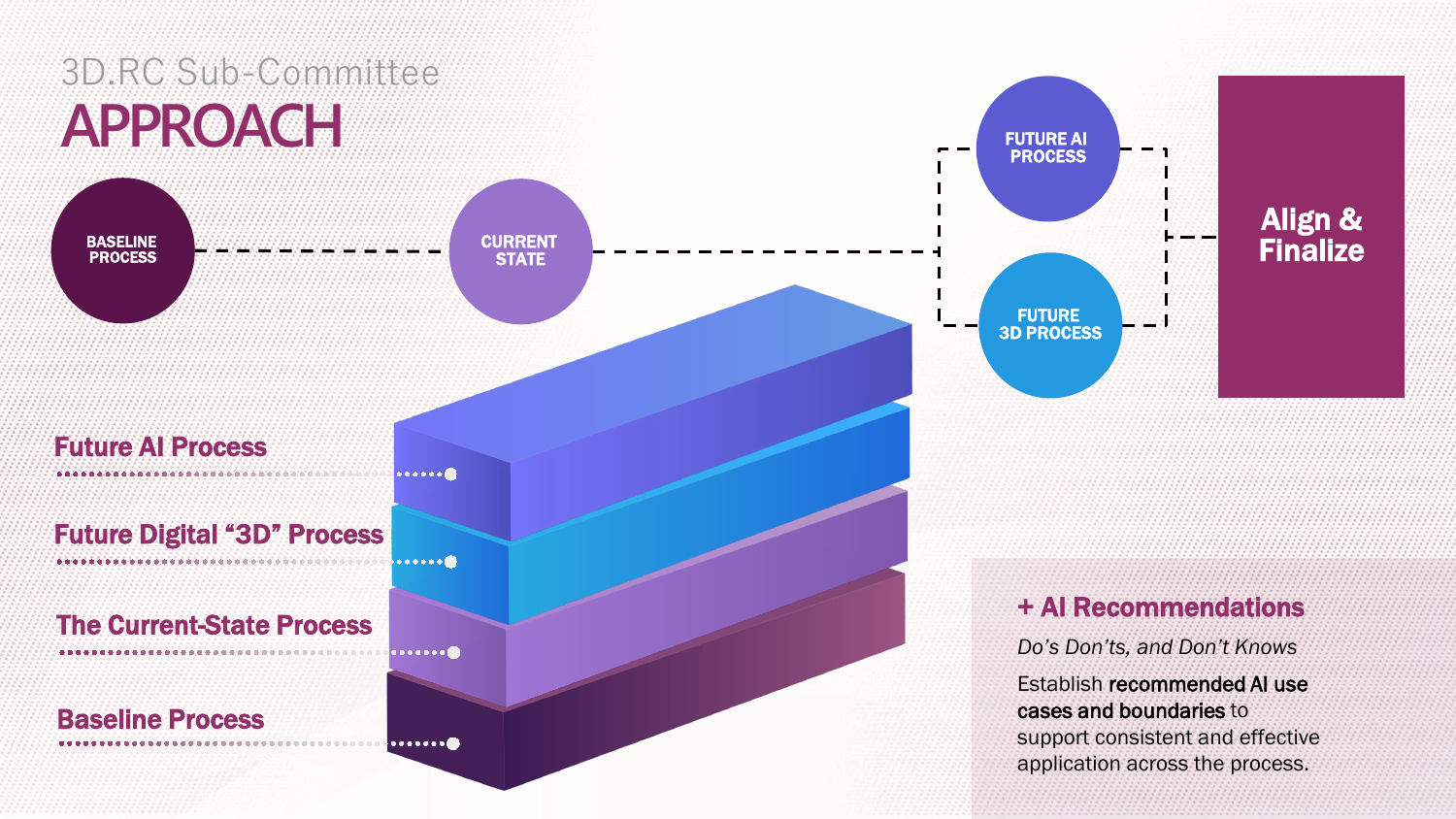
The clearest finding was a boundary. AI caught on quickly in early design because it's fast, visual and easy to learn, but it doesn't build anything. As Phillip put it, "you can get a great visual, but it's not going to actually translate to a pattern or something you can use in production." The build starts with the pattern, which is where 3D takes over, and the tools that would bridge the gap don't fully connect yet. AI can also hallucinate, and its images may show something that can't be manufactured at all. Someone with the expertise to spot that still has to check its work.
3D, meanwhile, lets teams decide earlier and redo less. In technical fit that means reviewing prototypes sooner, pre-evaluating samples and reviewing grading without physical samples in the building. No single tool covers the whole workflow, though, so teams need to know which one helps at which stage, judged on what it can do today. Chris would love automated pattern generation, but she knows it doesn't exist yet.
I can live without AI, but AI cannot live without me.
Chris Clerkin-Zenz, Technical Fit Subcommittee Co-Chair
Next, the subcommittee wants the industry to test its map, and like the others, it needs help to get there. It's asking tech designers and fit experts to take its survey, validate the workflow findings and point out the blind spots. Six new members joined in 2026, and it's always open to more, though it will vet them closely to get the right skills in the room.
To find out more, visit the Technical Fit subcommittee page.
What comes next for the 3DRC
Congratulations to every chair and member across the three subcommittees. Sandra Gagnon, Senior Director of DPC at Target, and one of the 3DRC’s directors, called this year’s work the strongest the group has produced, a fitting start to its second decade.
All of this was done by volunteers, on top of their day jobs, with Kalypso’s project managers keeping the subcommittees on track. And the work is starting to connect: Innovation’s fabric accuracy feeds Technical Fit’s digital fit, which in turn shapes what Education teaches and certifies. Expect more of that in 2027.
The 3DRC itself is changing too. Next year members will see some rebranding and a scope that reaches beyond 3D, and the board has been re-engaging the SteerCo and recruiting new members to support it.
The tools will keep changing every few weeks. Standards, skills and shared ways of working are what last, and they only get built if people show up.
If you’d like to get more closely involved, whether shaping the group’s new direction on the SteerCo or joining the work of one or more subcommittees, get in touch with me directly. The more the merrier.
Watch the full video shareout below.


