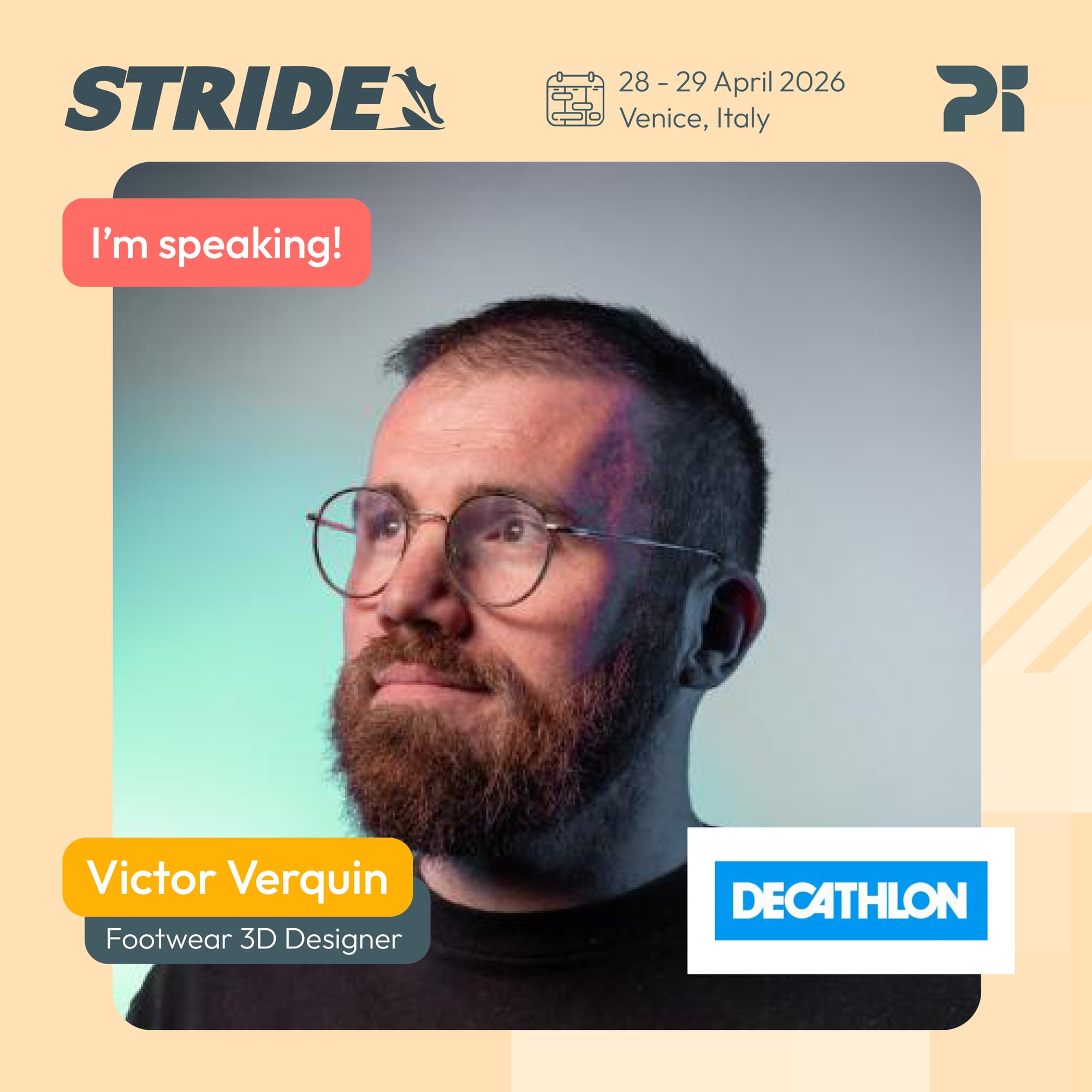


Speakers’ Corner gives you a preview of the voices you’ll hear at upcoming PI events, straight from the people shaping fashion and footwear.
In this edition, Victor Verquin, Footwear 3D Designer at Decathlon, shares his perspective on where digital product creation is heading, and what it keeps getting wrong. From why photorealistic AI renders are producing mediocre shoes, to why the last real bottleneck is getting a 3D mesh into a production mould.
What's the biggest shift you've seen in footwear design or development over the past year?
Thanks to new tools allowing designers to materialise and think in ways beyond their traditional sketch and Illustrator workflow, we are seeing more footwear designed around the foot — with all its complexity — as a whole unit, rather than a plain sole with an upper on top. This gives much more inspiration and room to play with components and new types of structure, which is very refreshing, especially when it's senior designers learning these new ways of working.
What excites you the most about the intersection of craft and technology right now?
With AI renderings, photorealistic renders, and 3D models taking over websites and mood boards, I think we are leaning more toward the counterpart of that. It's about the feeling of components on your feet and how they interact. It's about using experimentation and different assembly methods, more organic and primitive aspects of footwear, and mixing them with new technologies and design methods.
The goal is to create products that aren't just overly beautiful, monolithic, or highly sculptural like the AI-generated renders we see everywhere. It's more about mixing human empathy with high-end components, while respecting the heritage of shoe assembly and fit. I think it's much better to design footwear around the human aspect, rather than just following trends. It feels almost like a pushback against the AI trend.
What's one challenge in digital product creation that still keeps you up at night?
The last real hurdle is how to transfer the master file design vision, with all its complexities, new textures, micro-details, and overall accuracy, into production moulds and patterns. We now have the tools to perfectly materialise the design vision, but getting that into the supply and production chain is still not easy. We are almost there, but there is still a lot of back and forth.
What innovation do you think will define the next five years of footwear?
Knitting programs, 3D printing, and photogrammetry scanning. Combined with a more circular approach to footwear design that is more environmentally respectful and better for the human body.
What's the most underrated capability a footwear design team needs to build today?
Trust. For a design team to be truly efficient, everyone involved needs to trust each other. Everyone shows up wanting to do their best, so establishing that is essential. Beyond that, we need to learn to be slightly irreverent toward established norms; to challenge everything, constantly ask why, and evaluate whether changing things is actually the right move.
If you could wave a magic wand and fix one industry bottleneck, what would it be?
Creating production moulds directly from a 3D mesh. That's it.
What's one misconception people have about digital design or 3D workflows?
Many people think the tools themselves know what to do, that there's some magic software that reads your mind and says, here are the laces, here is the sole exactly as you want it. Just right-click and you're done.
What people don't appreciate is the expert knowledge a 3D designer brings to the process. Software can't just do everything. As a human, you need to know why you're doing something, what is or isn't possible, and how to make the right choices. Ultimately, designing is about making the right choices.
How are sustainability and circularity influencing the way you design or source products?
It's at the core of our thinking. We need to value the circularity of components and the methods used to assemble the shoe. We also have to consider human labour; we must design things that are easy to assemble, to minimise strenuous work. We don't want people to suffer while making our products. We want them to enjoy the process of manufacturing as much as we hope they enjoy wearing them.
What does great collaboration between design, development, and manufacturing look like to you?
It happens when everyone is perfectly aligned on the ultimate goal, wants to do their absolute best to achieve it, and has mutual respect for each other's opinions and proposed changes, all in the service of creating the best possible product.
What's one lesson you wish you'd learned earlier in your career?
That some people simply don't want to change things. You shouldn't invest too much effort before confirming that people are actually open to change. Even if you design the best possible product, stakeholders might not recognise its value or be willing to adopt it. Plenty of projects I've worked on never saw the light of day simply because people preferred sticking to what already existed.
Do you think AI will replace or empower footwear designers?
I don't think AI will replace designers. What worries me is that executive boards and HR departments might not fully value design expertise, making the right decision to integrate AI, but the wrong decision to lay off the exact people best equipped to use it. AI is a tool, not a workforce replacement.
Is the future of product creation more human-led or data-driven?
Creation will always be a deeply human field, so it will naturally remain human-led, driven by empathy and observation. Using the right data is what empowers us to make the right design decisions.
What's currently overhyped in the footwear innovation space?
Generative AI creating photorealistic renders of very mediocre shoes.
What's the best example you've seen of a digital tool actually improving creativity?
Tools that empower traditional designers to intuitively create 3D models. Software like Gravity Sketch VR, Blender, and Substance Painter lets designers build 3D models while keeping the mindset and efficiency of a 2D workflow. Giving more people the ability to master 3D modelling, to spin a product around and design every micro-detail, has led to some genuinely groundbreaking footwear.
What's one piece of advice you'd give to a brand trying to modernise its product pipeline?
Before you attempt to modernise, make sure you have the right people and that your current team actually wants to change how they work. Listen to them. If you lack the skills internally, hire people who can help guide the transition. And do not underestimate how long this takes. Don't put excessive pressure on a team while simultaneously asking them to completely overhaul their workflow.
Favourite shoe of all time and why?
I don't have a single favourite. I cherish every shoe I've created alongside great designers — not because I made them, but because they remind me of the connections and human interactions we shared while making something we were proud of. I keep at least one pair from every designer I've worked with. It's the best reminder of those experiences.
Tool you couldn't live without?
My sketchbooks and a black fineliner. Even as a 3D expert, every ideation process starts from hand to paper. I genuinely believe it's the best starting point for any creative work.
One word that sums up where the footwear industry is heading next year?
Empathic. In an increasingly dehumanised world of industrialisation, I hope people become more empathic in their creations.
The most inspiring project or person you've worked with recently?
The entire Kiprun team. An incredible mix of fantastic senior designers and fresh talent with brilliant ideas. It was a huge challenge to work with them (and the athletes) to design a whole new brand of running shoes for Decathlon. Tough, but we did it, and that first generation is now in stores. I'm incredibly proud of what that design team pulled off.
Finish the sentence. In 2026, great footwear design will be...
...human-centered.
Victor will be joining us at Stride Europe, taking place 28-29th April in Venice, where he'll be sitting on our panel on, 'Digital Reality Check: What’s Worked, What’s Broken & What We've Learned the Hard Way?'.