

The footwear industry has a waste problem it has largely been able to ignore because the data to quantify it has never existed. That changes now.
Published by Fashion for Good and Circle Economy, the Closing the Footwear Loop report maps post-consumer footwear waste in Europe through stakeholder interviews with recyclers, sorters and industry experts, and an on-the-ground pilot where 1,200 individual non-rewearable shoes were analysed across 14 data points each.
Here is everything footwear brands need to know...
📥 Want to read the full report? Download it here.
The Problem at Large
- The scale of the crisis is staggering, but largely invisible.
- 23.8 billion pairs of shoes are produced globally every year
- ~90% of disposed footwear ends up in landfill or incineration
- Recycling remains below 1% globally for the combined textiles and footwear stream
- A single running shoe can contain up to 65 distinct parts assembled through more than 360 manufacturing steps
Despite those numbers, the industry has had almost no reliable data on what actually happens to shoes after disposal. Part of the reason is structural. Most post-consumer footwear is exported under the same trade codes as worn clothing, meaning volumes, quality grades and end destinations are impossible to track with any precision. Part of it is complexity. That level of construction makes material recovery both technically challenging and economically unviable under current conditions. And part of it is simply that no one has looked hard enough, at scale, until now.
Bottom line: The footwear industry has been flying blind on its own waste. This report provides the first detailed map of where things actually stand.
- Half of all collected footwear can't be reworn, and that fraction is worse than apparel.
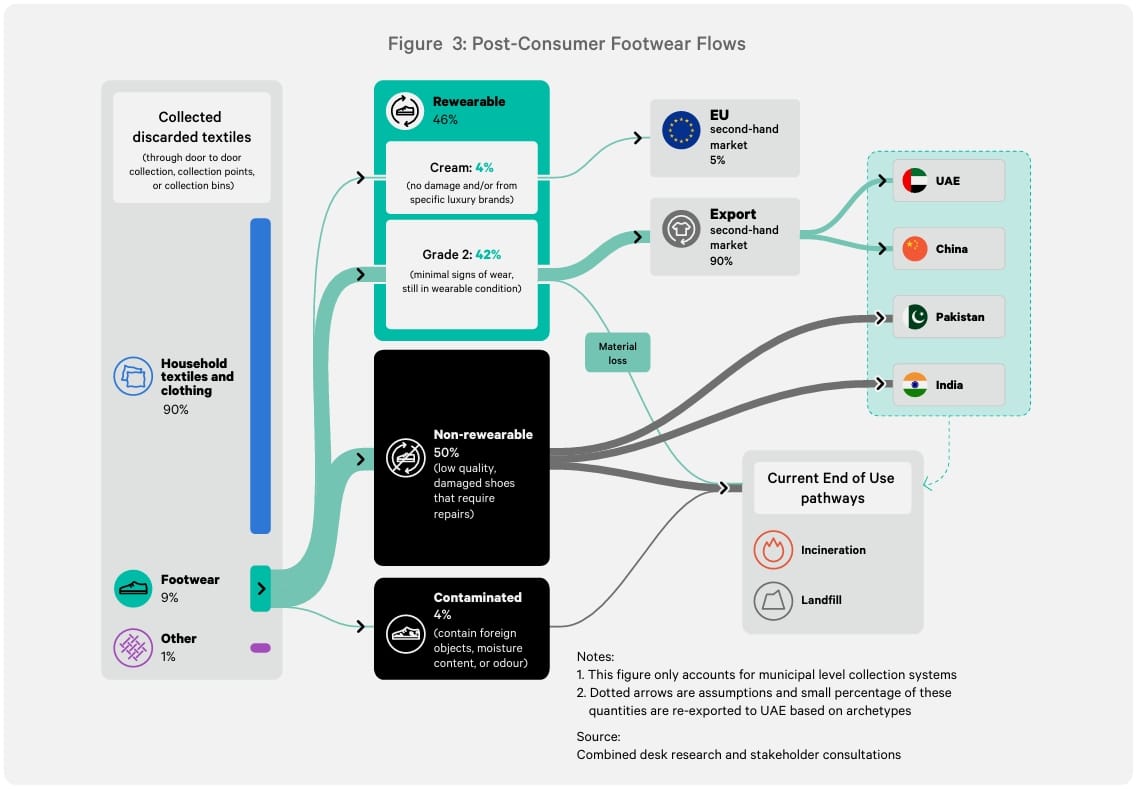
Of the footwear collected through Europe's textile waste streams:
- 50% is classified as non-rewearable: shoes too damaged, too dirty or too incomplete to be resold
- 4% is contaminated by moisture, paint, chemicals or foreign objects, making it problematic even for recycling
- 46% is rewearable, split between 42% Grade 2 (minimal wear, still sellable) and just 4% cream quality (undamaged, resellable within Europe)
For context, in apparel the rewearable fraction is 55%. Footwear lags behind, and unlike apparel, it has almost nowhere to go once it drops out of the reuse stream. Footwear also makes up just 9% of the total collected textile stream by weight, meaning it receives proportionally little infrastructure investment despite the disproportionate complexity of its end-of-life challenge.
Bottom line: The majority of collected footwear has no viable end-of-life pathway today. That is the problem this report is trying to solve.
What the Waste Stream Actually Looks Like
- Most rewearable footwear leaves Europe, and almost none of it is recycled.
Of the rewearable fraction, 90% is exported, primarily to the UAE, China and Pakistan, rather than resold within Europe. Cream quality is the exception, finding a market in European second-hand shops. For non-rewearable and contaminated footwear, the destinations are Pakistan and India, or incineration and landfill.
The informal economy around post-consumer footwear in destination countries like Pakistan is significant and genuinely circular in its own way. Footwear is sorted, paired, graded and resold through established informal markets, and traders and artisans restore shoes that would otherwise become waste. But the burden of imported waste on these countries continues to grow, and European exporters are primarily motivated by avoiding high domestic incineration costs rather than by genuine circular intent. Any shift toward domestic recycling needs to account for the livelihoods that currently depend on this trade. The expertise in these markets deserves recognition, not replacement.
Experts interviewed for this report suggested the real recycling figure is likely lower than even the published 5% EU estimate, and that current collection systems function primarily as waste management rather than circular recovery mechanisms.
Bottom line: Exporting is not a circular strategy. It is a cost management strategy that moves material around and shifts the burden onto countries with less regulatory protection.
- A quarter of "non-rewearable" shoes have no physical damage at all.
This is the finding that should stop brands in their tracks. Of the 1,200 non-rewearable shoes analysed, 24% showed no visible physical damage whatsoever. They were classified as non-rewearable not because they were broken, but because they were single shoes without a pair, styles with no second-hand demand, or items that had simply slipped through a system not designed to keep them in circulation.
The primary causes of non-rewearability in the remaining 76% were aesthetic rather than structural:
- Soiling accounted for 50% of upper damage
- Discolouration accounted for 27%
- Tears or holes accounted for just 16%
The sole told a different story. 74% of shoes showed no sole damage at all.
Bottom line: Cleaning, refurbishment and better disposal habits, specifically encouraging consumers to donate paired shoes, could rescue a significant fraction of what is currently written off.
Why Recycling Is So Hard
- Footwear complexity is the core recycling barrier.
- In apparel, 93% of the non-rewearable fraction is mono-layered
- In footwear, only 10.5% of shoes shared the same material for both midsole and outsole
- 52% of uppers had blended material compositions
- The most common primary sole materials were SBS (16%), EVA (15%) and Rubber/SBR (14%)
- Current recycling approaches can lose up to 50% of post-consumer input during the mechanical process alone
Even seemingly simple shoes combine multiple polymers, foams, textiles, rubbers and adhesives. Performance footwear, designed around biomechanical support and long-term durability, is particularly dense with specialised components. Apparel recycling technology is simply not equipped to handle this level of material complexity.
Bottom line: The barrier to footwear recycling is not a lack of recyclable materials. It is the way those materials are bonded, layered and assembled together.
- Glue is everywhere, and it is one of the biggest obstacles to recycling.
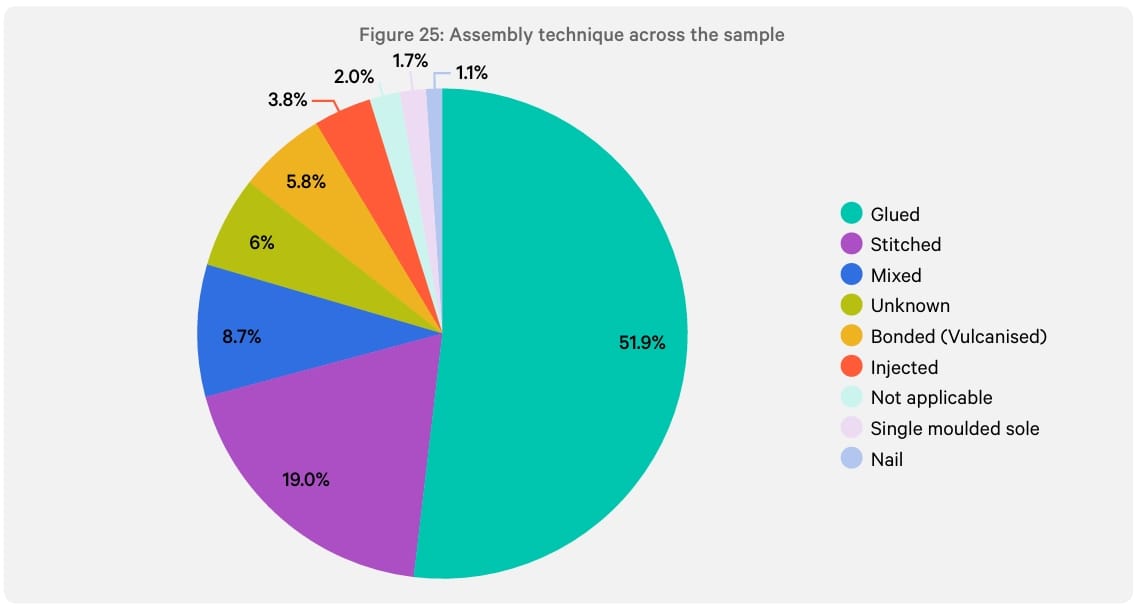
- 51.9% of shoes were assembled using permanent adhesives
- Only 19% were stitched
- Mixed techniques, typically gluing combined with stitching or nails, accounted for 8.7%
- Nearly all performance shoes were glued
That single fact cascades into problems across the entire end-of-life chain. Glued construction prevents the clean separation of materials needed for high-value recycling. Adhesive residues contaminate recovered material streams. The adhesive layer physically obstructs NIR scanners, preventing identification of the material underneath. And adhesives act as a persistent contaminant in chemical recycling processes.
Bottom line: Reversible adhesives and mechanical fasteners are not just a design preference. They are a prerequisite for any realistic recycling pathway.
- Near-Infrared scanning struggles badly with footwear.
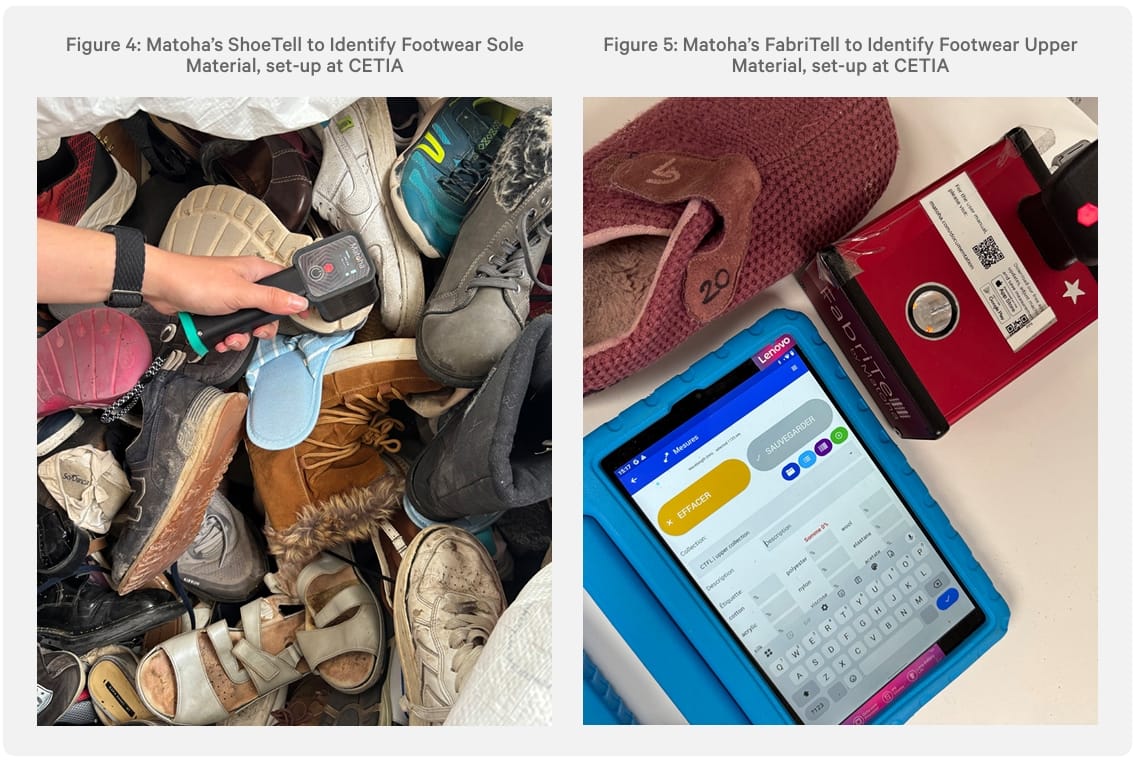
- 37% of sole materials could not be identified at all
- 97% of black soles were classified as "unknown"
- Black soles accounted for 24.6% of the entire sample
- 17% of upper materials also could not be identified
- A complementary PICVISA pilot found up to 50% of post-consumer input can be lost during mechanical recycling
The reason black soles defeat NIR is that carbon black pigments absorb the near-infrared spectrum rather than reflecting it, making polymer identification impossible. Roughly a quarter of all footwear entering any automated sorting system is effectively invisible to the technology currently deployed.
Bottom line: The industry's existing investment in sorting infrastructure does not transfer cleanly to footwear. Technology built specifically for footwear, not adapted from apparel or plastics, is needed.
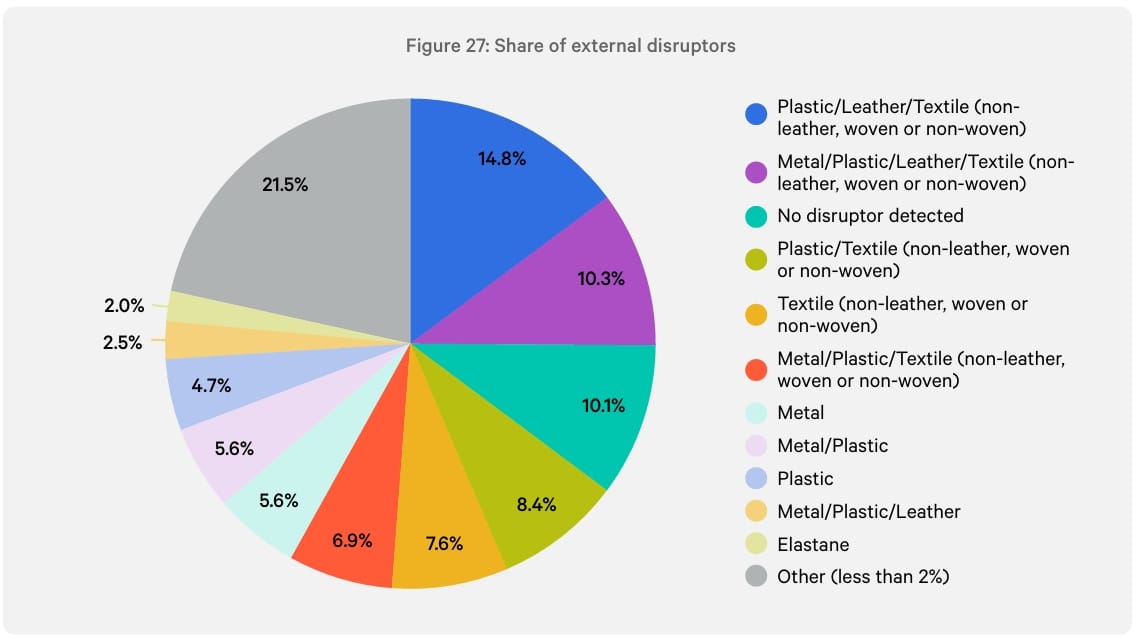
- Disruptors are almost universal, and harder to handle than in apparel.
- 89.9% of shoes contained at least one external disruptor (logos, patches, trims)
- Those external disruptors spanned 37 unique material combinations
- 21.8% had internal disruptors: hidden metal or plastic components detectable only via X-ray
- Internal disruptors were most common in boots (50% metal) and performance shoes (25% plastic)
In apparel, disruptors like zips and buttons are common but usually easy to remove. In footwear, internal disruptors are load-bearing and biomechanically necessary. They are structural reinforcements designed in for functional reasons, which makes them far harder to design out than a sewn-on badge.
Bottom line: Brands need to audit not just what their shoes are made of, but what is hidden inside them, and ask whether those components can be made detachable without compromising performance.
Where Opportunity Exists
- The sole is the best near-term recycling opportunity, but identification must come first.
The sole consistently emerges as the most promising target for recycling investment:
- Thermoplastic materials like SBS and TPU are mechanically recyclable in principle
- EVA has emerging de-crosslinking technologies that could improve its recovery
- Rubber showed the most consistent recovery rates in automated sorting trials
THE 8 IMPACT's complementary study processed over 2,000 pairs of sneakers end-to-end and demonstrated that recycled rubber and EVA can replace virgin compounds at industrial scale, achieving price parity and meeting brand specifications with up to 40% recycled content. Closed-loop recycling for specific archetypes is technically feasible.
But the unknown fraction remains the central obstacle. With over a third of soles currently unidentifiable and carbon black pigments defeating NIR scanning for a quarter of all soles, the material visibility needed to route feedstock into the right process does not yet exist at scale.
Bottom line: Sole recycling works under controlled conditions for specific archetypes. Scaling it requires solving the identification problem, and that starts with design choices made long before the shoe reaches a sorting facility.
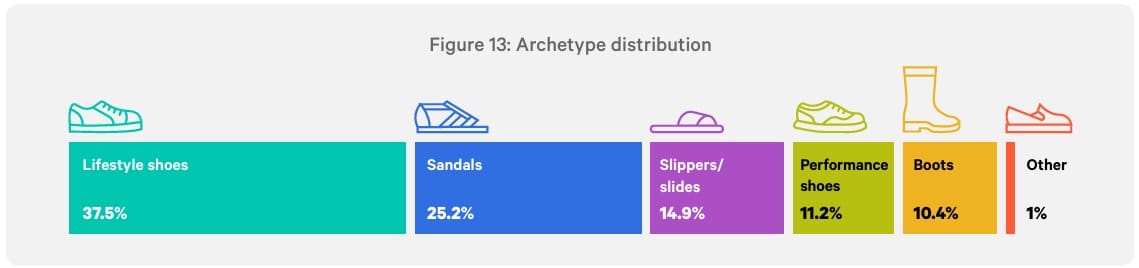
- Design stage choices determine recyclability downstream.
Two findings that look like data points are actually design briefs.
Firstly, nearly a quarter of all soles are black, and 97% of those are unidentifiable by NIR. The use of carbon black pigments, standard across the industry for durability and aesthetics, is directly creating an unrecyclable fraction. Alternatives exist but must be validated against performance standards.
Secondly, lifestyle shoes made up 37.5% of the non-rewearable stream, followed by sandals at 25.2%. These high-volume, lower-complexity archetypes are where circular design interventions would have the greatest reach and the most achievable implementation.
Bottom line: Circularity in footwear is not a recycling problem. It is a design problem. The choices made at the start of the product cycle determine what is possible at the end.
What Needs to Change
- The recommendations require action across four levels, in parallel.
The report is explicit that no single intervention closes the loop. Progress requires coordinated movement across four levels simultaneously.
At the product level
Design for disassembly, reduce unnecessary material blends, eliminate decorative disruptors where possible, move away from carbon black pigments in soles, and embed Digital Product Passports to make material composition traceable through the product's entire life.
At the service level
Integrate cleaning, repair and refurbishment into sorting infrastructure to extend the rewearable fraction before it reaches the recycling or disposal stream. The 24% of undamaged non-rewearable shoes in this study represents an immediate, low-technology opportunity.
At the system level
Invest in dedicated preprocessing capacity for footwear, including cutting, delamination and sole separation, that does not currently exist at scale. Develop sorting technology built for footwear rather than adapted from other sectors. Support manual and hybrid sorting as near-term solutions while longer-term automation matures.
At the policy level
Decouple footwear from apparel in EPR frameworks. The structural differences in composition, construction and end-of-life processing make shared legislation a poor fit. Introduce recycled-content targets and eco-modulation incentives specifically for footwear, and establish data systems capable of tracking post-consumer flows with the granularity this report has demonstrated is possible.
Bottom line: The data now exists to act. The question is whether brands, recyclers, sorters, policymakers and innovators will treat it as a shared foundation, or wait for someone else to move first.
This is the most rigorous look yet at where post-consumer footwear actually goes and why so little of it gets recycled.
The findings are uncomfortable not because the problems are new, but because there is now data to prove they are structural. Design choices being made in studios right now are determining what will and won't be recyclable in 2030.
Phase 2 on circular design guidelines and Phase 3 on recycling innovation validation follow later this year. Worth keep your eyes peeled!
Closing the Footwear Loop Phase 1 was produced by Fashion for Good and Circle Economy, with pilots conducted at CETIA in partnership with Matoha, PICVISA and THE 8 IMPACT. Innovation partners include adidas, Inditex, ON, Otto Group, PVH Corp., Reformation, Target and Zalando.
📥 Download the full 71-page report here.