


There is a version of a conference about merchandise planning that is mostly software. Demos, dashboards, the slide deck that opens with a market size figure and closes with a QR code for a free trial. RE:PLAN is not that conference.
As the only merchandise planning event built specifically for fashion, it is intentionally intimate. The people who show up tend to know the difference between a session that confirms what they already believe and one that genuinely challenges how they work.
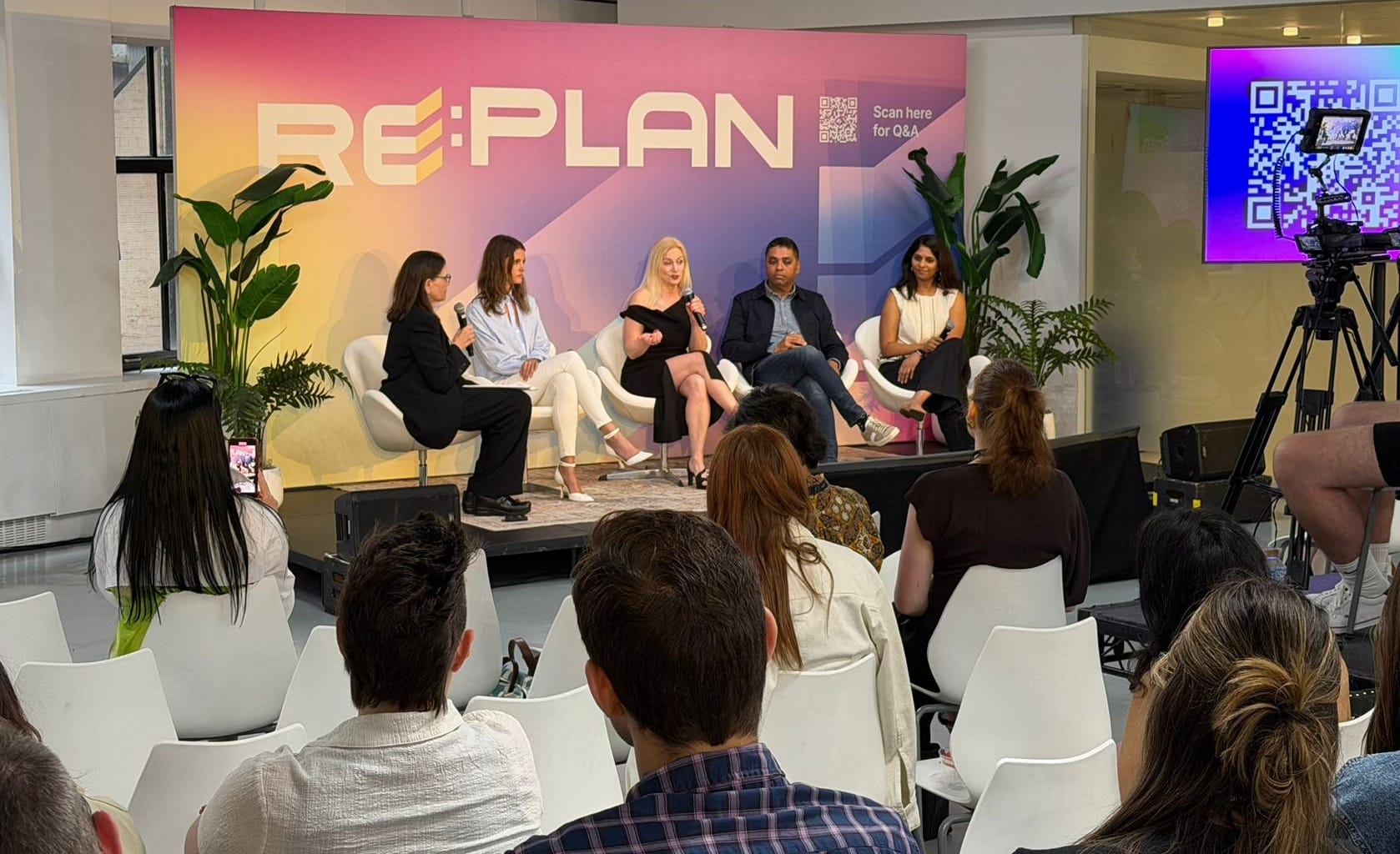
Two days in New York this May kept surfacing the same argument: the plans which fail most often fail in the handoffs, not the numbers. And that the industry is still, in many cases, treating the people problem as though it were the technology problem with the wrong label.

I. The Foundation Is People, Not Process
The team question nobody is asking clearly enough
The opening fireside set a tone that ran through the rest of the event: that the planning function's biggest capability gap is not analytical. It is human.
Any model, any system, any AI-assisted forecast can tell you what the numbers say. What it cannot do is understand why those numbers are what they are, what the context underneath them means, and what the business should actually do with the gap between the math and the moment. That is the planner's job. And most organisations are not building planners who can do it. They are building planners who can report it.
Anyone - including AI - can look at a number and tell you what the math is. But it takes a special understanding of the business to say: this is the number, and this is why. And until you understand that piece, you can't really drive forward.
- Alicia Cassidy, VP Planning & Allocation, Ferragamo
The hiring philosophy that kept surfacing is worth examining closely. Business acumen first, obviously. But beyond that, care. Do they care about the work? Do they care about the team? Do they take pride in what they produce? This is not soft. It is the thing that determines whether a planner improves or plateaus — because caring is what makes someone open to feedback, willing to practice before a high-stakes meeting, and capable of the self-reflection that separates the planners who get better from the ones who get more experienced while staying the same.
If you are hiring for the role rather than the trajectory, you will get people who can do the job as it currently exists but cannot evolve it as conditions change. In a planning environment being reshaped by tariffs, AI, and social-media-driven demand spikes, the difference between those two things is not academic.

What conviction looks like before you have it
The gap between knowing your numbers are right and being willing to defend them was a pattern that kept resurfacing. Early-career planners prepare thoroughly, believe their analysis, and then let the room talk them out of it. The problem compounds; the more technically excellent a planner is, the more invisible they can become if they have not developed the confidence to hold a position under pressure.
But then there is the flipside. Conviction without openness is stubbornness. Openness without conviction is invisibility. The planning community has more of the second than the first right now, and the room's response to both observations suggested it knew this.
The goal is not to be unpersuadable. It is to be someone worth persuading; grounded enough in the data, and present enough in the room, that when you do move, it means something.
II. When the World Stops Making Sense
Directionally correct is a strategy
The volatility panel got to the burning topic no planning team in the US has been able to ignore: tariffs. What made it genuinely useful was that the room declined to pretend there was a technical solution to a fundamentally political problem, and concentrated instead on the discipline that allows planning teams to make good decisions even when the information environment is chaotic.
The phrase that became the session's defining frame: directionally correct. Not optimised. Not right. Directionally correct. Consider the GPS analogy: you know where you are going, you know roughly how to get there, and you accept that the route is going to change. What matters is that you keep orienting toward the destination, not that you find the road that was on your original map.
This sounds obvious. It is not.

The pressure on planning teams - from leadership, from finance, from the mythology of accurate forecasting that has accumulated around the function over decades - is still predominantly to be right, not to be responsive. Building an organisation that can make micro-decisions confidently with 80% of the data, recalibrate when new information arrives, and avoid the paralysis of waiting for certainty that is never coming, this is a genuine capability that very few organisations have systematically developed. Several voices in the room were explicit in that they would rather make a decision today with most of the information than wait three weeks for completeness and miss the window entirely.
The structural argument that arose from the trade side of the panel is equally important. The current tariff environment is genuinely unprecedented in velocity, but structural trade volatility, be that through quotas, shipping disruptions, geopolitical shocks, is not new.
Companies that built parallel supply chains, pre-positioned materials, and diversified their vendor base before they needed to are having a meaningfully different conversation right now than those building optionality under pressure.
The practical toolkit is unglamorous but vital: first-sale pricing to reduce duty exposure, supplier cost-sharing under genuine distress, bonded warehouse facilities to defer payments during policy uncertainty. It is the plumbing behind the supply chain. The brands that laid it before the disruption arrived are not scrambling.
The margin that looked good and wasn't
Emma Reid from Happy Socks described a decision made in 2023 to raise prices on gift sets to capture higher margin. The logic was sound, but the outcome was damaging. B2B revenue appeared to increase as higher prices inflated the value of pre-orders, but in their own channels volumes fell, sell-through dropped, and discounting spiked. Net margin went negative. Worse, the weakness in own channels was visible to wholesale customers, who pulled back orders the following year.
The fix was aggressive, cutting prices by fifteen percentage points, accepting a lower margin percentage to recover volume and cash. Volumes tripled. Revenue tripled. Net margin in absolute terms went up.
The lesson is one that planning teams should probably be making more explicitly to the organisations around them: the margin percentage on a slide is a presentation number. Cash is what keeps the business operational. The instinct to protect percentage targets during cost pressure can destroy the cash position that makes survival possible.
Planning owns that argument, and in many organisations is not making it loudly enough.

III. AI Wins, Warnings, and What Actually Changed
An honest account of where AI is actually adding value
The AI panel was among the event's most anticipated sessions. What it delivered was considerably more useful than the typical industry treatment, which tends to compress into either enthusiasm or anxiety, often within the same paragraph.
The clearest wins sit in two places: pre-season machine learning-based forecast baselines that improve accuracy and allow planners to cover more SKUs, and in-season real-time data for allocation, sizing, and pricing decisions, where the gap between reacting to a trend that is still present and reacting after it has passed is often the competitive difference.
Where the room was more cautious (and the caution matters), is the risk of over-reactivity. Real-time data is powerful. But adjusting strategy based on one hour of sales data for a new launch is not using AI well; it is using anxiety faster. The models hallucinate. They require critical assessment. And the commitment structure of a supply chain means that being strategically reactive to short-term signals can damage vendor relationships and long-term planning discipline in ways that are slow and expensive to repair.
The risk of real time data all the time is if you don't set a strategy and commit to it and you're overly reactive with the information, it can be damaging to your business and your relationships.
- Kenzi Parton, VP Planning & Operations Transformation, Kendo Brands (LVMH)
On trust and knowing when to stop
Planning teams are not going to trust AI outputs because their technology leader told them to. They will trust them when they can see the back-testing, follow the forecast accuracy improvements over time, and participate in the model's evolution rather than receiving it as a finished product. This is a change management problem more than a technology problem, and it is one the industry has not resolved.
Equally important is knowing when to call something off. Several practitioners described shutting down AI use cases when the expected efficiency gain did not materialise, and being clear-eyed about that being the right call rather than a failure. The willingness to exit a pilot you believe in more than the data does is a capability that organisations consistently undervalue. It is also one that planning, grounded in measurement and honest accountability, is better placed to exercise than most functions.
The implementation principle that held across all of it: start with one thing done well. The use cases that succeeded started with a focused MVP - core forecasting, say - and built from there, with people able to follow and absorb progress at each stage. The ones that tried to do everything simultaneously produced inconsistency everywhere and left teams with no sense of whether the change was working.

IV. Planning Breaks in the Handoffs
Where it actually goes wrong
If everyone agrees that planning should be cross-functional, collaborative, and aligned around shared data, why does the evidence suggest most organisations are doing something considerably more fragmented?
The collective answer distilled to three things: clear roles and responsibilities, a living corporate calendar that everyone actually follows, and accountability that does not get diffused when things go wrong. What is interesting is that none of those three things is technically difficult. All three are organisationally difficult, because they require people to accept constraints on their autonomy, share information they might prefer to control, and own failures rather than redirect them.
One initiative that came up illustrates what the structural fix actually looks like in practice: Allocation 101 sessions for buyers that gradually expanded into a cross-functional education programme, pulling in visual merchandisers, finance partners, and global merchants.
The return is not just goodwill, but fewer escalations, faster decisions, and a cross-functional group that can respond to a CEO's question together rather than retreating to their own data and presenting competing versions of the truth.

Planning is the police, but that is not the whole job.
The phrase that landed as a laugh line but pointed at a real tension: planning is the fashion police. Planning holds the open-to-buy. Planning says no. Planning is the function that keeps buyers from committing to the most beautiful thing the showroom has ever produced when the receipts are already overcommitted.
That discipline is necessary. But it is not sufficient.
The alternative model is not softer; it means approaching cross-functional partners with genuine curiosity, taking calculated risks together, and sharing accountability for the outcome. It is harder, because it requires the planner to be genuinely open to being changed by the conversation.
The organisations where planning is shaping the business, rather than just governing it, tend to be the ones where that openness is real rather than performative.
The lessons that had to be learned the hard way
One of the more useful moments came from a simple question posed during the closing session: what is one thing about planning, collaboration, or forecasting that you wish you had learned earlier?
The answers formed an accidental curriculum. Be more open earlier — the instinct to have the answers is what stops you learning the ones you need. Push harder when you know you are right — approval doesn't pause the pressure to drive more. And understand that the goal of the plan is not to be accurate. The goal is to make the business better. Those are not always the same thing.
The questions that RE:PLAN surfaced are not new. How do you plan when visibility disappears? How do you build a team that can think, not just report? When should you trust the model and when should you trust your judgement?
What shifts at a gathering like this one is not the questions, but the clarity about why they are hard. The plans that fail are not failing because planning teams do not understand retail math. They are failing in the handoffs: between planning and buying, between pre-season assumptions and in-season reality, between what leadership was told and what actually happened. They are failing because the cross-functional machinery that is supposed to catch those gaps does not exist, or exists on paper, or exists only for the parts of the process that already work.
Two days in New York couldn't close those gaps. But a room of people naming them honestly is, at minimum, a better starting position than pretending the numbers alone will sort it out.
RE:PLAN's 7 Takeaways at a Glance
- Hire for trajectory, not just for the role.
Business acumen matters. What compounds over a career is curiosity, care, and the willingness to receive feedback. The planner who stops learning becomes the planner you have to work around. - Directionally correct is a strategy, not a consolation prize.
In a volatile environment, planning for 100% accuracy is planning to freeze. Establish your threshold for good enough to act on, make the decision, and build in the mechanism to recalibrate when the information improves. - Margin percentage is vanity. Cash is sanity.
Under cost pressure, the instinct to protect margin percentage can destroy the cash position that makes everything else possible. Planning owns this argument, so make it. - AI earns trust through participation, not declaration.
Model outputs that appear without explanation will be overridden. Back-testing, explainability, and involving people in the rollout are not nice-to-haves. They are the mechanism by which the organisation actually changes. - Start with one thing that works, then build.
The MVP principle applies to technology implementation the same way it applies to product. Start with core forecasting done well. Layer on promotions, newness, discontinuation. Trying to do everything simultaneously produces inconsistency everywhere. - Know when to call it.
Cutting a use case that is not producing efficiency is not failure. It is good planning. Organisations that cannot exit a pilot they believe in more than the data do are going to keep spending on things that are not working. - Planning breaks in the handoffs, not the numbers.
Clear roles, a living corporate calendar, and real accountability are unglamorous. They are also what separates the organisations that can respond to disruption from the ones that are still trying to get the most recent data into the same spreadsheet.
RE:PLAN will return in 2027. Register your interest here.