


Valentin Ferté had never run an ultramarathon. Since joining Vivobarefoot, his longest run had been maybe 10km. Then he designed a barefoot trail shoe, trained for months, and lined up for 50km through the Sahara desert, in the shoe he helped build.
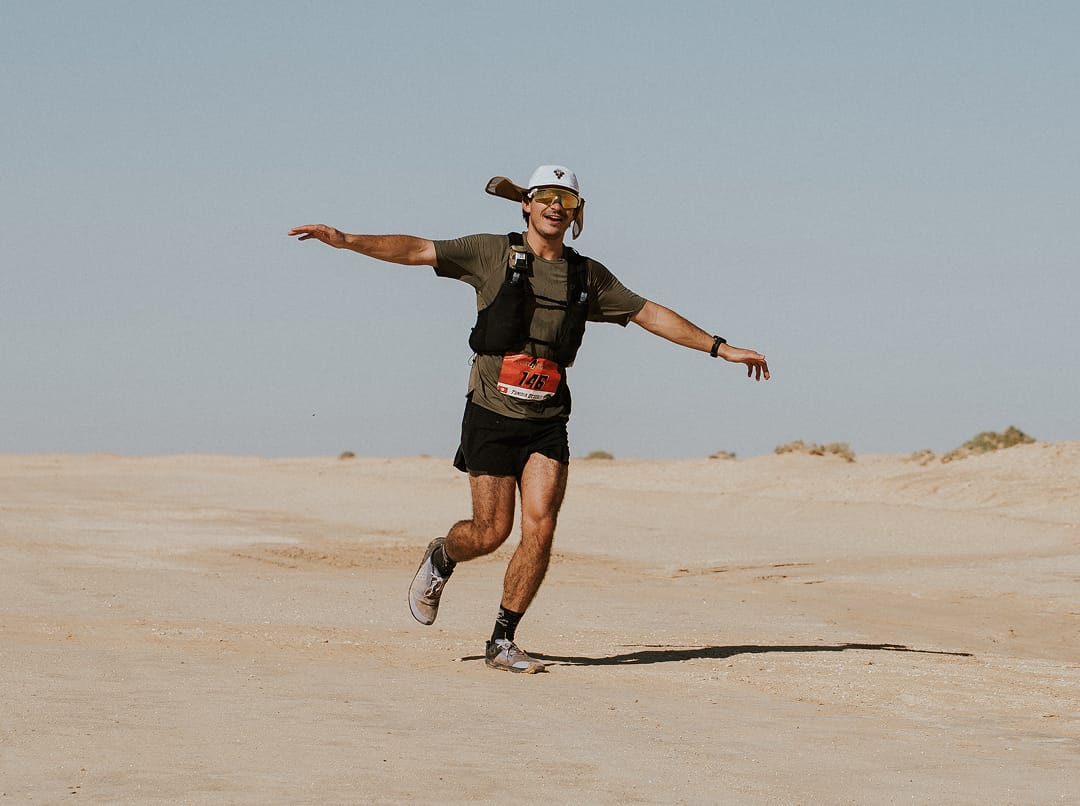
Right at the start of the race, he took a wrong turn, in the lead, but, as it turned out, the wrong lead. He'd been running alone, trying to read the tracks of the 100km runners who'd set off earlier, when the trail vanished beneath him. A string of WhatsApp messages caught up with him a few minutes later: wrong way. He was probably at the back of the pack by then, he reasoned, "but that's fine, it's part of the experience, isn't it?" He was still having fun, and for Valentin, every mistake and every fail is an opportunity for a lesson. He got back on course, and several hours later he crossed the finish line of the Ultra 4 Charity Tunisian Desert Race in first place, in the 50km category, wearing the Primus Trail Flow.
Being a designer is not only just drawing things on the corner of a desk and sending them to a factory hoping it will turn out well. In reality, it's being connected to the people, connected to the environment.
Before the design sketchbook
Growing up next to a forest, in a medium-sized city in the north of France, he spent his time outdoors, running, cycling, playing tennis, building huts and climbing trees. Alongside it, an interest in creation, art and drawing took hold early. A little prematurely by his own account, that grew into a fascination with anatomy, and later biomechanics: the study of how the body moves.
He still carries something of that childhood curiosity into the job. "I love the naïve attitude that kids have, and the way they look at the world," he says. "Seeing the world with fresh eyes every time you look at it matters a lot in design, I believe." Design, in his telling, isn't a problem with a single correct solution to be calculated.
I don't approach design as a mathematical equation where there are only a few correct ways to achieve the right result. I think designing objects is much more open and fun than that.
That early interest in the body eventually became a diploma project on reconnecting to nature through the feet, and not long after, a job at adidas, where he rotated through performance running, Originals, outdoor, innovation and specialist sport over several years. He was, by then, already something of an outlier in the building, walking around the office barefoot and showing up to the brand run club in minimalist footwear. "I was sometimes referred to as the shoe designer who didn't like wearing shoes," he says.
Three and a half years ago, he reached out to Vivobarefoot's Asher Clark, and the fit was immediate. It happened naturally, he says, because the brand's philosophy already aligned with his own. "So it may all look like a well-thought-out plan, but it wasn't," he says. "Just me following my interests, developing skills and relevance, creating opportunities, and having a bit of luck sometimes."
He doesn't claim to have a design mantra, exactly, but he has something close to one. Connecting with people, athletes, ambassadors, partners, the users who'll eventually buy the shoe, is central to how he works, especially when a project starts to lose momentum. Connecting with people outside of the brand and product 'bubble' really helps keep a project relevant and can even elevate it. The other half of it is a refusal to over-rationalise the job.
Not everything needs to be rational. Designing is different from art, of course, but intuition and originality have their place. We are animals driven by feelings and creativity, and we all enjoy some level of surprise and novelty.
Bringing barefoot back to running
Ferté's main brief when he joined Vivobarefoot was to bring running back into a brand that, for the better part of a decade, had watched the wider industry treat barefoot running almost as taboo.
The reasons trace back to Born to Run, the book that sparked a wave of interest in minimalist footwear, and to the wave of five-toed, ultra-minimal shoes that rode that interest into the mainstream, and into trouble. As the trend took off, a lot of people got injured because they didn't make the transition to minimalist footwear properly, Ferté explains, and one of the category's biggest names ended up facing legal action as a result. A lot of brands stepped back from running in barefoot shoes after that. Vivobarefoot didn't.
We believe at Vivo that this is possible. You can run in barefoot shoes. It's just a matter of giving time to your body and transitioning properly.
The numbers he cites are striking: roughly 95% of people are born with perfectly healthy feet, he says, and by the age of 18 only around 50% still have them. He puts the blame squarely on footwear. "From the age of five or six, we start to put kids in narrow shoes, and now there is more and more cushioning, and we start to see the impact."
That belief sits directly opposite where the rest of the performance running market has been heading. The mainstream running world, as he sees it, has been engineering the ground away from underneath its runners, stiffer soles, more carbon, more foam, in pursuit of shaving time off a marathon PB.
But what is the trade-off when you wear this every day? What is the impact on your health, on your posture, on your enjoyment in general? The main technology is the foot. This is the best invented technology that we all have available on ourselves.
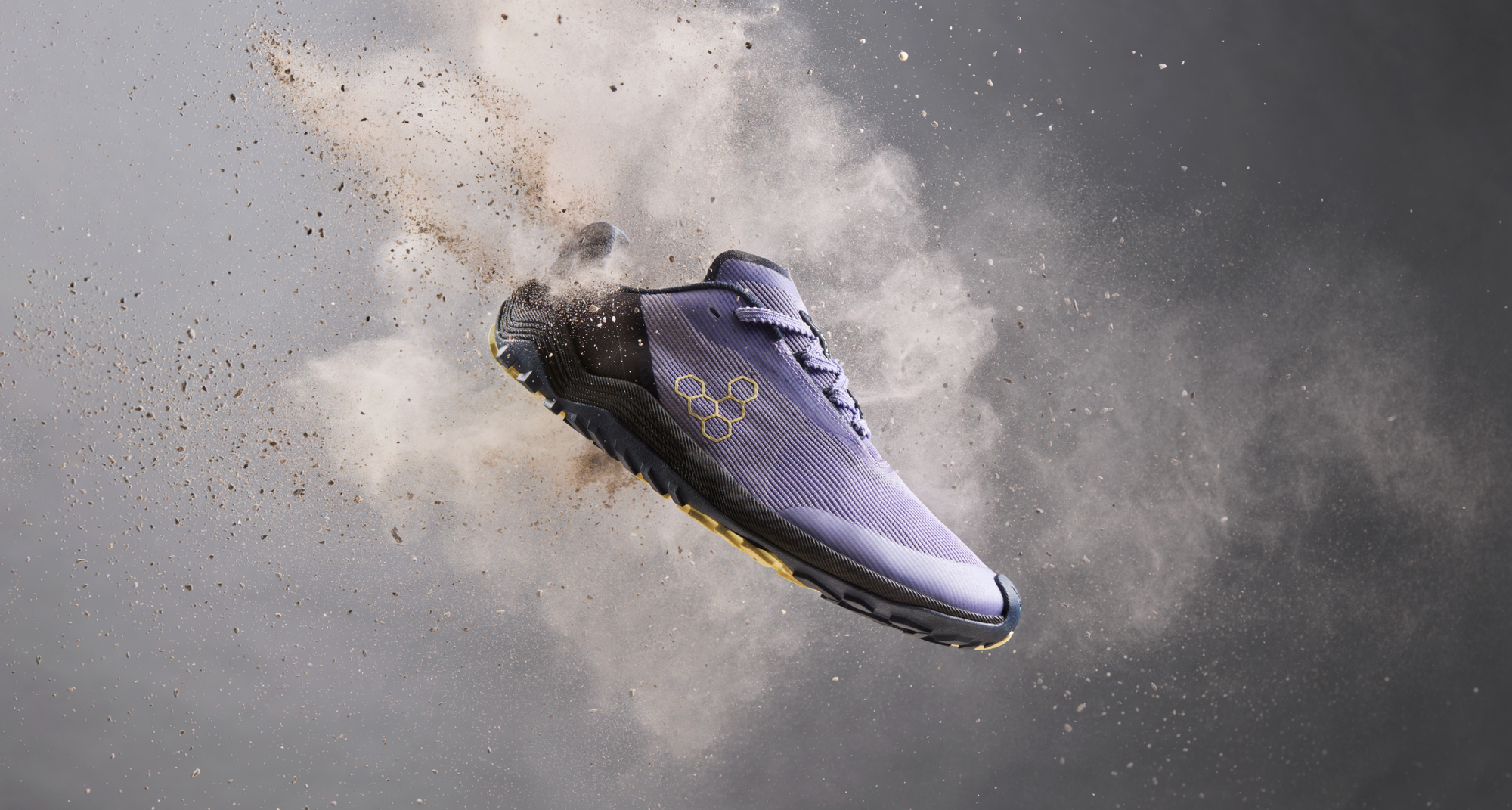
That thinking shaped the brief for the Primus Flow franchise, three shoes (Primus Flow, Primus Trail Flow, and Primus Trail Flow Mid) built, in the project's own words, around "natural performance," "freedom," and "connection."
It's language you can also find in the design itself. The flow lines running across each shoe's upper aren't decoration, but a direct reference to air moving over the top of a runner's foot as they move forward. "We try to be as inspired by nature as possible at Vivo," Ferté says. "Flowing air is a very pure representation of movement. That felt like a meaningful inspiration for a collection of running shoes."
The shoe starts with the people
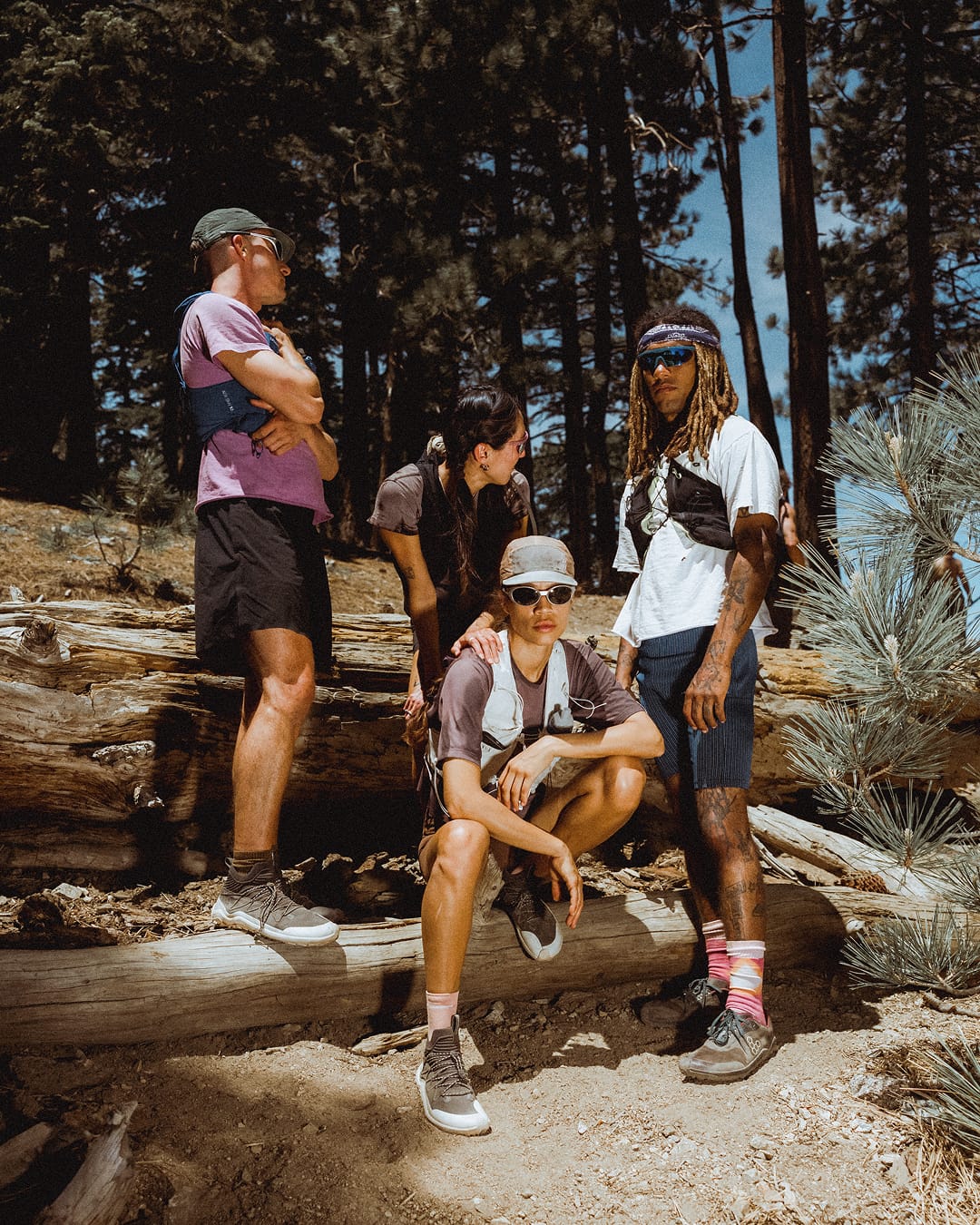
Ask Ferté where a shoe begins, and the answer isn't a material or a silhouette. "The shoe starts with the people. Who will wear it? When? Where? In what context?" he says. "Whether there is a defined brief or not, I like to spend time there. This is what gives me inspiration."
From there, his process is deliberately loose and multi-modal: a big marker and paper, digital sketching on the iPad, 3D modelling in VR with a headset and Gravity Sketch, and what he calls "digital collage," a blend of AI-generated imagery, existing shoes, textures and his own sketches layered together. He keeps it loose on purpose, with no expectations of how polished it needs to look. "It can create very interesting starting points."
The VR modelling in particular has become central to how he ideates, and he's candid about why he skips more conventional 3D software.
These tools are amazing for other things, but through all the layers, possible actions, shortcuts, tutorials, I lose speed. And speed isn't only good for efficiency. It allows you to ideate more, express concepts quickly, kill 90% of them quickly, and pursue the remaining 10%.
On the Primus Trail Flow specifically, he pushed the idea further, building what he believes was one of the first "3D tech-packs" at Vivobarefoot: sending a full 3D model to the factory to explain a construction detail on the upper and the sole layering, rather than relying purely on a flat spec sheet.
AI sits inside that process too, but on his terms, and at more than one stage of a project. He uses it for rough ideas and inspiration images, but also to generate realistic imagery or short films of people wearing something still only a concept, useful for selling an idea internally before it exists. What it isn't, he's careful to add, is a shortcut around his own judgment.
I don't feel that AI is doing the work for me. I see it more as a companion or collaborator within the process. I'm still deciding what goes in, what is interesting, what gets rejected, what gets developed and ultimately what gets presented to the wider team.
Where exactly the tool stops assisting and starts steering is a question he clearly enjoys sitting with rather than resolving neatly. "Do we sometimes want the tool to make decisions for us? Every tool and every material has its own properties. They enable certain things, but they also create constraints, and those constraints inevitably influence what we make."
Beyond his own desk, Ferté sees digital tools reshaping the wider production process too, most visibly in Biome, Vivo's on-demand 3D-printed footwear project, made without a last at all. "It's absolutely relevant to today's world and will help shape the future of footwear, for sure," he says, "a very ambitious project with highly talented people steering that boat."
He's less certain about which of his own current tools will still feel current in five years' time. AI tools will keep evolving quickly enough to make today's versions feel dated, he suspects, but a pen and marker on paper won't. "People still visit prehistoric caves to see early paintings of hands and animals. There is something true about that."
Prototyping is where he expects the fastest change.
3D modelling, 3D printing and other rapid sampling processes are going to make some of our current prototyping methods outdated. I'm enthusiastic about this, as creating and trying new tools allows for new outcomes.
Chasing lightness and the trouble with a clean answer
Vivobarefoot's older shoes relied on a rubber cupsole: flexible, protective of the upper, but heavy. For the Flow franchise, Ferté's team replaced it with a proper midsole for the first time, ETPU paired with a TPU outsole on the road shoe, ETPU paired with a rubber outsole on the trail version, and set about shaving weight wherever they could. The Primus Trail Flow, the shoe Ferté wore in the Sahara, comes in at 219g, against 281g for its cupsole-based predecessor, the Primus Trail FG 3.5.
Getting there wasn't a matter of simply going thinner. Go too soft and the shoe feels cushioned but unstable, he explains. Too stiff, and you lose the flexibility. The recipe was worked out first on Primus Flow, the road shoe that launched ahead of the Trail Flow: a genuinely rigorous internal wear-test, twelve runners, a range of paces, only thickness and hardness changing between rounds. "I took care of the entire wear-testing of this project," Ferté says. "This combination was indeed what we suspected would be the favourite for barefoot runners," landing on 4mm and 50–55C durometer as the final spec, six millimetres of material underfoot in total.
Where the data doesn't hand you a clean answer, Ferté leans on something less quantifiable: staying connected to who the shoe is actually for.
Sometimes none of the options are right and we need to explore further, consider different materials, challenge suppliers and manufacturers.
There's an irony sitting underneath all of this: Ferté himself rarely gets to feel it first. He has big feet, bigger than the standard sample size used for most projects, so he usually only gets to test a shoe from the outside, listening to runners rather than trusting his own feel. He doesn't frame it as a disadvantage.
It's very easy to become biased when you're testing the product you're working on yourself. We want people who wear our shoes to feel what is under their soles. It sometimes makes the job harder than at other brands.
Feeling, he says, is the whole point of the exercise, and a genuinely difficult thing to design for, since it's so personal and subjective by nature.
50km through the Sahara
By the time the Primus Trail Flow launched, in the latter half of 2025, Ferté had an opportunity in front of him that went beyond the usual product launch playbook: a partnership with Ultra 4 Charity for their inaugural desert ultramarathon in Tunisia, the first in a planned series of races across different biomes, desert, mountain, snow, jungle, that map almost exactly onto Vivo's own ESC exploration collection. "That really resonated with us," he says. "It's an amazing platform for us."
He decided to run it himself, despite having never completed an ultramarathon before. He'd covered real distance once, a 25km race in the sand, but that was nearly eight years earlier, long before he joined Vivobarefoot. Building back up meant being deliberately, sometimes frustratingly, patient. "I built a training programme and didn't stick to it," he admits. "The best training programme is the one that allows the rest of your life to continue." He held himself to one rule instead: hit the weekly kilometre volume, whatever shape the week took. He started at 15km a week and built to around 75km at his peak, mixing easy runs, long runs, intervals and resistance training, running exclusively in Vivobarefoots throughout.
The caution wasn't paranoia; he'd injured himself in the past transitioning too quickly from cushioned running shoes to barefoot running, and by stacking interval sessions without enough recovery. This time, recovery got equal billing with training: sleep, nutrition, hydration, and being progressive with his own body.
I wanted to prove to myself that I could do it.
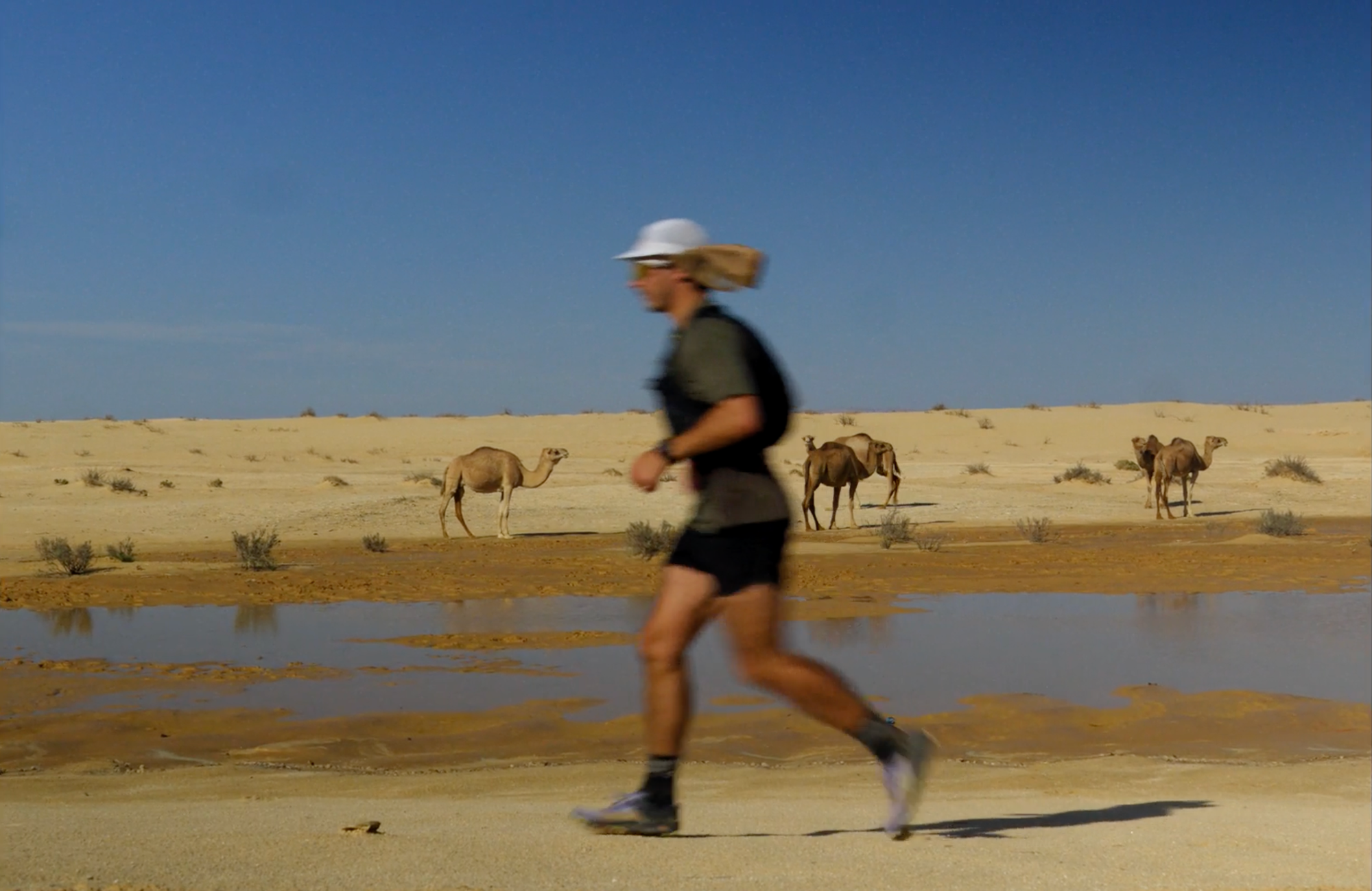
Heat was the other variable he couldn't fully train for from London. He mixed in sauna sessions and treadmill runs dressed for winter, and got lucky with an unusually warm London summer, but it wasn't enough to fully prepare him. Race day brought temperatures of 36–37°C (97–99°F), and the following day pushed close to 39°C (102°F). "This heat is something different," he says in footage from the race, describing having to talk himself through it once the sun came up.
Forgetting about the shoe
The weekend offered three distances: 100km, 50km and 25km, with Ferté entering the standalone 50km race. Asked what surprised him mid-race, not at the finish, but somewhere in the thick of it, his answer is almost anticlimactic, in the best way. He'd expected sand to work its way into the shoe's open, breathable mesh as he crossed dune after dune, having decided against wearing gaiters. But it never did.
I got to simply forget about the shoe pretty quickly, which is what I want.
The wrong turn at the start of the race, it turns out, meant he covered closer to 58km rather than the official 50km by the time he was done. What carried him through the extra distance was less about grit than about the people along the way. The checkpoints had a good effect on him, he says: arriving fatigued, chatting with people, leaving each one with a smile that carried him for the next few kilometres. At one point, mid-race, he even managed a FaceTime call to his wife. "I thought, 'Hey, I'm definitely not running so fast that I can't give a call to my biggest supporter.' She has a competitive spirit too, so she really gets why I get involved in challenges."
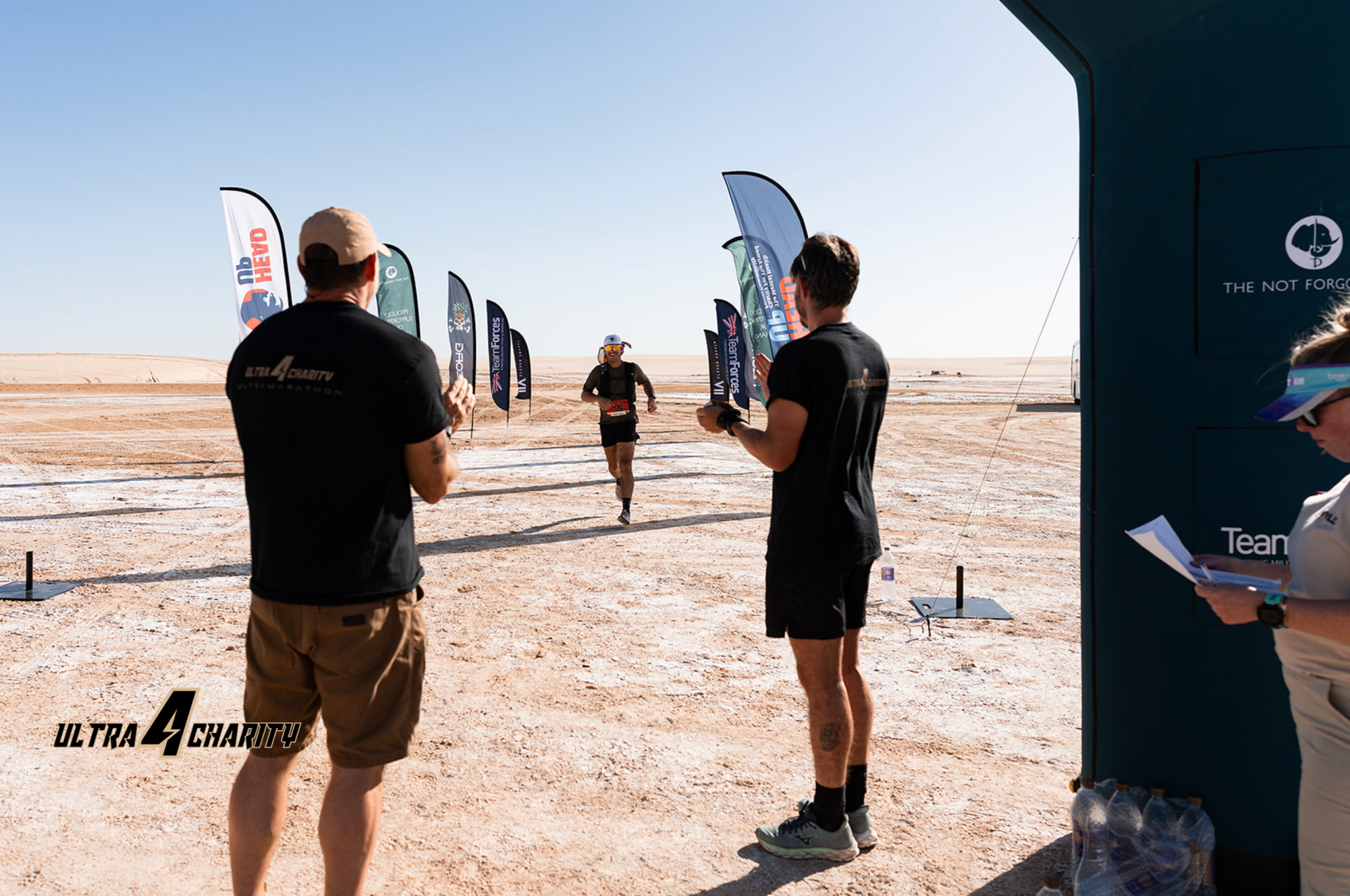
About four or five kilometres from the finish, at the last checkpoint, the Vivobarefoot film crew, who he counts as close friends, followed him the rest of the way in a 4x4, which made the last kilometres even more fun. He climbed the final dune, ran down to the finish line, and was met with hugs. "I realised I felt pretty good," he says. "The last kms and arriving was actually a very rewarding feeling."
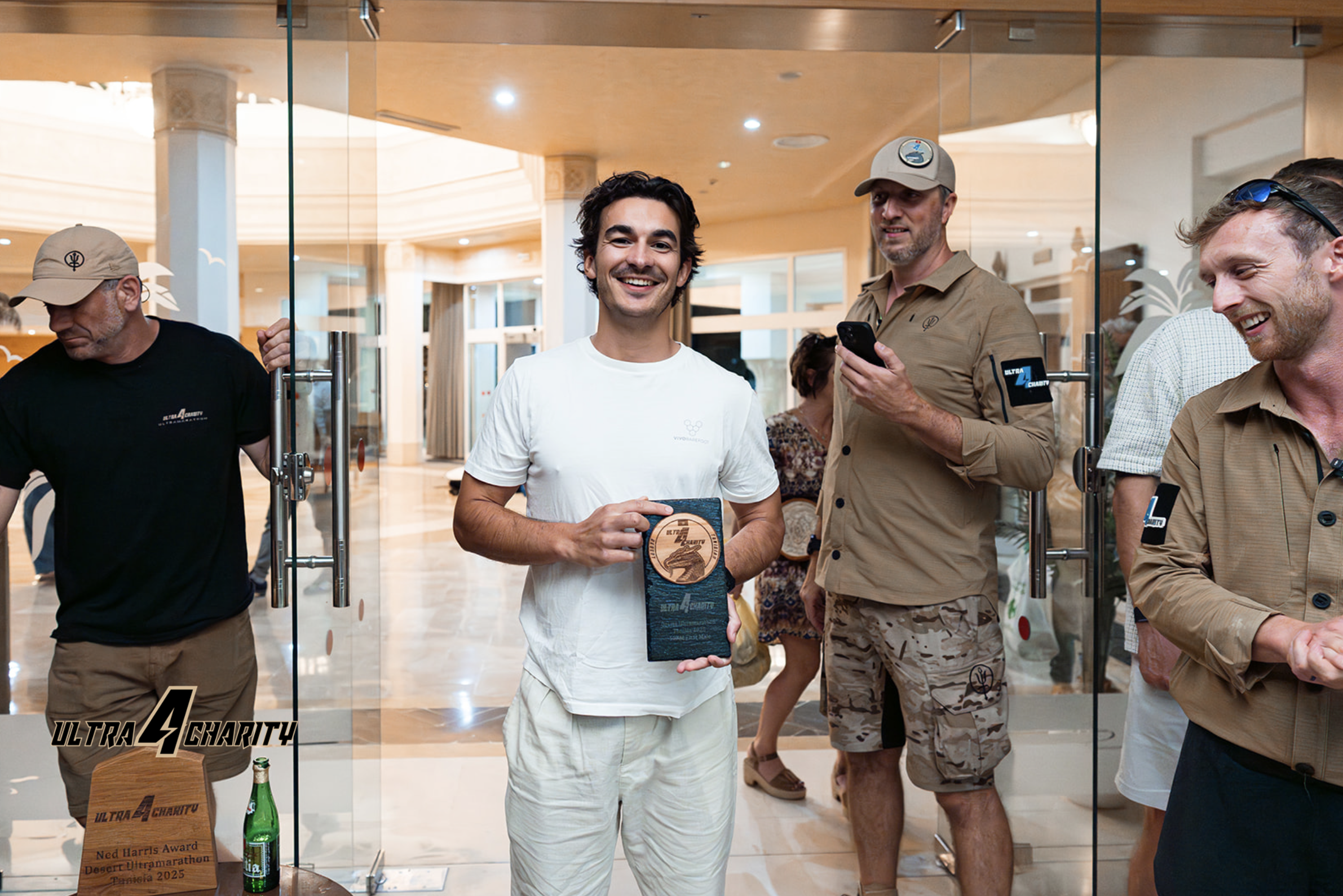
Then the bigger surprise landed. "Well, I just ran the 50km of Ultra 4 Charity here in Tunisia in the desert, and somehow I won it," he says, in footage filmed moments after finishing. Vivobarefoot had around eight runners competing across the weekend's distances. Ferté took the 50km. His colleague Ana won the 25km. On its own, having a team out there finishing the races was already a strong story, he says, but the two wins took it further. There was something in doing it alongside people too, some familiar, some met only days before. "It creates a very unique connection."
Not one Vivobarefoot runner, across every distance, got a blister, in a sport where taping feet at aid stations is practically routine. Their reason, he says, isn't a secret.
Our not-so-secret secret is a wide toe box that allows people's toes to have room to move freely. This is a huge benefit biomechanically, but it also helps prevent blisters.
What he took from the finish line was less about the result than what it proved. Running in Vivobarefoot shoes against a field mostly in cushioned, narrow shoes with carbon plates and foam, doing something that felt genuinely difficult, brought back a specific kind of confidence.
That was the confidence that we're doing something right, and that it works.
People at the aid stations and at the finish kept telling him he looked fresh and positive. His body told a different story. "I was definitely not fresh in my legs. My taste was saturated from the sweet taste, and I struggled to drink my electrolytes, and ate only half of the calories I had planned." What stayed with him was the gap between the two. "I realised how your mental state can affect so much your physical state, and as a consequence your ability to push your limits."
He waited at the finish for his colleagues running the 50km and 100km to come in, then headed back to the hotel for a shower and a beer. The thought that stuck, in the end, wasn't really about the race at all.
Doing hard things creates a very rewarding feel. Doing it as a group, for a great purpose, by raising money for noble causes, makes you feel that you are doing something good, not just for yourself, but to also help those that need it.
What the desert changed, and what it didn't
The Primus Trail Flow was never designed specifically for desert conditions. It was built as an all-round trail shoe. That it performed as well as it did in the Sahara has quietly shaped what Vivobarefoot builds next. A new, more technical shoe is already in the pipeline for the next Ultra 4 Charity race, in the Albanian mountains.
We're really getting inspired by that recipe, that package we have for the sole and for the upper as well. I can't say much yet, but this is a super exciting project. I would hope that by kilometre 40, the runners will still feel as agile and light on their feet as they did at kilometre one.
Longer term, the ambition goes beyond any single shoe. Making Vivobarefoot's shoes recyclable or biodegradable, not just built from recycled content, sits high on the list, tracked internally through the brand's own V-Matrix rating system. He's candid that the industry isn't there yet.
Not every material or manufacturing process has a truly sustainable alternative. Part of our responsibility as a brand is to help push that change rather than simply wait for the perfect solution to exist. Individuals have more power than they sometimes realise. What people choose to buy today influences what brands and factories will produce in the next two, five or ten years.
Vindication, carefully worded
A decade after a lawsuit effectively froze barefoot running as a category, Ferté is careful with the word "vindication." He doesn't reject it outright, but he complicates it, pointing to a contrast he finds genuinely interesting: there has never been as much foam under human feet as there is today, and yet there have probably never been as many barefoot footwear brands either.
His caution is less about Vivobarefoot's case and more about how it should be made. Transitioning to barefoot footwear after years in thick, narrow, inflexible shoes is a process, he stresses, not a swap you can make overnight.
Footwear is equipment. It's a tool. And like any tool, it can help you do certain things, but the user still has to do the work. I'm not aware of any miracle shoe. Every footwear technology comes with benefits and compromises, whether that's cushioning, carbon plates, minimalism or something else. Our belief is simply that the human body is already an incredibly capable piece of technology.
Asked whether the confidence from the race was for the runners or for the brand's philosophy, he lands on both. It's confirmation for the brand internally, he says, but also a chance to show a wider audience that they can do it too. "I am not a professional athlete, I'm just someone that took on a challenge. I did it, probably a lot of people can. And most people probably don't need 35+ mm of foam and carbon inserts under their feet."
Asked, finally, what the kid who built huts in that French forest would make of where he's ended up, Ferté closed with: "He would probably want to follow me on my adventures," he laughs. What matters to him is not growing up too quickly, not forgetting to have fun, chasing interests that later turn into the right reasons for doing things. He remembers dreading the alternative as a kid: silent exams, then a repetitive desk job, nine to five. "I think I've somehow managed to avoid quite a lot of that, so I hope my younger self would be proud."
Ferté still climbs trees whenever he gets the chance.


