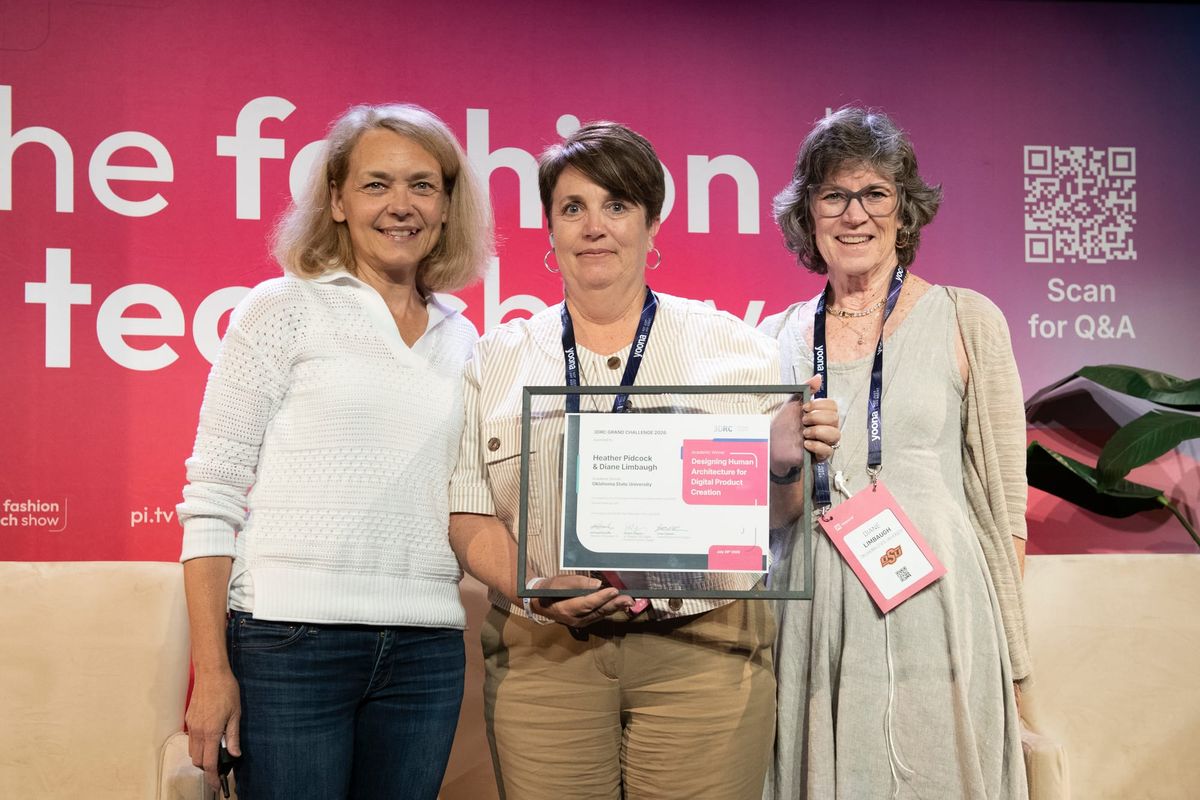


The 3DRC Grand Challenge returned this year with a new brief: Designing the Human Infrastructure for Digital Product Creation. After a decade of fashion brands investing in 3D, simulation, AI, and automation, the Challenge argued that the industry's real constraint had shifted. The limiting factor is no longer software capability, but human readiness to work effectively within digital systems. Entrants were asked to show, concretely, how people and digital tools actually work together: real skills gaps, real workflow friction, real organisational change, not theory.
Our four semi-finalists answered that brief from four different corners of the industry: production, governance, fit, and organisational readiness, but with the shared diagnosis that the knowledge that actually makes fashion products work has always lived in people's heads. It rarely gets written down, and it walks out the door when those people retire, get outsourced, or simply move on.
None of the four are trying to replace that expertise with technology, but they are trying to make sure it survives contact with scale.
Cloud Couture - Start-up Semi-finalist
Turning decades of production know-how into a workflow anyone can use
Cloud Couture is built on the observation that as AI becomes capable of generating almost anything, the greatest opportunity isn't creating more designs, but making decades of apparel production expertise accessible to everyone building the next generation of fashion brands. That knowledge has always lived in the heads of experienced merchandisers, pattern makers, and production managers, passed down through industry experience rather than documented in a way founders and designers could readily access.
Its clearest proof point is Richard Henry, a tennis instructor and musician who built Vibe Tennis into a brand with a loyal community but had never taken a product to a factory. No technical designer. No production team. No idea how to brief a manufacturer. Five days after working with Cloud Couture, he had a digital sample and a factory proposal. Fifteen days later, a fit sample. Eight weeks after that, a full production run, built on a single physical sample.
That's the gap Cloud Couture set out to close, between having a product vision and knowing how to manufacture it. The platform puts production knowledge directly into the workflow. A mood board becomes product categories and tiers; as a founder or designer refines a product, the platform explains, at the moment of the decision, how a fabric or construction choice affects cost, quality, and market positioning.
At the heart of that workflow is the tech pack, the single document that determines whether a production run succeeds or fails. Cloud Couture's proprietary Fabric Intelligence and Fit Intelligence engines automate roughly 80% of the work behind its creation, allowing founders and designers to focus on the part no AI should decide: the choices that define the brand.
Cloud Couture is built on the belief that production knowledge shouldn't be proprietary; two brands can use the same production language and still create completely different products because taste and brand voice were never the bottleneck. Access to manufacturing knowledge was. Cloud Couture automates what can be standardised, while leaving what defines the brand in human hands.
Richard Henry isn't an isolated case. A five-year-old children's outerwear label, built by a mother with no formal design background, used the platform to launch its first matching adult-and-kids jacket line with a China factory with 4,000 units in twelve weeks. A local sports retailer launched its first private-label polo without a single physical sample at all.
Different founders, different products, same underlying story: someone with vision and no production team, walking away with a factory-ready order.
I wasn't trying to build a fashion tech company. I was trying to launch a brand, but at every step I hit a wall where the answer depended on knowing the right person. The process felt opaque, expensive, and full of avoidable mistakes. That's when I realised the opportunity wasn't just to build better design tools, but to make apparel production expertise accessible, so founders and designers could spend more time creating and less time figuring out how to manufacture a product.
— Sadia Sharmin, Founder, Cloud Couture
🔗 To find out more, contact Sadia Sharmin and visit Cloud Couture.
Fashion Institute of Technology - Academic Semi-finalist
If it's not cut-ready, it's not ready
According to Joseph Altieri, fashion digitised its tools faster than it redesigned the human systems needed to actually trust them. A 3D-simulated garment can look flawless on screen and still come back from the factory twisted at the leg or inconsistent across sizes. “Looks right” and “is ready to cut” are different questions, and most organisations have no structured way to tell them apart.
That observation grew out of more than four decades in apparel manufacturing, consulting, and higher education. Throughout his career, Altieri watched companies invest millions in new technologies while the manufacturing knowledge needed to make those technologies reliable became increasingly fragmented through retirements, outsourcing, and increasingly complex global supply chains. Teaching future professionals while continuing to work with manufacturers reinforced that digital transformation was advancing faster than the human systems needed to support it.
To test that idea, Altieri developed the Collaborative Review & Decision System (CRDS), a governance framework designed to bridge the gap between digital product creation and physical manufacturing. Rather than replacing existing PLM, 3D, or AI tools, CRDS introduces structured decision-making, accountability, and validation into the product development process.
The framework was demonstrated using Northline Denim, a heritage-inspired label producing relaxed-fit, vintage-wash five-pocket jeans across multiple vendor relationships. The pilot focused specifically on the fit drift, wash variability, and revision loops that continue to challenge denim production. CRDS doesn't replace the PLM or 3D tools already in place; it sits between digital creation and physical production, requiring a garment to successfully pass four decision gates across simulation accuracy, construction feasibility, material and wash validation, and cutting and production readiness, before it can be considered genuinely production-ready rather than simply visually approved.
What makes CRDS distinctly human-centred is that it treats accountability as infrastructure. Every checkpoint has a clearly defined owner responsible for validating decisions before work moves downstream. A Digital Translator interprets what AI and simulation tools are actually communicating. A Technical Design Gatekeeper determines whether the garment is genuinely ready for production. A Vendor Feedback Loop captures factory intelligence and feeds it back into development before problems become recurring costs. Instead of digital and physical development colliding at the sample stage, the question, “Who's supposed to catch this?” already has an answer.
Applied to the Northline Denim pilot, CRDS projects a 35% reduction in sampling iterations, 24% faster approval cycles, 31% improvement in first-pass approvals, and a 22% reduction in fit-related returns, costs that often remain hidden because they are absorbed incrementally throughout development rather than traced back to their source. Because CRDS is a governance layer rather than another software platform, it scales as effectively for emerging brands as it does for global enterprises seeking standardised decision-making across multiple regions and vendor networks.
For Altieri, the innovation is not another digital tool but a better way of organising human expertise. The framework begins with the simple premise that technology can simulate a garment, but people create the confidence to manufacture it. Digital transformation succeeds only when organisations intentionally build the human infrastructure that allows digital decisions to become manufacturing decisions.
Ultimately, if it's not cut-ready, it's not ready.
The idea didn't come from a single moment. It came from seeing the same challenge from multiple perspectives over more than four decades in apparel manufacturing, consulting, and higher education. I watched companies invest millions in digital technologies while the manufacturing knowledge needed to make those technologies successful became increasingly fragmented through retirements, outsourcing, and increasingly complex global supply chains.
Teaching future professionals while continuing to work with manufacturers made that disconnect even more apparent. Everyone was asking how AI, 3D design, Digital Product Creation, and automation would transform the industry, but I found myself asking a different question: Who is designing the human system that allows all of these technologies to work together? I realised we weren't facing a technology gap, but a knowledge gap.
That realisation became the foundation for CRDS and Designing the Human Infrastructure for Digital Product Creation: a framework built on the belief that lasting digital transformation begins by preserving manufacturing knowledge, creating structured workflows, and making accountability as intentional as the technology itself.
— Joseph Altieri, Fashion Institute of Technology
🔗 To find out more, contact Joseph Altieri, Adjunct Professor, FIT.
Instituto de Biomecánica (IBV) - Academic Semi-finalist
Capturing the feeling a last maker can't quite put into words
Ask any last maker how they know a shoe will fit, and you'll get an answer that's hard to word; it's a feeling, built over thousands of pairs, for how a foot behaves inside a shape. That expertise is real and valuable, and almost impossible to scale or hand over. It lives in one person's hands, not in a system anyone else can use.
IBV's 3DAvatarFit starts from that problem. Built on its 3DAvatarFeet capture layer, it brings together accurate 3D foot models, product data on lasts, materials and construction, and, critically, the fit experts' own judgement calls, captured as structured, reusable knowledge rather than left to walk out the door with them. A last maker's annotation, a technician's calibration, a customer's real-world fit feedback all become part of one picture the whole team can draw on.
AI is given a specific, limited role here. It surfaces likely fit outcomes, flags inconsistencies, and points to relevant precedent. But interpreting intent, validating exceptions, and deciding what it means for a product stays with the humans who understand that fit is never purely mechanical. That division is deliberate: fit runs on trust, and trust needs explainable outputs and clear accountability, not a black box.
The system is also built to actually enter a business, not just live in a deck. A smartphone camera is enough to capture an accurate foot model, embedded as a "find your size" moment on the product page a shopper is already viewing. On the brand side, it's designed to slot into an existing ecommerce setup with no need to expose a full customer database or collect identifying personal information. This is backed by ISO 27001-certified security and EU-hosted infrastructure, the unglamorous detail that determines whether a good idea survives contact with a brand's IT and legal teams.
The payoff is that design teams get fit visibility earlier, cutting the sample-and-correct cycle. Products calibrate to real morphology rather than nominal sizing, meaning fewer returns and more confident customers. A broader range of real foot shapes gets represented over time. And because the knowledge is captured rather than tacit, new team members can be brought up to speed against a shared library instead of years of shadowing, turning decades of individual expertise into something the whole organisation actually knows.
🔗 To find out more, contact Beatriz Fernández Gallo, Innovation Manager, IBV.
Nottingham Trent University - Academic Semi-finalist
Tackling the problem of technology readiness
Most fashion organisations don't have a technology problem anymore; they have a readiness problem. AI and 3D tools are more accessible than ever, but knowing where they'll genuinely help, which teams need which capabilities, and whether the organisation can absorb the change is a much harder question. One usually answered by whoever's selling the software.
Nottingham Trent University and CAD for Fashion built something different: a diagnostic that belongs to no vendor and prescribes no fixed path. A nominated lead sets the scope and invites participants across functions and seniority; each person answers confidentially about their own capability, workflows, confidence and barriers. The organisation gets back a picture of itself that reflects the whole floor, not just the boardroom.
That picture is where the depth is. Rather than a single score, the report offers three lenses on the same evidence: a prioritised SWOT for where the organisation stands, an alignment view (McKinsey 7S) to see whether strategy, systems, skills and culture are pulling together, and a TOWS-based action view that turns findings into where to start. It's built to be read by a pattern cutter and a CEO alike; accessible enough to spark a conversation, rigorous enough to hold up as evidence.
The diagnostic isn't pitching anything. Organisations can act on findings themselves, follow signposts to public funding and training, or bring in a partner of their own choosing. NTU and CAD for Fashion have deliberately walled off the diagnostic from their own commercial services, so the results stay independent.
The team is moving from prototype into validation with a white paper in November, followed by further prototype development and user testing in early 2027. The ambition is bigger than one tool. Each diagnostic will contribute to a growing, anonymised dataset on digital readiness in the fashion industry, with a focus on capability gaps and adoption barriers.
These diagnostics will build shared insight into where organisations are ready, where they are stretched, and where change depends on understanding the conditions around technology, making that learning freely available to the sector rather than locked inside isolated platforms, subscriptions or pilot projects.
🔗 To find out more, contact Jen Bell, Associate Professor - Creative AI, Nottingham Trent University
To all four of this year's semi-finalists, thank you. Whether the knowledge you're working to save lives in a merchandiser's head, a last maker's hands, a professor's four decades in the industry, or an organisation's own uncounted blind spots, you are all making the same bet that the future of this industry depends on capturing human judgement, not replacing it.
The trophy may have gone elsewhere, but this work deserves attention regardless. Reach out, explore, and support these teams as they keep building.
Missed the winner announcements? Catch them here:
 Michael Ratcliffe
 Michael Ratcliffe