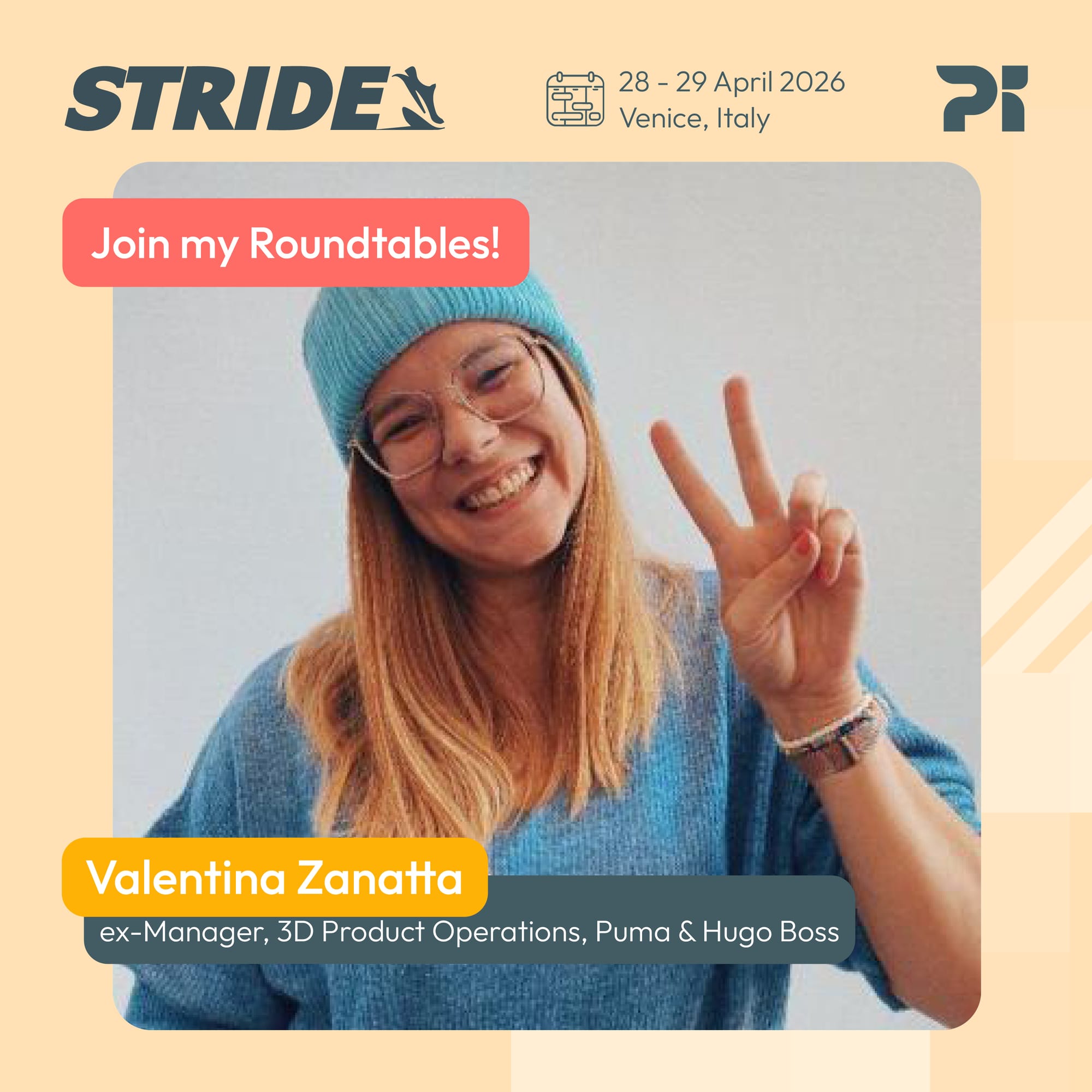


Speakers’ Corner gives you a preview of the voices you’ll hear at upcoming PI events, straight from the people shaping fashion and footwear.
In this edition, Valentina Zanatta, ex-Manager of 3D Product Operations at Puma & Hugo Boss, shares her perspective on what it actually takes to build digital workflows that hold. From why data consistency across the pipeline keeps her up at night, to why the real threat to footwear designers isn't AI but complacency.
1. What has been the most significant change you've observed in footwear design or development in the last year?
Honestly, the last year has also been marked by widespread layoffs across the industry and 3D is one of the areas where budgets have been cut first.
There's an irony in that, because at the same time, the conversation has definitively shifted from 'should we do 3D?' to 'how do we integrate it properly into our workflow?' It's no longer a nice-to-have.
The question now is who has the courage to build around it seriously, even under pressure.
2. What excites you most right now about the meeting point of craft and technology?
The realisation that technology isn't a substitute for production, it's an amplifier of it. If the tools we already have were used more consciously, the whole industry would benefit.
I think we're at the intersection of a second revolution: the first was the shift from pencil and paper to Illustrator, and now, the shift is from Illustrator to 3D and AI. The difference now is that the tools exist, what's missing is the courage to actually try.
3. What's one challenge in digital product creation that still keeps you up at night?
Data consistency across the pipeline. You can have a beautiful 3D model and still watch it fall apart when it hits factory communication. The handoff between creative vision and technical specification remains messier than it should be in 2026.
4. What innovation do you think will define the next five years in footwear?
Parametric design tied to real consumer data. Not mass customisation in the buzzword sense, but genuinely responsive product development, where fit, last geometry, and material choices are informed by actual usage patterns rather than assumptions.
5. What's the most underrated skill or mindset that teams need to develop today?
Systems thinking. Most teams optimise locally (a great 3D artist, a great developer) but struggle to see the full pipeline as a connected system. The biggest efficiency gains don't come from individual tools; they come from understanding how everything talks to everything else.
6. If you could wave a magic wand and fix one industry bottleneck, what would it be?
Standardisation of 3D file formats and material libraries across brands and suppliers. The duplicated effort (everyone rebuilding the same materials from scratch) is enormous.
But alongside that, I'd want software that manages to be both creatively intuitive and technically rigorous. Tools like CLO3D and Style3D are heading in the right direction: approachable enough that new designers aren't scared off, but deep enough to support real production workflows. That balance matters a lot if you want the next generation to actually adopt this way of working.
7. What's a misconception people have about digital design or 3D workflows?
That 3D is faster by default. It can be dramatically faster, but only if the upstream decisions (brief, reference, approval criteria) are equally clear. Garbage in, garbage out applies to 3D just as much as it does to physical sampling.
8. How are sustainability and circularity influencing how you design or source products?
They're forcing earlier decision-making. Material choices that used to happen late in development now need to be baked in from the first digital concept. 3D actually supports this: you can evaluate a material's environmental profile before you've cut a single physical piece.
9. How do you envision excellent collaboration between design, development, and production?
Shared language and shared tools. Not everyone using the same software, but everyone able to read the same file. The best collaborations I've been part of had one thing in common: no one was waiting on a translation.
10. What's one lesson you wish you'd learned earlier in your career?
That advocating for process change is part of the job. But I'd add something else: the fashion industry's relationship with change became very clear to me during COVID.
Some people were already working in 3D, but moving from a handful of internal experiments to an entire supply chain operating digitally requires a mindset shift and that's something many companies are genuinely afraid to make from the roots up. COVID forced it.
I wish I'd understood earlier that waiting for the industry to be ready is not a strategy.
11. Do you think AI will replace or augment footwear designers?
Augment, but that's not as comfortable an answer as it might sound. Augmentation still means that designers who don't adapt will be replaced, just by other designers who have learned to work with AI effectively. The tool isn't the threat; complacency is.
12. Will the future of product creation be more human-led or data-led?
Human-curated, data-informed. Data can tell you what people bought; it can't tell you what they didn't know they wanted yet. The designer's job shifts from pure creation to intelligent interpretation, which is actually a more interesting role...if you're willing to embrace it.
13. What's overrated right now in footwear innovation?
Metaverse footwear as a standalone product category. The digital wearable space has real potential, but a lot of what's been released so far is marketing exercise dressed as innovation. When it connects to physical product strategy, it becomes interesting. Standalone, it's mostly noise.
14. What's the best example you've seen of digital tools actually enhancing creativity rather than killing it?
Using Blender for explorative ideation before any brief is locked. When there's no pressure to produce a manufacturable output, just to think spatially, that's where I've seen digital tools genuinely expand what a designer considers possible.
15. What's one piece of advice you'd give to a brand looking to modernise its development pipeline?
Start with the handoffs, not the tools. Map where information gets lost between teams before you layer technology on top.
But equally important: talk to the people who actually execute the work.
There's no point imposing a new software or workflow top-down if the people using it every day weren't part of the decision. The best results I've seen come from teams where fresh ideas and real operational knowledge meet, everyone working toward the same outcome instead of getting in each other's way.
16. The tool you couldn't live without?
Blender. It's the one where I still feel like I'm thinking, not just executing.
17. One word that sums up the direction footwear will take next year?
Convergence.
18. Complete this sentence: In 2026, great footwear design will be…
…the one that makes the pipeline invisible; where the consumer only sees the idea, and the complexity that got it there leaves no trace.
Valentina will be joining us at Stride Europe, taking place 28-29th April in Venice, where she'll be leading two interactive roundtables — 'How Much Does Supplier Readiness Define Your 3D Workflow?' and 'Can One 3D Footwear Asset Ever Work End-to-End?' — and sitting on our closing all-female panel, 'What Nobody Tells You About Making Digital Work'.