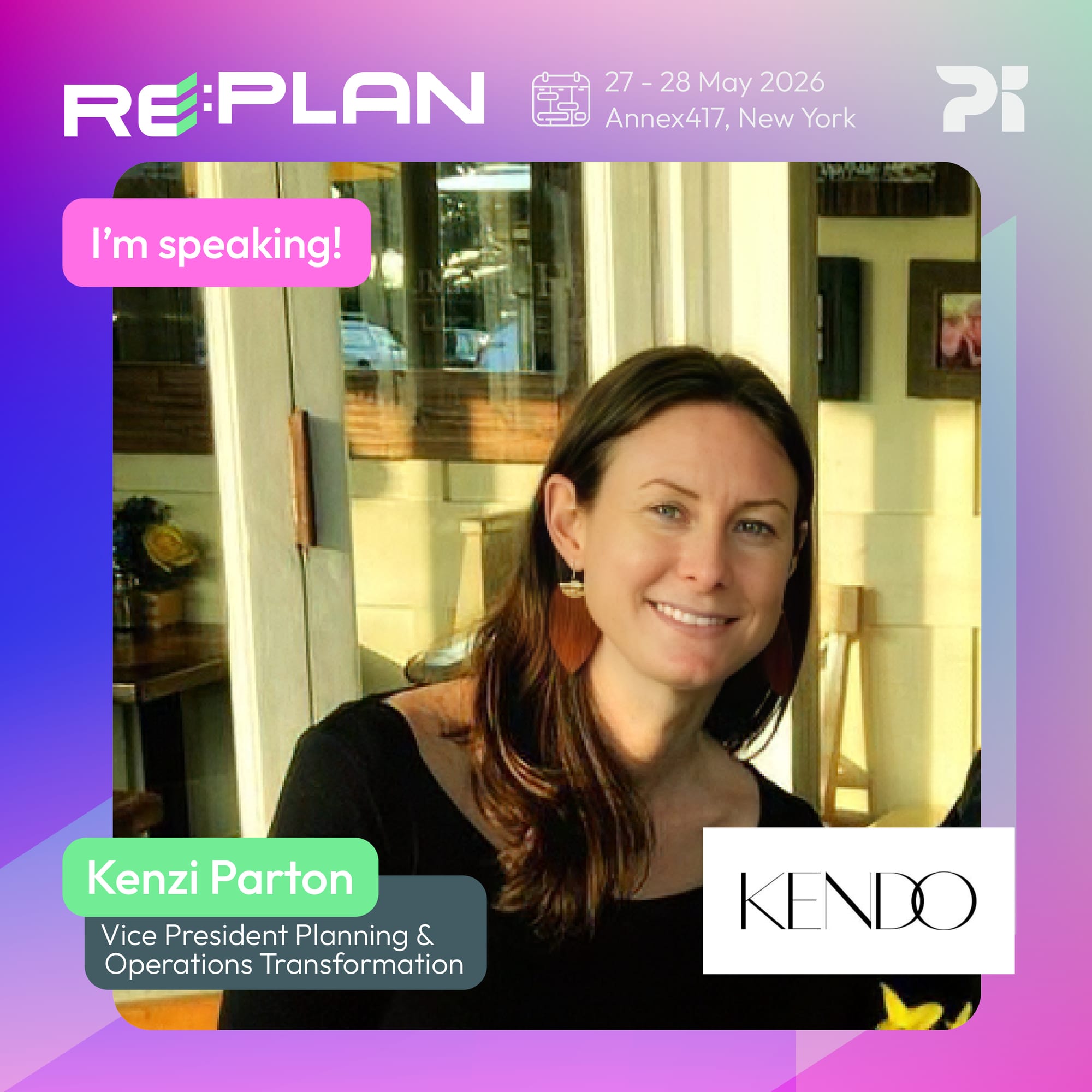


Speakers’ Corner gives you a preview of the voices you’ll hear at upcoming PI events, straight from the people shaping fashion and footwear.
In this edition, Kenzi Parton, VP, Planning & Operations Transformation at Kendo Brands (LVMH) & ex-Levi's, shares her perspective on what it actually takes to modernise merchandise planning — from building trust in AI-driven models and lowering override rates to why business acumen, not better data, is the skill that separates great planners from good ones.
1. What's the biggest shift you've seen in merchandise planning over the past year?
Higher ML adoption—and more importantly, lower override rates. That’s the real signal. Teams are starting to trust the models.
We’re using that to automate the baseline so planners can spend more time on what actually drives the business: longer-term thinking and better decisions.
2. How are you balancing intuition and data when building your plans today?
Intuition still matters. Experienced planners understand patterns and business cycles in ways models don’t fully capture. The key is using data to validate and challenge that instinct—not replace it.
3. What's the most persistent friction in the planning cycle that still needs fixing?
Speed. Reacting quickly enough to action real-time demand signals—especially viral or unplanned events—is still a challenge. The market moves faster than most supply chains are built to support.
On top of that, there’s always tension between driving newness and managing costly markdowns and product transitions. That balance is the work.
4. Which emerging capability or technology will reshape merchandise planning in the next five years?
Two areas. First, new product forecasting—we’re getting closer to connecting trend signals, like-SKU mapping, and macro data into something that’s predictive and accurate.
Second, Agentic AI. Not just surfacing insights, but taking action—adjusting allocations, triggering replenishment, flagging lifecycle decisions. That’s a meaningful shift.
5. What's the most underrated skill planners need to develop now?
Business acumen. Strong planners understand what’s driving the numbers—consumer behavior, commercial strategy, and how decisions are made.
The data tells you what. Business context tells you why.
6. If you could remove one bottleneck between planning and buying, what would it be?
Shared visibility.
When teams are working off different data—or different interpretations—you get misalignment quickly. Fix that, and everything moves faster.
7. What's a common misconception people have about modern merchandise planning?
That planning is just about the numbers. It’s really about connecting consumer demand, product strategy, and financial outcomes. The analysis supports that—it’s not the end goal.
8. How is AI influencing the way you forecast, model demand, or build scenarios?
AI is now core to how we build a baseline—we have better data and more signals than before.
The next step that’s moving quickly is Agentic AI—systems that don’t just recommend actions, but execute within guardrails and oversite. That’s where the model really shifts.
9. What does great collaboration between planning, design, buying and supply chain look like to you?
Healthy conflict. You need strong perspectives from product, planning, and supply chain—and a willingness to challenge assumptions. That’s how you get to better answers. Especially in an environment where inputs can change overnight.
10. What's one lesson about planning or forecasting you wish you'd learned earlier?
Listen to your partners—and build strong relationships. Plans don’t fail because of math. They fail when teams aren’t aligned.
11. Will AI make planning more accurate — or simply faster?
Both—but we’re further along on speed. Accuracy, especially around newness and virality, is still evolving. That’s the next unlock.
12. Is the future of planning more customer-driven or financially driven?
It’s a sequence. Start with what the customer wants, support it with margin targets—then apply financial discipline to make it sustainable.
13. What's overhyped right now in the planning/forecasting technology space?
Real-time data that moves faster than your ability to act on it. If you can’t execute, it doesn’t help—it just creates noise so you have to focus on areas you can action.
14. What's the best example you've seen of digital tools improving planning outcomes?
Assortment and pricing. The ability to read the market and act quickly—especially in-season—is a real advantage.
15. What's one piece of advice you'd give a brand trying to modernize its planning function?
Balance short-term wins with long-term ambition. Build something that works, prove the value, then scale. Don’t wait for perfect.
16. Favourite planning tool or capability and why?
Pricing scenario planning. It lets you respond to what’s actually happening—not what you planned months ago. That flexibility matters.
17. A planning win you're most proud of from the past year?
Building strong leaders and teams who understand the business and partner effectively. That’s what drives results over time, builds stability and engagement, and keeps the organization moving forward—and it’s what motivates me most.
18. One word that sums up where merchandise planning is heading?
Amplification; expanding the impact of individuals, and enabling faster decisions with the right guardrails, data, and context in place.
19. The most inspiring person or team you've collaborated with recently?
Teams that are willing to rethink how planning works, not just optimize around the edges. It’s exciting to see some of the agentic solutions that are hitting the market.
20. Finish this sentence: "In 2026, great merchandise planning will…"
…still come down to the right product, place, and time—but with more speed and precision. The complexity behind it will keep increasing. The goal is making that invisible to the customer.
Kenzi will sit on a keynote fireside chat at Re:Plan USA 2026 (27-28th May, NYC) on 'When Planning Scales, Everything Changes' — an honest conversation about what planning looks like in the real world when structures collide with speed, tools meet habits, and accuracy becomes a competitive advantage rather than a theoretical goal.